

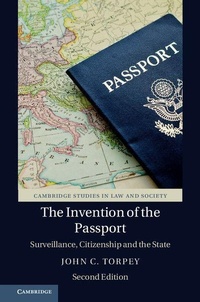
The Invention of the Passport
Surveillance, Citizenship and the State
2nd Edition
Published on 26. July 2018
Book
Hardback
280 pages
978-1-108-47390-3 (ISBN)
Description
This book presents the first detailed history of the modern passport and why it became so important for controlling movement in the modern world. It explores the history of passport laws, the parliamentary debates about those laws, and the social responses to their implementation. The author argues that modern nation-states and the international state system have 'monopolized the 'legitimate means of movement',' rendering persons dependent on states' authority to move about - especially, though not exclusively, across international boundaries. This new edition reviews other scholarship, much of which was stimulated by the first edition, addressing the place of identification documents in contemporary life. It also updates the story of passport regulations from the publication of the first edition, which appeared just before the terrorist attacks of 9/11, to the present day.
More details
Series
Edition
2nd Revised edition
Language
English
Place of publication
Cambridge
United Kingdom
Target group
Professional and scholarly
College/higher education
Edition type
Revised edition
Illustrations
Worked examples or Exercises
Dimensions
Height: 235 mm
Width: 157 mm
Thickness: 20 mm
Weight
566 gr
ISBN-13
978-1-108-47390-3 (9781108473903)
Copyright in bibliographic data and cover images is held by Nielsen Book Services Limited or by the publishers or by their respective licensors: all rights reserved.
Schweitzer Classification
Other editions
Additional editions
E-Book
07/2018
Cambridge University Press
€21.99
Available for download
E-Book
06/2018
2nd Edition
Cambridge University Press
€26.49
Available for download
Person
John C. Torpey is Presidential Professor of Sociology and History and the Director of the Ralph Bunche Institute for International Studies at the Graduate Center, City University of New York. Before coming to the Graduate Center, he was an Associate Professor of Sociology at the University of British Columbia, Vancouver. Previously he was an Assistant Professor and the Chair of the International Studies Faculty Board at the University of California, Irvine. He has held fellowships from the National Endowment for the Humanities, the German Marshall Fund, the European University Institute (Florence), and the Center for European Studies at Harvard University, Massachusetts. His other publications include Intellectuals, Socialism and Dissent: The East German Opposition and its Legacy (1995), Documenting Individual Identity (2001, coedited with Jane Caplan), Making Whole What Has Been Smashed: On Reparations Politics (2006), Transformations of Warfare in the Modern World (2016, coedited with David Jacobson), and The Three Axial Ages: Moral, Material, Mental (2017), as well as numerous articles in such journals as Theory and Society, Journal of Modern History, Sociological Theory, and Geneses: Sciences sociales et histoire. In 2016-2017, he was President of the Eastern Sociological Society.
Content
Preface to the second edition; Introduction; 1. Coming and going: on the state monopolization of the legitimate 'means of movement'; 2. 'Argus of the Patrie': the passport question in the French Revolution; 3. Sweeping out Augeas's stable: the nineteenth-century trend toward freedom of movement; 4. Toward the 'crustacean type of nation': the proliferation of identification documents from the late nineteenth century to the First World War; 5. From national to postnational? Passports and constraints on movement from the interwar to the postwar era; 6. 'Everything changed that day': passport regulations after the terrorist attacks of September 11, 2001; Conclusion: a typology of 'papers'; References; Index.