

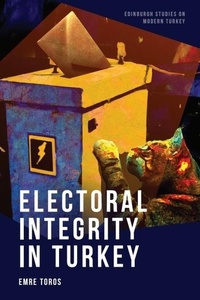
Electoral Integrity in Turkey
Will be published approx. on 31. December 2025
Book
Paperback/Softback
256 pages
978-1-4744-9235-5 (ISBN)
Description
This book provides a unique framework to explain the causes and consequences of electoral problems in Turkey. Although highly illuminating, the existing studies fall short of explaining the particularities of numerous singular electoral settings. This gap is especially valid for the grey-zone regimes, which are neither clearly democratic nor conventionally authoritarian in Turkey.
Establishing a historical outlook by scrutinising the elections which have taken place since the 1950s, Emre Toros identifies the challenges related to electoral integrity nested at individual and institutional levels. In this way, this book contributes to electoral integrity literature by utilising the valuable research strategies of the existing studies, proposing alternative data sources that will better understand the phenomena and, most importantly, employing a methodology that will suit both singular and comparative cases.
Establishing a historical outlook by scrutinising the elections which have taken place since the 1950s, Emre Toros identifies the challenges related to electoral integrity nested at individual and institutional levels. In this way, this book contributes to electoral integrity literature by utilising the valuable research strategies of the existing studies, proposing alternative data sources that will better understand the phenomena and, most importantly, employing a methodology that will suit both singular and comparative cases.
Reviews / Votes
This book is a must-read for understanding the working of elections in a competitive authoritarian regime and the challenges facing Turkish democracy. Professor Toros uses rich empirical analysis, bringing together alternative data sources that complement one another to reveal a comprehensive picture of electoral integrity in Turkish multiparty elections. It is a welcome contribution to the discipline that aims to understand how elections are used to build a democratic regime. -- Ali Carkoglu, Koc UniversityMore details
Series
Language
English
Place of publication
Edinburgh
United Kingdom
Target group
Professional and scholarly
Illustrations
8 black and white tables, 35 black and white line arts
Dimensions
Height: 234 mm
Width: 156 mm
Thickness: 14 mm
Weight
363 gr
ISBN-13
978-1-4744-9235-5 (9781474492355)
Copyright in bibliographic data and cover images is held by Nielsen Book Services Limited or by the publishers or by their respective licensors: all rights reserved.
Schweitzer Classification
Person
Emre Toros is a professor of Political Science and dean at the Faculty of Communication, Hacettepe University Ankara, Turkey. He has completed his academic studies in Turkey and abroad, including King's College London, Malmoe, Stanford and Harvard Universities. He is a student of political behaviour, and his primary interests are social research design, including data collection, processing, analysis and reporting. During his research, Professor Toros received several awards and grants, including the Swedish Institute visiting scholar grant, the British Academy Newton Advanced Scholarship Award, the Fulbright Visiting Scholar Grant and The Scientific and Technological Research Council of Turkey Research Grant. His work appeared on journals including Democratization, British Journal of Middle Eastern Studies, Journal of Southeast European and Black Sea, Political Research Exchange, International Journal of Forecasting and Turkish Studies.
Content
List of FiguresList of TablesAbbreviationsPreface and Acknowledgements
Part I. Introduction1. Context, Arguments and Structure2. Electoral Integrity in the Turkish Electoral History3. Putting Turkey in Perspective
Part II. Causes for Perceptions of Damage to Electoral Integrity4. An Account of Individual Perceptions of Damage to Electoral Integrity5. Electoral Management Bodies as Establishers of Electoral Integrity
Part III. Consequences of Perceived Damage to Electoral Integrity6. Does Electoral Integrity Matter for Vote Choice?7. How Do Public Perceptions of Problems with Electoral Integrity Shape Trust in Government?8. How Do Perceptions of Electoral Integrity Relate to Electoral Expectations?9. Policy Preferences on Postponement of Elections owing to COVID-19 - Evidence from a Conjoint Experiment
Part IV ConclusionConclusion
Epilogue: General and Presidential Elections of 2023 - An Integrity OutlookIndex
Part I. Introduction1. Context, Arguments and Structure2. Electoral Integrity in the Turkish Electoral History3. Putting Turkey in Perspective
Part II. Causes for Perceptions of Damage to Electoral Integrity4. An Account of Individual Perceptions of Damage to Electoral Integrity5. Electoral Management Bodies as Establishers of Electoral Integrity
Part III. Consequences of Perceived Damage to Electoral Integrity6. Does Electoral Integrity Matter for Vote Choice?7. How Do Public Perceptions of Problems with Electoral Integrity Shape Trust in Government?8. How Do Perceptions of Electoral Integrity Relate to Electoral Expectations?9. Policy Preferences on Postponement of Elections owing to COVID-19 - Evidence from a Conjoint Experiment
Part IV ConclusionConclusion
Epilogue: General and Presidential Elections of 2023 - An Integrity OutlookIndex