

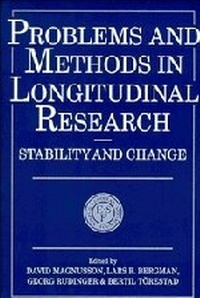
Problems and Methods in Longitudinal Research
Stability and Change
Published on 12. December 1991
Book
Hardback
367 pages
978-0-521-40195-1 (ISBN)
Description
This volume focuses on methods of data treatment, emphasising the importance of careful matching of methodology to the substantive problem under consideration. It deals particularly with concepts of stability and change which are central to personality and developmental research. Contributions to this volume explore the methodology and scope of life span studies in a varity of contexts, including intellectual and cognitive development, transitions such as that from childhood to early adult life, social mobility, behavioural genetics, and psychological disorder, particularly depression. A valuable reference for a wide range of interests in developmental psychology, social and behavioural science, psychiatry, epidemiology and statistics.
Reviews / Votes
"...provides good examples of a wide variety of methods, ranging in degree of complexity, for analyzing longitudinal data; the authors represent many disciplines and are international experts in longitudinal methods; and their applications cover areas as diverse as cognition and intelligence, self and personality, health status, and even social mobility...raises sociologists' awareness of the individual differences perspective favored in many other disciplines...will appeal to scholars from many disciplines who have specialized interests in individual development over time. It is also a fine volume for sociologists who want to learn more about the ways in which researchers in the individual-differences tradition approach individual analyses." Richard A. Setterson, Jr. & Thomas D. Cook, Contemporary Sociology "...One finds in the 15 chapters both quantitative and qualitative procedures appropriate for questions on several levels of analysis. Examples are provided from numerous fields. The issues are critical both to planning and successful execution so the content of this volume will be useful for a long time." Perceptual and Motor SkillsMore details
Series
Language
English
Place of publication
Cambridge
United Kingdom
Target group
Professional and scholarly
Illustrations
69 Tables, unspecified; 61 Line drawings, unspecified
Dimensions
Height: 236 mm
Width: 158 mm
Thickness: 26 mm
Weight
648 gr
ISBN-13
978-0-521-40195-1 (9780521401951)
Copyright in bibliographic data and cover images is held by Nielsen Book Services Limited or by the publishers or by their respective licensors: all rights reserved.
Schweitzer Classification
Other editions
New editions
Bertil Torestad | David Magnusson | Lars R. Bergman
Problems and Methods in Longitudinal Research
Stability and Change
Book
03/1994
Cambridge University Press
€115.80
Shipment within 15-20 days
Additional editions
Bertil Torestad | David Magnusson | Lars R. Bergman
Problems and Methods in Longitudinal Research
Stability and Change
Book
03/1994
Cambridge University Press
€115.80
Shipment within 15-20 days
Persons
Content
1. Studying individual development: problems and method; 2. Modeling individual and average human growth data from childhood to adulthood; 3. Intraindividual variability in older adults' depression scores: some implications for developmental theory and longitudinal research; 4. Now you see it, now you don't - some considerations on multiple regression; 5. Differential development of health in a life-span perspective; 6. Assessing of change in a cohort-longitudinal study with hierarchical data; 7. Statistical and conceptual models of 'turning points' in developmental processes; 8. Qualitative analysis of individual differences in intraindividual change: examples from cognitive development; 9. Application of correspondence analysis to a longitudinal study of cognitive development; 10. Event history models in social mobility research; 11. Behavioural genetic concepts in longitudinal analyses; 12. Genetic and environmental factors in a developmental perspective; 13. Structural equation models for studying intellectual development; 14. Longitudinal studies for discrete data based on latent structure models; 15. Stability and change in patterns of extrinsic adjustment problems.