

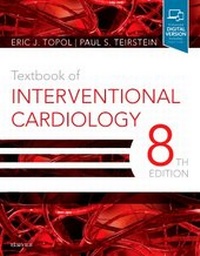
Textbook of Interventional Cardiology
8th Edition
Published on 15. October 2019
Book
Hardback
1184 pages
978-0-323-56814-2 (ISBN)
Description
From new research and equipment to new procedures, applications, and approaches, the field of interventional cardiology is one of the fastest-changing areas in medicine. Increasing data and recent technological advances have resulted in exciting changes - and an even greater need for cutting-edge, authoritative guidance on current practice. Textbook of Interventional Cardiology, 8th Edition, covers the theories, trends, and applications of diagnostic and interventional cardiology that cardiologists, cardiac surgeons, vascular surgeons, referring physicians, and advanced practitioners need to know.
Focuses on the latest treatment protocols for managing patients at every level of complexity.
Includes all-new chapters on Coronary Stenting, Diagnosis and Treatment of Coronary Microvascular Disease, Percutaneous Transcatheter Valve in Valve Implantation, and Percutaneous Tricuspid Valve Repair.
Features hundreds of new illustrations, tables, and boxes for visual clarity and quick reference.
Offers expanded coverage of transcatheter aortic valve interventions with extensive updates on practice implications.
Discusses hot topics such new atherectomy devices, percutaneous mitral valve replacement, and percutaneous treatment of paravalvular leak.
Provides the unique insights of expert leaders in the field who have pioneered today's innovative devices and techniques and lend their own analysis of practical, evidence-based clinical applications.
Presents the most recent data on how genomics and genetics impact interventional cardiology.
Provides an in-depth understanding of cardiology, making it well suited for cardiology and interventional cardiology exam preparation.
Enhanced eBook version included with purchase. Your enhanced eBook allows you to access all of the text, figures, and references from the book on a variety of devices.
Focuses on the latest treatment protocols for managing patients at every level of complexity.
Includes all-new chapters on Coronary Stenting, Diagnosis and Treatment of Coronary Microvascular Disease, Percutaneous Transcatheter Valve in Valve Implantation, and Percutaneous Tricuspid Valve Repair.
Features hundreds of new illustrations, tables, and boxes for visual clarity and quick reference.
Offers expanded coverage of transcatheter aortic valve interventions with extensive updates on practice implications.
Discusses hot topics such new atherectomy devices, percutaneous mitral valve replacement, and percutaneous treatment of paravalvular leak.
Provides the unique insights of expert leaders in the field who have pioneered today's innovative devices and techniques and lend their own analysis of practical, evidence-based clinical applications.
Presents the most recent data on how genomics and genetics impact interventional cardiology.
Provides an in-depth understanding of cardiology, making it well suited for cardiology and interventional cardiology exam preparation.
Enhanced eBook version included with purchase. Your enhanced eBook allows you to access all of the text, figures, and references from the book on a variety of devices.
More details
Edition
8th edition
Language
English
Place of publication
Philadelphia
United States
Target group
Professional and scholarly
Illustrations
Approx. 1000 illustrations (750 in full color)
Dimensions
Height: 276 mm
Width: 216 mm
Weight
3580 gr
ISBN-13
978-0-323-56814-2 (9780323568142)
Copyright in bibliographic data and cover images is held by Nielsen Book Services Limited or by the publishers or by their respective licensors: all rights reserved.
Schweitzer Classification
Other editions
New editions
Paul S. Teirstein | Matthew J. Price | Eric J. Topol
Textbook of Interventional Cardiology
Book
approx. 11/2026
9th Edition
Elsevier
€294.50
Not yet published
Additional editions
Eric J. Topol | Paul S. Teirstein
Textbook of Interventional Cardiology
E-Book
07/2019
8th Edition
Elsevier
€200.99
Available for download
Previous edition

Eric J. Topol | Paul S. Teirstein
Textbook of Interventional Cardiology
Book
09/2015
7th Edition
Elsevier
€229.02
Article exhausted; check for reprint
Persons
Eric Topol is one of the most influential cardiologists and scientists in the world, a true "rock star? in cardiology. He is internationally known due to his serving as Editor-in-Chief of Medscape, his numerous multi-million dollar ground-breaking NIH research studies, his widely adopted medical innovations, and his frequent appearances on broadcast television. He is the founding director of the Scripps Translational Institute where large multidisciplinary teams investigate medical innovations in practice, research, and education for the future of medicine.
Because of Dr Topol's incredibly busy schedule and the fact that Dr Teirstein acted as lead editor on the current edition, Dr Topol has proposed a succession plan for the revision, with his colleague Dr Teirstein officially lead editor and the addition of their colleague Dr Price as a second new editor, and a title change from Textbook of Interventional Cardiology to Topol's Textbook of Interventional Cardiology. Paul Teirstein, MD, is Chief of Cardiology, Director of Interventional Cardiology, and Medical Director at the Scripps Prebys Cardiovascular Institute/Scripps Clinic in La Jolla, California.
Because of Dr Topol's incredibly busy schedule and the fact that Dr Teirstein acted as lead editor on the current edition, Dr Topol has proposed a succession plan for the revision, with his colleague Dr Teirstein officially lead editor and the addition of their colleague Dr Price as a second new editor, and a title change from Textbook of Interventional Cardiology to Topol's Textbook of Interventional Cardiology. Paul Teirstein, MD, is Chief of Cardiology, Director of Interventional Cardiology, and Medical Director at the Scripps Prebys Cardiovascular Institute/Scripps Clinic in La Jolla, California.
Content
1 Individualized Assessment for Percutaneous or Surgical-Based Revascularization
2 Evidence-Based Interventional Practice
3 Diabetes
4 Noninvasive Evaluation: Functional Testing,Multidetector Computed Tomography, and Stress Cardiac MRI
5 Intracoronary Pressure and Flow Measurements
6 Contrast-Induced Acute Kidney Injury and the Role of Chronic Kidney Disease in Percutaneous Coronary Intervention
7 Radiation Safety During Cardiovascular Procedures
8 Coronary and Valvular Intervention Prior to Noncardiac Surgery
9 Sex and Ethnicity Issues in Interventional Cardiology
10 Platelet Inhibitor Agents
11 Anticoagulation in Percutaneous Coronary Intervention
12 Thrombolytic Intervention
13 Other Adjunctive Drugs for Coronary Intervention: Beta-Blockers, Calcium-Channel Blockers, and Angiotensin-Converting Enzyme Inhibitors
14 Coronary Stenting: Practical Considerations, Equipment Selection, Tips and Caveats
15 Coronary Stenting
16 Bioresorbable Coronary Scaffolds
17 Drug-Eluting Balloons
18 Elective Intervention for Stable Angina or Silent Ischemia
19 Intervention for Non-ST-Segment Elevation Acute Coronary Syndromes
20 Percutaneous Coronary Intervention in Acute ST-Segment Elevation Myocardial Infarction
21 Post-Percutaneous Coronary Intervention Hospitalization, Length of Stay, and Discharge Planning
22 Interventions in Cardiogenic Shock
23 Bifurcations and Branch Vessel Stenting
24 Percutaneous Coronary Intervention for Unprotected Left Main Coronary Artery Stenosis
25 Complex and Multivessel Percutaneous Coronary Intervention
26 Intervention for Coronary Chronic Total Occlusions
27 Bypass Graft Intervention
28 The Thrombus-Containing Lesion
29 Complications of Percutaneous Coronary Intervention
30 Periprocedural Myocardial Infarction and Embolism-Protection Devices
31 Access Management and Closure Devices
32 Transradial Access for Cardiovascular Catheterization and Intervention
33 Role of the Cardiac Surgeon and the Heart Team
34 Restenosis
35 Role of Adjunct Devices: Atherectomy, Cutting Balloon, and Laser
36 Supported Percutaneous Intervention
37 Regional Centers of Excellence for the Care of Patients With Acute Ischemic Heart Disease
38 Diagnosis and Treatment of Coronary Microvascular Disease
39 Lower Extremity Interventions
40 Upper Extremities and Aortic Arch
41 Chronic Mesenteric Ischemia: Diagnosis and Intervention
42 Renal Artery Stenosis
43 Device Therapy for Resistant Hypertension
44 Aortic Vascular Interventions (Thoracic and Abdominal)
45 Venous Intervention
46 Carotid and Cerebrovascular Intervention
47 Stroke Centers and Interventional Cardiology
48 Imaging for Intracardiac Interventions
49 Percutaneous Closure of Patent Foramen Ovale and Atrial Septal Defect
50 Left Atrial Appendage Closure and Stroke: Local Device Therapy for Cardioembolic Stroke Protection
51 Mitral Valvuloplasty
52 Percutaneous Mitral Valve Repair and Replacement
53 Balloon-Expandable Transcatheter Aortic Valve Replacement Systems
54 Self-Expanding Transcatheter Aortic Valve Replacement
55 Percutaneous Transcatheter Valve-in-Valve Implantation
56 Pulmonary Valve Interventions
57 Percutaneous Tricuspid Valve Repair
58 Hypertrophic Cardiomyopathy
59 Percutaneous Balloon Pericardiotomy for Patients With Pericardial Effusion and Tamponade
60 Transcatheter Therapies for Congenital Heart Disease
61 Stem Cell Therapy for Ischemic Heart Disease
62 Percutaneous Treatment of Paravalvular Leak
63 Interventional Heart Failure
64 Qualitative and Quantitative Coronary Angiography
65 Intravascular Ultrasound
66 The Dynamic Spectrum of Coronary Atheroma: From Atherogenesis to Vulnerable Plaque to Plaque Regression
67 Optical Coherence Tomography
68 Medical Economics in Interventional Cardiology
69 Quality of Care in Interventional Cardiology
70 Volume and Outcome
2 Evidence-Based Interventional Practice
3 Diabetes
4 Noninvasive Evaluation: Functional Testing,Multidetector Computed Tomography, and Stress Cardiac MRI
5 Intracoronary Pressure and Flow Measurements
6 Contrast-Induced Acute Kidney Injury and the Role of Chronic Kidney Disease in Percutaneous Coronary Intervention
7 Radiation Safety During Cardiovascular Procedures
8 Coronary and Valvular Intervention Prior to Noncardiac Surgery
9 Sex and Ethnicity Issues in Interventional Cardiology
10 Platelet Inhibitor Agents
11 Anticoagulation in Percutaneous Coronary Intervention
12 Thrombolytic Intervention
13 Other Adjunctive Drugs for Coronary Intervention: Beta-Blockers, Calcium-Channel Blockers, and Angiotensin-Converting Enzyme Inhibitors
14 Coronary Stenting: Practical Considerations, Equipment Selection, Tips and Caveats
15 Coronary Stenting
16 Bioresorbable Coronary Scaffolds
17 Drug-Eluting Balloons
18 Elective Intervention for Stable Angina or Silent Ischemia
19 Intervention for Non-ST-Segment Elevation Acute Coronary Syndromes
20 Percutaneous Coronary Intervention in Acute ST-Segment Elevation Myocardial Infarction
21 Post-Percutaneous Coronary Intervention Hospitalization, Length of Stay, and Discharge Planning
22 Interventions in Cardiogenic Shock
23 Bifurcations and Branch Vessel Stenting
24 Percutaneous Coronary Intervention for Unprotected Left Main Coronary Artery Stenosis
25 Complex and Multivessel Percutaneous Coronary Intervention
26 Intervention for Coronary Chronic Total Occlusions
27 Bypass Graft Intervention
28 The Thrombus-Containing Lesion
29 Complications of Percutaneous Coronary Intervention
30 Periprocedural Myocardial Infarction and Embolism-Protection Devices
31 Access Management and Closure Devices
32 Transradial Access for Cardiovascular Catheterization and Intervention
33 Role of the Cardiac Surgeon and the Heart Team
34 Restenosis
35 Role of Adjunct Devices: Atherectomy, Cutting Balloon, and Laser
36 Supported Percutaneous Intervention
37 Regional Centers of Excellence for the Care of Patients With Acute Ischemic Heart Disease
38 Diagnosis and Treatment of Coronary Microvascular Disease
39 Lower Extremity Interventions
40 Upper Extremities and Aortic Arch
41 Chronic Mesenteric Ischemia: Diagnosis and Intervention
42 Renal Artery Stenosis
43 Device Therapy for Resistant Hypertension
44 Aortic Vascular Interventions (Thoracic and Abdominal)
45 Venous Intervention
46 Carotid and Cerebrovascular Intervention
47 Stroke Centers and Interventional Cardiology
48 Imaging for Intracardiac Interventions
49 Percutaneous Closure of Patent Foramen Ovale and Atrial Septal Defect
50 Left Atrial Appendage Closure and Stroke: Local Device Therapy for Cardioembolic Stroke Protection
51 Mitral Valvuloplasty
52 Percutaneous Mitral Valve Repair and Replacement
53 Balloon-Expandable Transcatheter Aortic Valve Replacement Systems
54 Self-Expanding Transcatheter Aortic Valve Replacement
55 Percutaneous Transcatheter Valve-in-Valve Implantation
56 Pulmonary Valve Interventions
57 Percutaneous Tricuspid Valve Repair
58 Hypertrophic Cardiomyopathy
59 Percutaneous Balloon Pericardiotomy for Patients With Pericardial Effusion and Tamponade
60 Transcatheter Therapies for Congenital Heart Disease
61 Stem Cell Therapy for Ischemic Heart Disease
62 Percutaneous Treatment of Paravalvular Leak
63 Interventional Heart Failure
64 Qualitative and Quantitative Coronary Angiography
65 Intravascular Ultrasound
66 The Dynamic Spectrum of Coronary Atheroma: From Atherogenesis to Vulnerable Plaque to Plaque Regression
67 Optical Coherence Tomography
68 Medical Economics in Interventional Cardiology
69 Quality of Care in Interventional Cardiology
70 Volume and Outcome