

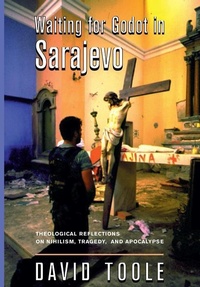
Waiting For Godot In Sarajevo
Theological Reflections on Nihilsim, Tragedy, and Apocalypse
Published on 26. June 1998
Book
Hardback
352 pages
978-0-8133-3503-2 (ISBN)
Description
In the summer of 1914, Archduke Franz Ferdinand was assassinated in Sarajevo, an event which led to the horror of World War I and which many historians suggest marked the beginning of the twentieth century. In 1992, Sarajevo again lurched into prominence as the focal point of one of the century's bloodiest civil wars. Yet Sarajevo at one point epitomized the dreams of the Enlightenment, a city where Christians, Jews, and Muslims peacefully coexisted. In the midst of Sarajevo's recent decline into chaos and destruction, Susan Sontag decided to produce Act I of Waiting for Godot, which, despite ever-looming danger, played to packed houses. Why? Why did this city of hope lie crushed at the end of the twentieth century? Why did Sontag stage an artistic production in the middle of such overwhelming tragedy? Why Waiting for Godot? And, most important, why the appreciative, silent tears of audience members who risked their lives to attend a play in the middle of a war?These are the questions that guide David Toole's theological reflections in Waiting for Godot in Sarajevo, where he seeks to come to terms with what it means to live a life of dignity in a world of undeniable suffering.
Toole skillfully weaves together Friedrich Nietzsche's views on nihilism with Michel Foucault's analysis of power to produce a metaphysics of tragedy, or a "politics of dying." Such politics are then used to shed new theological light on the Christian apocalypse and what it means to be alive at the end of the twentieth century. In making his argument, Toole draws innovative connections between such diverse figures as John Milbank, Alasdair MacIntyre, Euripides, John Howard Yoder, and Norman Maclean (author of A River Runs Through It and Young Men and Fire), all the while using Beckett's play as a compass for his direction. The end result is a fascinating, eminently readable, unexpectedly adventurous theological inquiry into the meaning of life.
Toole skillfully weaves together Friedrich Nietzsche's views on nihilism with Michel Foucault's analysis of power to produce a metaphysics of tragedy, or a "politics of dying." Such politics are then used to shed new theological light on the Christian apocalypse and what it means to be alive at the end of the twentieth century. In making his argument, Toole draws innovative connections between such diverse figures as John Milbank, Alasdair MacIntyre, Euripides, John Howard Yoder, and Norman Maclean (author of A River Runs Through It and Young Men and Fire), all the while using Beckett's play as a compass for his direction. The end result is a fascinating, eminently readable, unexpectedly adventurous theological inquiry into the meaning of life.
More details
Language
English
Place of publication
United States
Publishing group
Taylor & Francis Inc
Target group
College/higher education
Professional and scholarly
Product notice
sewn/stitched
Cloth over boards
With dust jacket
Dimensions
Height: 237 mm
Width: 158 mm
Thickness: 30 mm
Weight
658 gr
ISBN-13
978-0-8133-3503-2 (9780813335032)
Copyright in bibliographic data and cover images is held by Nielsen Book Services Limited or by the publishers or by their respective licensors: all rights reserved.
Schweitzer Classification
Person
David Toole is visiting assistant professor of liberal studies at the University of Montana.
Content
* Waiting for Godot in Sarajevo * From Out of the Abyss: Nihilism According to Nietzsche and His Critics * Between Nihilism and Apocalypse: The Tragic Theology of John Milbank * Toward a Metaphysics of Tragedy: Justifying the World as Art * From a Metaphysics to a Politics of Tragedy: Michel Foucault and the Lyricism of Protest * On the Borders of Heaven and Earth: The Tragic Politics of Michel Foucault * Worthy Are the Slaughtered: Toward an Apocalyptic Style * Revolutionary Subordination: The Apocalyptic Politics of Jesus and the Church * Epilogue: Returning to Sarajevo