

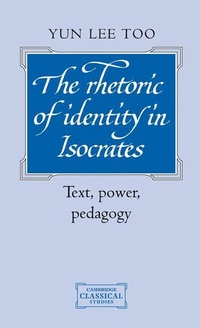
The Rhetoric of Identity in Isocrates
Text, Power, Pedagogy
Published on 31. March 1995
Book
Hardback
290 pages
978-0-521-47406-1 (ISBN)
Description
The Rhetoric of Identity in Isocrates offers a sustained interpretation of the Isocratean corpus, showing that rhetoric is a language which the author uses to create a political identity for himself in fourth-century Athens. Dr Too examines how Isocrates' discourse addresses anxieties surrounding the written word in a democratic culture which values the spoken word as the privileged means of political expression. Isocrates makes written culture the basis for a revisionary Athenian politics and of a rhetoric of Athenian hegemony. In addition, Isocrates takes issue with the popular image of the professional teacher in the age of the sophist, combating the negative stereotype of the greedy sophist who corrupts the city's youth in his portrait of himself as teacher of rhetoric. He daringly reinterprets the pedagogue as a figure who produces a discourse which articulates political authority.
Reviews / Votes
"Students of ancient rhetoric will be very glad that there is now a monograph on Isocrates in English....They will find the book interesting and suggestive...." Bryn Mawr Classical Review "The Rhetoric of Identity in Isocrates strengthens our understanding of the process by which Isocrates created his literary ethos and the necessity for such a rhetorical display." Rhetoric ReviewMore details
Series
Language
English
Place of publication
Cambridge
United Kingdom
Target group
Professional and scholarly
Dimensions
Height: 222 mm
Width: 145 mm
Thickness: 21 mm
Weight
543 gr
ISBN-13
978-0-521-47406-1 (9780521474061)
Copyright in bibliographic data and cover images is held by Nielsen Book Services Limited or by the publishers or by their respective licensors: all rights reserved.
Schweitzer Classification
Other editions
Additional editions
E-Book
12/2013
1st Edition
Cambridge University Press
€36.99
Available for download
Person
Content
Introduction; 1. Isocrates and logos politikos; 2. The unities of discourse; 3. The politics of the small voice; 4. Isocrates in his own write; 5. The pedagogical contract; 6. The politics of discipleship; Brief afterword; Appendix 1. Isocrates and Gorgias; Appendix 2. Concerning the chariot-team.