

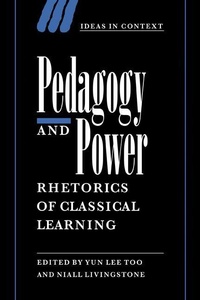
Pedagogy and Power
Rhetorics of Classical Learning
Published on 27. August 1998
Book
Hardback
336 pages
978-0-521-59435-6 (ISBN)
Description
Pedagogy and Power is a volume of interdisciplinary essays which explores the political dimensions of Graeco-Roman education and of its subsequent models. Seeking to make the various structures and discourses of intellectual authority more apparent, the essays argue that there is a social context for the knowledge imparted by classical models of pedagogy. They examine how such pedagogues instruct their pupils to function as citizens who rule or are ruled, privileging certain knowledge over others, and including some individuals while excluding others. Overall the book shows that the complex and plural authorities and power that have been associated with classical learning and knowledge are not part of a legacy to be unproblematically inherited or reproduced.
Reviews / Votes
'... an example of impressive interdisciplinary scholarship, deserving of study by scholars in history, English and other language studies as well as classics.' Bryn Mawr Classical ReviewMore details
Series
Language
English
Place of publication
Cambridge
United Kingdom
Target group
Professional and scholarly
Illustrations
1 Halftones, unspecified
Dimensions
Height: 235 mm
Width: 157 mm
Thickness: 24 mm
Weight
697 gr
ISBN-13
978-0-521-59435-6 (9780521594356)
Copyright in bibliographic data and cover images is held by Nielsen Book Services Limited or by the publishers or by their respective licensors: all rights reserved.
Schweitzer Classification
Persons
Content
Notes on contributors; Acknowledgements; Introduction Yun Lee Too; 1. Classics: from discipline in crisis to (multi-)cultural capital Paul Cartledge; 2. Schoolboys and gentlemen: classical pedagogy and authority in the English public school Christopher Stray; 3. 'Die Zung' ist dieses Schwert': classical tongues and gendered curricula in German schooling to 1908 Sarah Colvin; 4. 'What does that argue for us?': the politics of teaching and political education in late eighteenth-century dialogues Clare Brant; 5. Women and classical education in the early modern period Jane Stevenson; 6. Pilgrimage to Parnassus: local intellectual traditions, humanist education and the cultural geography of sixteenth-century England Warren Boutcher; 7. 'Not so much praise as precept': Erasmus, panegyric and the Renaissance art of teaching princes David Rundle; 8. Teachers, pupils and imperial power in eleventh-century Byzantium Panagiotis A. Agapitos; 9. Reading power in Roman Greece: the paideia of Dio Chrysostom Tim Whitmarsh; 10. Children, animals, slaves and grammar Catherine Atherton; 11. A good man skilled in politics: Quintilian's political theory Teresa Morgan; 12. The voice of Isocrates and the dissemination of cultural power Niall Livingstone; 13. Xenophon's Cyropaedia: disfiguring the pedagogical state Yun Lee Too; Select bibliography; Index.