

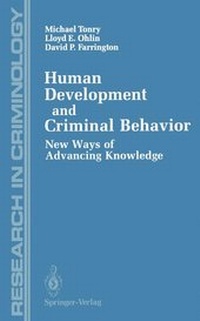
Human Development and Criminal Behavior
New Ways of Advancing Knowledge
Published on 6. November 1990
Book
Hardback
X, 223 pages
978-0-387-97360-9 (ISBN)
Description
Human Development and Criminal Behavior proposes an exten-
sive agenda for crime research. The book is part of a pio-
neering effort to understand the causes of crime, particu-
larly its developmental course. It defines and sets the con-
ditions necessary to conduct an accelerated longitudinal
study of individuals at risk to become engaged in criminal
careers. This work offers a blueprint for research to eluci-
date and possibly prevent crime in our society.
sive agenda for crime research. The book is part of a pio-
neering effort to understand the causes of crime, particu-
larly its developmental course. It defines and sets the con-
ditions necessary to conduct an accelerated longitudinal
study of individuals at risk to become engaged in criminal
careers. This work offers a blueprint for research to eluci-
date and possibly prevent crime in our society.
More details
Series
Edition
1991
Language
English
Place of publication
NY
United States
Target group
Research
Product notice
sewn/stitched
Cloth over boards
Illustrations
Bibliography
Dimensions
Height: 0 mm
Width: 0 mm
Weight
520 gr
ISBN-13
978-0-387-97360-9 (9780387973609)
DOI
10.1007/978-1-4613-9055-8
Schweitzer Classification
Other editions
Additional editions
Michael Tonry | Lloyd E. Ohlin | David P. Farrington
Human Development and Criminal Behavior
New Ways of Advancing Knowledge
Book
11/2011
Springer
€53.49
Shipment within 7-9 days
Persons
Content
1 Introduction.- 2 Overview of Theories and Hypotheses.- Design and Sampling Issues.- 3 Accelerated Longitudinal Design.- 4 Longitudinal-Experimental Combinations.- 5 Community Sampling.- 6 Household and Individual Sampling.- 7 Sampling Yield.- 8 Site Selection.- Measurement and Analysis.- 9 Common Variables.- 10 Measurement Issues.- 11 Statistical Methods and Analysis.- Cohort Studies.- 12 Prenatal and Preschool Cohorts.- 13 Young Adolescent Cohorts.- 14 Young Adult Cohorts.- 15 Sibling Study.- Appendix I Preparatory Field Work and Supplemental Studies.- Appendix II Issues in the Use of Biomedical Measures.- Appendix III Program on Human Development and Criminal Behavior-Participants.- References.