

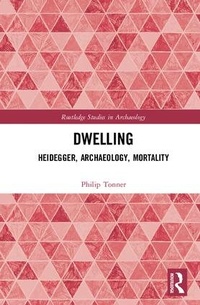
Dwelling
Heidegger, Archaeology, Mortality
1st Edition
Published on 30. August 2017
Book
Hardback
172 pages
978-1-138-70542-5 (ISBN)
Description
Dwelling: Heidegger, Archaeology, Mortality negotiates the discourses of phenomenology, archaeology and palaeoanthropology in order to extend the 'dwelling perspective', an approach in the social sciences particularly associated with Tim Ingold and a number of other thinkers, including Chris Tilley, Julian Thomas, Chris Gosden and Clive Gamble, that developed out of an engagement with the thought of Martin Heidegger.
This unique book deals with Heidegger's philosophy as it has been explored in archaeology and anthropology, seeking to expand its cross-disciplinary engagement into accounts of early humans and death awareness. Tonner reads Heidegger's thought of dwelling in connection to recent developments in the archaeology of mortuary practice amongst our ancestors. Agreeing with Heidegger that an awareness of death marks out a distinctive way of 'being-in-the-world', Tonner rejects any relict anthropocentrism in Heidegger's thought and seeks to break down simple divisions between humans and pre-humans.
This book is ideal for readers wishing to cross disciplinary boundaries and to challenge anthropocentric thinking in accounts of human evolution. It would be ideal for professional researchers in the fields covered by the book as well as for graduate students and advanced undergraduates.
This unique book deals with Heidegger's philosophy as it has been explored in archaeology and anthropology, seeking to expand its cross-disciplinary engagement into accounts of early humans and death awareness. Tonner reads Heidegger's thought of dwelling in connection to recent developments in the archaeology of mortuary practice amongst our ancestors. Agreeing with Heidegger that an awareness of death marks out a distinctive way of 'being-in-the-world', Tonner rejects any relict anthropocentrism in Heidegger's thought and seeks to break down simple divisions between humans and pre-humans.
This book is ideal for readers wishing to cross disciplinary boundaries and to challenge anthropocentric thinking in accounts of human evolution. It would be ideal for professional researchers in the fields covered by the book as well as for graduate students and advanced undergraduates.
More details
Series
Language
English
Place of publication
London
United Kingdom
Publishing group
Taylor & Francis Ltd
Target group
College/higher education
Illustrations
12 s/w Tabellen
12 Tables, black and white
Dimensions
Height: 234 mm
Width: 156 mm
Weight
408 gr
ISBN-13
978-1-138-70542-5 (9781138705425)
Copyright in bibliographic data and cover images is held by Nielsen Book Services Limited or by the publishers or by their respective licensors: all rights reserved.
Schweitzer Classification
Other editions
Additional editions
Book
12/2019
1st Edition
Routledge
€68.90
Shipment within 15-20 days
E-Book
08/2017
Routledge
€63.49
Available for download
E-Book
08/2017
Routledge
€63.49
Available for download
Person
Philip Tonner is Head of Philosophy and Religion at Hutchesons' Grammar School in Glasgow. His work explores the relationships between philosophy, archaeology, museology and education. He is the author of Heidegger, Metaphysics and the Univocity of Being (Continuum 2010) and Phenomenology Between Aesthetics and Idealism (Noesis Press 2015).
Content
Chapter 1 Introduction, Chapter 2 Heidegger and the dwelling perspective, Chapter 3 Origins, Chapter 4 Dwelling and Mortality, Chapter 5 Modernity, dwelling and phenomenological archaeology, Chapter 6 Conclusion