

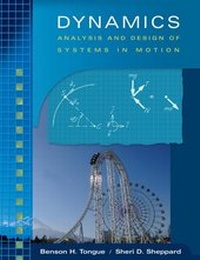
Dynamics
Analysis and Design of Systems in Motion
1st Edition
Published on 10. November 2004
Book
Hardback
560 pages
978-0-471-40198-8 (ISBN)
Description
Dynamics: Analysis and Design of Systems in Motion, by Benson H. Tongue of University of California-Berkeley, and Sheri D. Sheppard of Stanford University, offers a student-focused approach to Dynamics. With a strong emphasis on drawing free body diagrams and the associated inertial response diagrams, an integrated use of computation, use of a structured problem-solving methodology, inclusion of real-world case studies, and robust pedagogy coupled with a truly engaging writing style, reviewers alike have praised this new Dynamics text. Additionally, this first edition has benefited from a comprehensive and thorough accuracy check by eight experienced Dynamics professors, and has been reviewed by more than 200 Statics and Dynamics professors.
The authors demonstrate to students how to map their understanding to more realistic situations, enabling them to more effectively break down complex problems into manageable parts.
More details
Edition
1., Auflage
Language
English
Place of publication
New York
United States
Publishing group
John Wiley and Sons Ltd
Target group
Professional and scholarly
Edition type
New edition
Illustrations
Illustrations (some col.)
Dimensions
Height: 26.2 cm
Width: 20.9 cm
Thickness: 25 mm
Weight
1219 gr
ISBN-13
978-0-471-40198-8 (9780471401988)
Schweitzer Classification
Other editions
New editions
Book
10/2009
2nd Edition
Wiley
€148.50
Article is exhausted; no reprint
Previous edition

Book
Wiley
€40.80
The article will not be published
Persons
Benson H. Tongue, Ph.D., is a Professor of Mechanical Engineering at University of California-Berkeley. He received his Ph.D. from Princeton University in 1988, and currently teaches graduate and undergraduate courses in dynamics, vibrations, and control theory. His research concentrates on the modeling and analysis of nonlinear dynamical systems and the control of both structural and acoustic systems. This work involves experimental, theoretical, and numerical analysis and has been directed toward helicopters, computer disk drives, robotic manipulators, and general structural systems. Most recently, he has been involved in a multidisciplinary study of automated highways and has directed research aimed at understanding the nonlinear behavior of vehicles traveling in platoons and in devising controllers that optimize the platoon's behavior in the face of non-nominal operating conditions. His most recent research has involved the active control of loudspeakers, a biomechanical analysis of human fall dynamics, and green engineering.
Dr. Tongue is the author of Principles of Vibration, a senior/first-year graduate-level textbook. He has served as Associate Technical Editor of the ASME Journal of Vibration and Acoustics as a member of the ASME Committee on Dynamics of Structures and Systems. He is the recipient of the NSF Presidential Young Investigator Award, the Sigma Xi Junior Faculty award, and the Pi Tau Sigma Excellence in Teaching award. He serves as a reviewer for numerous journals and funding agencies and is the author of more than eighty publications.
In his spare time Benson races his bikes up and down mountains, draws and paints, birdwatches, and creates latte art.
Sheri D. Sheppard Ph.D., is the Carnegie Foundation for the Advancement of Teaching Senior Scholar principally responsible for the Preparations for the Professions Program (PPP) engineering study. She is an Associate Professor of Mechanical Engineering at Stanford University. She received her Ph.D. from the University of Michigan in 1985. Besides teaching both undergraduate and graduate design-related classes at Stanford University, she conducts research on weld fatigue and impact failures, fracture mechanics, and applied finite element analysis.
Dr. Sheppard was recently named co-principal investigator on a NSF grant to form the Deter for the Advancement of Engineering Education (CAEE), along with faculty at the University of Washington, Colorado School of Mines, and Howard University. She was co-Principal investigator with Professor Larry Leifer on a multi-university NSF grant that was critically looking at engineering undergraduate curriculum (Synthesis). In 1999, Sheri was named a fellow of the American Society of Mechanical Engineering (ASME) and the American Association for the Advancement of Science (AAAS). Recently Sheri was awarded the 2004 ASEE Chester F. Carlson Award in recognition of distinguished accomplishments in engineering education. Before coming to Stanford University she held several positions in the automotive industry, including senior research engineer at Ford Motor company's Scientific Research Lab. She also worked as a design consultant, providing companies with structural analysis expertise. In her spare time Sheri likes to build houses, hike, and travel.
Content
1. Background and Roadmap
2. Kinematics of Particles
3. Kinetics of Particles
4. Energy of Particles
5. Multi-Particle Systems
6. Kinematics of Rigid Bodies Undergoing Planar Motion
7. Kinetics and Energetics of Rigid Bodies Undergoing Planar Motion
8. Kinematics and Kinetics of Rigid Bodies in Three-Dimensional Motion
9. Vibratory Motion