

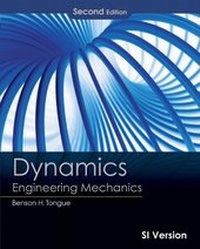
Dynamics
Engineering Mechanics, International Student Edition
2nd Edition
Published on 2. February 2010
Book
Paperback/Softback
616 pages
978-0-470-55304-6 (ISBN)
Description
The second edition provides engineers with a conceptual understanding of how dynamics is applied in the field. It builds their problem-solving skills. New problems with a wider variety of difficulty levels and applications have been added. An online problem-solving tool is available to reinforce how to find solutions. New images are included to add a visual element to the material. These show the link between an actual system and a modeled/analyzed system. Engineers will also benefit from the numerous new worked problems, algorithmic problems, and multi-part GO problems.
More details
Persons
Benson H. Tongue, Ph.D., is a Professor of Mechanical Engineering at University of California-Berkeley. He received his Ph.D. from Princeton University in 1988, and currently teaches graduate and undergraduate courses in dynamics, vibrations, and control theory.
Dr. Tongue has served as Associate Technical Editor of the ASME Journal of Vibration and Acoustics as a member of the ASME Committee on Dynamics of Structures and Systems. He is the recipient of the NSF Presidential Young Investigator Award, the Sigma Xi Junior Faculty award, and the Pi Tau Sigma Excellence in Teaching award. He serves as a reviewer for numerous journals and funding agencies and is the author of more than eighty publications.
Sheri D. Sheppard Ph.D., is the Carnegie Foundation for the Advancement of Teaching Senior Scholar principally responsible for the Preparations for the Professions Program (PPP) engineering study. She is an Associate Professor of Mechanical Engineering at Stanford University. She received her Ph.D. from the University of Michigan in 1985.
Dr. Sheppard was recently named co-principal investigator on a NSF grant to form the Deter for the Advancement of Engineering Education (CAEE). In 1999, she was named a fellow of the American Society of Mechanical Engineering (ASME) and the American Association for the Advancement of Science (AAAS). In 2004 Dr. Shepard was awarded the ASEE Chester F. Carlson Award in recognition of distinguished accomplishments in engineering education.
Dr. Tongue has served as Associate Technical Editor of the ASME Journal of Vibration and Acoustics as a member of the ASME Committee on Dynamics of Structures and Systems. He is the recipient of the NSF Presidential Young Investigator Award, the Sigma Xi Junior Faculty award, and the Pi Tau Sigma Excellence in Teaching award. He serves as a reviewer for numerous journals and funding agencies and is the author of more than eighty publications.
Sheri D. Sheppard Ph.D., is the Carnegie Foundation for the Advancement of Teaching Senior Scholar principally responsible for the Preparations for the Professions Program (PPP) engineering study. She is an Associate Professor of Mechanical Engineering at Stanford University. She received her Ph.D. from the University of Michigan in 1985.
Dr. Sheppard was recently named co-principal investigator on a NSF grant to form the Deter for the Advancement of Engineering Education (CAEE). In 1999, she was named a fellow of the American Society of Mechanical Engineering (ASME) and the American Association for the Advancement of Science (AAAS). In 2004 Dr. Shepard was awarded the ASEE Chester F. Carlson Award in recognition of distinguished accomplishments in engineering education.
Content
* Chapter 1: Background and Roadmap
* Chapter 2: Motion of Translating Bodies
* Chapter 3: Inertial Response of Translating Bodies
* Chapter 4: Energetics of Translating Bodies
* Chapter 5: Multi-Body Systems
* Chapter 6: Kinematics of Rigid Bodies Undergoing Planar Motion
* Chapter 7: Kinetics of Rigid Bodies Undergoing Two-Dimensional Motion
* Chapter 8: Kinematics and Kinetics of Rigid Bodies in Three-Dimensional Motion
* Chapter 9: Vibratory Motions