

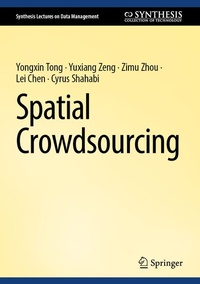
Spatial Crowdsourcing
Description
This book explores the essential computing paradigm of crowdsourcing, particularly the rise in utility and application of crowdsourced spatiotemporal data. This book begins with an overview of how the ubiquity of mobile internet services and the growth of the sharing economy have created ideal conditions for the growth of spatial crowdsourcing, why humans are ideal contributors to spatiotemporal tasks that must be completed at specific locations and times, and the core challenges of crowdsourcing that data. Readers then get a deeper dive into practical application issues. In particular, this book centers on identifying four core algorithmic issues in spatial crowdsourcing: (1) task assignment, (2) quality control, (3) incentive mechanism design, and (4) privacy protection. Readers find this books contains a comprehensive and systematic review of existing research on these issues and analyzes representative spatial crowdsourcing applications with explanations of how those four technical issues enable them. This book describes a number of real-life examples that demonstrate recent successes, techniques, and specific challenges in crowdsourcing for applications that provide urban services, such as ride sharing and live-mapping. Finally, this book discusses open questions that need to be addressed in future spatial crowdsourcing research and applications.
More details
Persons
Yongxin Tong received a Ph.D. in Computer Science and Engineering from The Hong Kong University of Science and Technology in 2014. He is currently a professor with the School of Computer Science and Engineering at Beihang University. His research interests include big spatio-temporal data analytics, crowdsourcing, crowd intelligence, federated learning, privacy preserving data analytics, and uncertain data management.
Yuxiang Zeng earned a B.S. degree from Nanjing University of Aeronautics and Astronautics, China, in 2014, an M.A. from Beihang University, China, in 2017, and a Ph.D. from The Hong Kong University of Science and Technology, Hong Kong SAR, in 2022, all in computer science and engineering. He is currently a postdoctoral researcher in the Department of Computer Science and Engineering at The Hong Kong University of Science and Technology. His research interests include spatio-temporal data management and crowdsourcing.
Zimu Zhou received a B.E. from the Department of Electronic Engineering at Tsinghua University, Beijing, China, in 2011, and a Ph.D. from the Department of Computer Science and Engineering at The Hong Kong University of Science and Technology, Hong Kong, in 2015. He is currently an assistant professor at the School of Information Systems at Singapore Management University, Singapore. His research focuses on mobile and ubiquitous computing.
Lei Chen received the B.S. degree in computer science and engineering from Tianjin University, China, in 1994, the M.A. degree from the Asian Institute of Technology, Thailand, in 1997, and the Ph.D. degree in computer science from the University of Waterloo, Canada, in 2005. He is now a professor with the Department of Computer Science and Engineering at The Hong Kong University of Science and Technology. His research interests include crowdsourcing, uncertain and probabilistic databases, multimedia and time series databases, and privacy. He is a fellow of the IEEE.
Cyrus Shahabi received the B.S. degree in computer engineering from the Sharif University of Technology, in 1989, and the M.S. and Ph.D. degrees in computer science from the University of Southern California, in May 1993 and August 1996, respectively. He is a professor of computer science, electrical engineering, and spatial sciences; the chair of the Computer Science Department; and the director of the Integrated Media Systems Center at USC's Viterbi School of Engineering. He was co-founder of two USC spin-offs, Geosemble Technologies and Tallygo, which were both acquired, in July 2012 and March 2019, respectively. He has authored two books and more than 300 research papers in the areas of databases, GIS and multimedia. He served as an associate editor of the IEEE Transactions on Parallel and Distributed Systems from 2004 to 2009, the IEEE Transactions on Knowledge and Data Engineering from 2010-2013, and the VLDB Journal from 2009 to 2015.
Content
Introduction.- Task Assignment.- Quality Control.- Incentive Mechanism.- Privacy Protection.- Applications of Spatial Crowdsourcing.- Conclusion.