

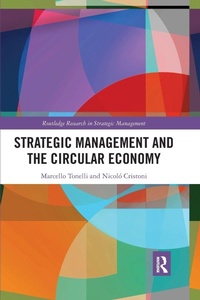
Strategic Management and the Circular Economy
1st Edition
Published on 30. April 2020
Book
Paperback/Softback
256 pages
978-0-367-51456-3 (ISBN)
Description
In recent years, the Circular Economy (CE) has gained worldwide attention as an effective alternative economic system to the current take-make-waste model of production and consumption. As more and more firms begin to recognize the potential of this novel approach, the CE quickly moves from theory to practice and the demand for a coherent and structured strategic approach - one that companies can rely upon when commencing their circular journey - grows accordingly. Strategic Management and the Circular Economy aims to bridge the theory-practice gap by putting forward a detailed step-by-step process for analysis, formulation, and planning of CE strategies.
Starting from a solid framework of easy-to-grasp constructs (key principles, business objectives and areas of intervention), the authors guide the reader through an understanding of how conventional tools for strategic management can be re-programed under a CE perspective. To assist learning and encourage circular thinking, the reader is constantly prompted with examples of how forward-looking companies across industries and geographies are already applying circular strategies to future-proof their operations, boost innovation, penetrate new markets and secure customer loyalty.
Starting from a solid framework of easy-to-grasp constructs (key principles, business objectives and areas of intervention), the authors guide the reader through an understanding of how conventional tools for strategic management can be re-programed under a CE perspective. To assist learning and encourage circular thinking, the reader is constantly prompted with examples of how forward-looking companies across industries and geographies are already applying circular strategies to future-proof their operations, boost innovation, penetrate new markets and secure customer loyalty.
Reviews / Votes
Finalist at the 2019 Best Book Awards (Business general category) for American Book FestSecond in the Philanthropy/ Nonprofit/ Sustainability catagory at the Axiom Business Book Awards 2020
'As mankind is overusing many natural ecosystems, new and rebalanced ways of doing business are needed. Moving towards a circular economy could offer a solution. Tonelli and Cristoni present a comprehensive framework to work on this solution from a strategic management perspective. This book is a must read for scholars and practitioners interested in actionable frameworks, business models, and strategic approaches to developing circular businesses' [Florian Luedeke-Freund, Chair for Corporate Sustainability, ESCP Europe Business School - Berlin, GERMANY]
'Over the last decades our awareness of the limits of the use of natural resources has become more and more embedded in evidence. However, only awareness cannot solve this. What we need is a course of action to turn this around. That?s what is offered in this book. The idea of the Circular Economy is both timely and rather straightforward, but its application comes together with many challenges and imperfections. The beauty of this book is that it embraces these difficulties in order to separate the rhetoric from substance. This proves to be very helpful in creating practical guidance for the application of the principles of the Circular Economy.' [Andre Nijhof, Professor Sustainable Business and Stewardship at Nyenrode Business Universiteit - Enschede Area, THE NETHERLANDS]
'Strategic Management and the Circular Economy opens with Victor Hugo's eponymous quote "you can resist an invading army; you cannot resist an idea whose time has come." With the increasing focus of neo-liberal governments on downsizing, the role of sustainability stewardship is increasingly moving towards the private sector. This book powerfully makes the case for enhanced sustainability management through the circular economy model in shaping the actions we need to take to preserve our own future. It presents easy to understand business models and strategies that will help to achieve the circular economy key principles of improved waste and resource sustainability in a world of finite resources and an ever-growing population' [Michele John, Associate Professor, Director Sustainable Engineering Group, Curtin - Perth, AUSTRALIA]
'Nowadays circular economy has become a top priority in the political agenda of most developed countries. Many initiatives have been put forward by governments to switch to a circular model, but there is still a poor understanding on how to support companies in adapting to the new economic system. This book provides a thorough analysis of how companies can effectively combine CE principles with business objectives and an exhaustive list of concrete examples from different countries and sectors is shared. All the information is presented from the realistic perspective that we cannot demand companies to radically change their business models and processes from one day to the next, and this aspect represents one of the most important added values of the book. The authors have succeeded in producing a helpful and clear guide for companies and policy makers, while keeping scientific rigour and solidity in their approach' [Michelle Perello, CEO Consulta Europa Projects and Innovation - Las Palmas de G.C., SPAIN]
'Strategic Management and the Circular Economy (CE) has an implication for the academia, practitioners and policymakers alike as it offers theoretical approaches as well as practical examples. It starts by arguing why enterprises can no longer rely on the linear economic paradigm, before explaining how circular economy as a strategic concept works. Through a series of in-depth and original discussions the book offers a rich contribution to companies, highlighting their interactions with stakeholders at various levels of society for the creation of a better future for us all' [Lara Johannsdottir, Professor, Environment and Natural Resources, School of Business, University of Iceland - Reykjavik, ICELAND]
'This is an inclusive, informative and appealing book on the complicated subject of the circular economy and strategic management. The way the circular economy is explained to replace the produce-use-dispose approach and to bring this concept into reality through strategic processes, policies, business models, and technologies is amazing. The book has not only highlighted the fruits of the circular economy, as repeatedly done in earlier books but rather practically demonstrated how one nation or society can implement the concept of circularity in its day-to-day activities and so boost its socio-economic and cultural development. Undoubtedly, this book is a must-read for all professions including academics, managers, engineers, scientists, researchers, policy and decision makers. I am very confident this book will have a positive and constructive impact in our understanding and learning of how to move ahead with this sustainable economic approach, in which waste becomes a valuable resource' [Abdul-Sattar Nizami, Head of Solid Waste Management Unit, Center of Excellence in Environmental Studies at King Abdulaziz University - Jeddah, SAUDI ARABIA]
'The book is an engaging and stimulating reading on the circular economy paradigm, which has gained momentum in recent years. On the one hand, it clearly and thoroughly explains how the adoption of a circular economy framework can have positive implications not only on the environment (e.g. saving scarce resources), which is what most people would expect, but also on society (e.g. meeting the growing needs of the middle-class) and on the economy (e.g. making industrial processes more cost-effective). On the other hand, the authors, while emphasizing the appeal and elegance of what could be described as a win-win approach, do not shy away from the complexities that the implementation of a circular economy model would entail. Indeed, after defining a circular economy theoretical framework, they set out a new and innovative methodology to allow practitioners to integrate such framework with more traditional strategic tools' [Matteo di Castelnuovo, Director of Master in Green Management, Energy and CSR, Universita` Bocconi - Milan, ITALY]
'The Circular Economy is a potential key driver for sustainable development. The concept has recently gained widespread uptake in business, academia and policy. Strategic Management and the Circular Economy provides an engaging overview for academics and practitioners wanting to understand the concept of the Circular Economy, as well as potential strategic approaches to start the transition from a linear take-make-waste to a Circular Economy paradigm' [Nancy Bocken, Professor in Sustainable Business Management & Practice, Lund University (IIIEE) - SWEDEN]
More details
Series
Language
English
Place of publication
London
United Kingdom
Publishing group
Taylor & Francis Ltd
Target group
College/higher education
Illustrations
21 s/w Tabellen
21 Tables, black and white
Dimensions
Height: 229 mm
Width: 152 mm
Thickness: 14 mm
Weight
379 gr
ISBN-13
978-0-367-51456-3 (9780367514563)
Copyright in bibliographic data and cover images is held by Nielsen Book Services Limited or by the publishers or by their respective licensors: all rights reserved.
Schweitzer Classification
Other editions
Additional editions
Marcello Tonelli | Nicolo Cristoni
Strategic Management and the Circular Economy
E-Book
10/2018
1st Edition
Routledge
€61.99
Available for download
Marcello Tonelli | Nicolo Cristoni
Strategic Management and the Circular Economy
E-Book
10/2018
1st Edition
Routledge
€61.99
Available for download
Marcello Tonelli | Nicolo Cristoni
Strategic Management and the Circular Economy
Book
10/2018
1st Edition
Routledge
€207.80
Shipment within 10-20 days
Persons
Dr Marcello Tonelli is the founder and Managing Director of WorlDynamics Pty Ltd, an organization that promotes sustainable development and green innovation. After obtaining his PhD degree in Business Strategy in 2009, Dr Tonelli worked with the Australian Centre of Entrepreneurship Research (ACE) in the fields of Social Innovation, Territorial Strategies, and Poverty Alleviation generating growing academic interest. He also practiced as a Certified Management Consultant and a Fellow of the Australian Institute of Management.
Nicolo Cristoni is a sustainability professional operating at the intersection of Environmental Stewardship, Sustainable Innovation and the protection of Human and Workers' Rights. He is specialized in planning and executing responsible sourcing programs for multinational brands that are increasingly Circular Economy-inspired. Nicolo also provides technical support to international human rights organizations.
Nicolo Cristoni is a sustainability professional operating at the intersection of Environmental Stewardship, Sustainable Innovation and the protection of Human and Workers' Rights. He is specialized in planning and executing responsible sourcing programs for multinational brands that are increasingly Circular Economy-inspired. Nicolo also provides technical support to international human rights organizations.
Content
Part I: An Overview
Chapter 1 - The Challenges of the Produce-Use-Dispose Model
Introduction
Exceeding Planetary Natural Thresholds
Scarcity of Raw Materials and Price Volatility
Rising Middle-Class Population
Structural Inefficiencies of the Current Economic Model
Conclusions
Chapter 2 - An introduction to the Circular Economy
Introduction
Biosphere and Technosphere Products
Technological, Regulatory and Social Factors
Conclusions
Part II: Circular Economy Strategy: Setting the Stage
Chapter 3 ? A CE Framework for Action
Introduction
EMS Versus CE
CE Guiding Principles
CE Business Objectives
CE Areas of Intervention
Conclusions
Chapter 4 ? CE Enabling Technologies
Introduction
Digital Technologies
Design & Engineering Technologies
Conclusions
Chapter 5 ? Business Models for a CE
Introduction
Net-Zero Innovation
Servitization
Product Life Extension
Product Residual Value Recovery
Conclusions
Part III: CE Strategic Management
Chapter 6 - Introducing the CE Strategic Process
Introduction
Organizational Culture
The CE Strategic Process
Current Strategy Identification
Idea Trees
Supporting Methods for Idea Tree Analysis: Circular Brainstorming
Conclusions
Chapter 7 - CE Data Collection and Prioritization: Firm, Industry and External Levels of Analysis
Introduction
The Value Chain
Supporting Methods for Undertaking Value Chain Analysis: Interviewing Key Personnel
The VRIE Framework
Five Forces
Supporting Methods for Undertaking CE Industry Analysis: Interviewing Key Personnel
PEST
Supporting Methods for Undertaking PEST Analysis: Interviewing Key Personnel
Conclusions
Chapter 8 - CE Data Integration
Introduction
PEST vs 5 Forces Matrix
SWOT Analysis
SWOT Adaptation #1: The Dynamic CE-SWOT
SWOT Adaptation #2: The CE-TOWS Matrix
Conclusions
Chapter 9 - Determining Your Preferred CE Position
Introduction
Strategic Quadrant
Supporting Methods for Market Positioning: Interviewing Key Personnel
Approaches to Internationalization
Supporting Methods for Internationalization Decision-Making: International Strategic Alternatives Checklist
Conclusions
Chapter 10 - Gap Analysis, CE Strategy Formulation and Planning
Introduction
Gap Analysis
Supporting Methods for CE Gap Analysis: Environmental Impacts Table
Supporting Methods for CE Gap Analysis: Circular Readiness Assessment
Formulating a CE Strategy
Supporting Methods for CE Strategy Formulation: Decision Priority Matrix
Supporting Methods for CE Strategy Formulation: The 4-Step Process for Piloting CE Ideas
CE Strategic Planning
Supporting Methods for Strategic Planning: Process Alternatives Checklist
Conclusions
Part IV: CE @ 360 degrees
Chapter 11 - Tools for CE Analysis at Micro Level
Introduction
Life Cycle Assessment (LCA)
Lifecycle Costing (LCC)
Material Input Per Unit of Service (MIPS)
Conclusions
Chapter 12 - Tools for CE Analysis at Macro Level
Introduction
Material Flow Analysis (MFA)
Value Chain Analysis (VCA)
Environmental Input-Output Analysis (EIOA)
Life Cycle Assessment (LCA)
Ecological Footprint (EF)
Environmentally-weighted Material Consumption (EMC)
Land and Ecosystem Accounts (LEAC)
Human Appropriation of Net Primary Production (HANPP)
Environmental Impact Assessment (EIA) and Strategic Environmental Assessment (SEA)
Cost Benefit Analysis (CBA) and Cost Effectiveness Analysis (CEA)
Conclusions
Chapter 13 - Conclusions
Chapter 1 - The Challenges of the Produce-Use-Dispose Model
Introduction
Exceeding Planetary Natural Thresholds
Scarcity of Raw Materials and Price Volatility
Rising Middle-Class Population
Structural Inefficiencies of the Current Economic Model
Conclusions
Chapter 2 - An introduction to the Circular Economy
Introduction
Biosphere and Technosphere Products
Technological, Regulatory and Social Factors
Conclusions
Part II: Circular Economy Strategy: Setting the Stage
Chapter 3 ? A CE Framework for Action
Introduction
EMS Versus CE
CE Guiding Principles
CE Business Objectives
CE Areas of Intervention
Conclusions
Chapter 4 ? CE Enabling Technologies
Introduction
Digital Technologies
Design & Engineering Technologies
Conclusions
Chapter 5 ? Business Models for a CE
Introduction
Net-Zero Innovation
Servitization
Product Life Extension
Product Residual Value Recovery
Conclusions
Part III: CE Strategic Management
Chapter 6 - Introducing the CE Strategic Process
Introduction
Organizational Culture
The CE Strategic Process
Current Strategy Identification
Idea Trees
Supporting Methods for Idea Tree Analysis: Circular Brainstorming
Conclusions
Chapter 7 - CE Data Collection and Prioritization: Firm, Industry and External Levels of Analysis
Introduction
The Value Chain
Supporting Methods for Undertaking Value Chain Analysis: Interviewing Key Personnel
The VRIE Framework
Five Forces
Supporting Methods for Undertaking CE Industry Analysis: Interviewing Key Personnel
PEST
Supporting Methods for Undertaking PEST Analysis: Interviewing Key Personnel
Conclusions
Chapter 8 - CE Data Integration
Introduction
PEST vs 5 Forces Matrix
SWOT Analysis
SWOT Adaptation #1: The Dynamic CE-SWOT
SWOT Adaptation #2: The CE-TOWS Matrix
Conclusions
Chapter 9 - Determining Your Preferred CE Position
Introduction
Strategic Quadrant
Supporting Methods for Market Positioning: Interviewing Key Personnel
Approaches to Internationalization
Supporting Methods for Internationalization Decision-Making: International Strategic Alternatives Checklist
Conclusions
Chapter 10 - Gap Analysis, CE Strategy Formulation and Planning
Introduction
Gap Analysis
Supporting Methods for CE Gap Analysis: Environmental Impacts Table
Supporting Methods for CE Gap Analysis: Circular Readiness Assessment
Formulating a CE Strategy
Supporting Methods for CE Strategy Formulation: Decision Priority Matrix
Supporting Methods for CE Strategy Formulation: The 4-Step Process for Piloting CE Ideas
CE Strategic Planning
Supporting Methods for Strategic Planning: Process Alternatives Checklist
Conclusions
Part IV: CE @ 360 degrees
Chapter 11 - Tools for CE Analysis at Micro Level
Introduction
Life Cycle Assessment (LCA)
Lifecycle Costing (LCC)
Material Input Per Unit of Service (MIPS)
Conclusions
Chapter 12 - Tools for CE Analysis at Macro Level
Introduction
Material Flow Analysis (MFA)
Value Chain Analysis (VCA)
Environmental Input-Output Analysis (EIOA)
Life Cycle Assessment (LCA)
Ecological Footprint (EF)
Environmentally-weighted Material Consumption (EMC)
Land and Ecosystem Accounts (LEAC)
Human Appropriation of Net Primary Production (HANPP)
Environmental Impact Assessment (EIA) and Strategic Environmental Assessment (SEA)
Cost Benefit Analysis (CBA) and Cost Effectiveness Analysis (CEA)
Conclusions
Chapter 13 - Conclusions