

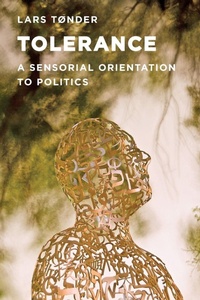
Tolerance
A Sensorial Orientation to Politics
Published on 17. October 2013
Book
Paperback/Softback
208 pages
978-0-19-931581-9 (ISBN)
Description
The main task of Tolerance is to reorient discussions in democratic theory so as better to theorize how tolerance can operate as an active force in the context of deep pluralism. The objective is to develop a theory of active tolerance attentive to the many different ways in which societies can become tolerant, and to discuss what might get lost, conceptually as well as politically, if we don't pay attention to how active tolerance subsists within other practices of tolerance. Tolerance exceeds existing accounts, I argue, not because it cannot be domesticated for the purposes of either restraint or benevolence, but because this domestication does not preclude the possibility of another, more active tolerance.
Tolerance develops this argument by mobilizing what I call a "sensorial orientation to politics." While a sensorial orientation does not refute the role of reason in democratic politics, it differs from its intellectualist counterpart by arguing that practices of reason-giving include ways of sensing the world, insisting that reason is always-already sensorial. A sensorial orientation, in other words, focuses on the embodied conditions of reasoning, which it takes to be neither completely synergistic nor immediately present, but reliant on representations, images, and memories, which situate sensory input within historically defined regimes of discourse and sensation, and which assume that sentient beings experience the world through both thought and action, mind and body.
Theorists discussed in the book include Seneca, Spinoza, Nietzsche, Marcuse, and Merleau-Ponty, together with Descartes, Locke, Kant, Mill, Rawls, Forst, Scanlon, Taylor, Brown, and Connolly. Tolerance draws on a critical consideration of these thinkers in order to shed new light on the role of tolerance in both contemporary democratic theory and contemporary public discourse. The aim is to show how tolerance once again can become a practice of empowerment and pluralization.
Tolerance develops this argument by mobilizing what I call a "sensorial orientation to politics." While a sensorial orientation does not refute the role of reason in democratic politics, it differs from its intellectualist counterpart by arguing that practices of reason-giving include ways of sensing the world, insisting that reason is always-already sensorial. A sensorial orientation, in other words, focuses on the embodied conditions of reasoning, which it takes to be neither completely synergistic nor immediately present, but reliant on representations, images, and memories, which situate sensory input within historically defined regimes of discourse and sensation, and which assume that sentient beings experience the world through both thought and action, mind and body.
Theorists discussed in the book include Seneca, Spinoza, Nietzsche, Marcuse, and Merleau-Ponty, together with Descartes, Locke, Kant, Mill, Rawls, Forst, Scanlon, Taylor, Brown, and Connolly. Tolerance draws on a critical consideration of these thinkers in order to shed new light on the role of tolerance in both contemporary democratic theory and contemporary public discourse. The aim is to show how tolerance once again can become a practice of empowerment and pluralization.
Reviews / Votes
Lars Tonder's Tolerance offers a highly original and sharply presented analysis of one of the most important concepts in democratic theory. This book is very timely in terms of its pertinence to many of today's crises and catastrophes. * Romand Coles, Contemporary Political Theory * Lars Tonder's approach in Tolerance to the potentially stale problem of toleration is bracingly original. Seeking to move beyond the traditional battle lines of toleration's supporters and its critics, Tonder shows us how we can see distinctly democratic modes of toleration in our active processes of somatic (as well as discursive) engagement with others, particularly when we willingly endure pain. Ranging from philosophy to comedy and visual art, Tolerance is a creative, thoughtful and, above all, generous contribution to our knowledge of what it means to live in pluralist democratic societies. * Andrew F. March, Yale University, author of Islam and Liberal Citizenship * Tonder's Tolerance makes an extraordinary and subtle claim: our rationalizations and justifications of tolerance can never live up to the felt burden of toleration. Rather than the proliferation of passive reasons that anaesthetize the lived experiences of everyday encounters, Tolerance calls for a 'sensorial reasoning' that attends to the trials, tribulations, and especially pains, that call forth a disposition of toleration. Masterfully argued engaging both contemporary and historical sources, as well as explorations of current events including the Danish cartoon war, Tonder has given us nothing less than a transvaluation of one of the most important - and urgent - concepts of modern political thought. * Davide Panagia, Canada Research Chair in Cultural Studies, Trent University *More details
Language
English
Place of publication
New York
United States
Target group
College/higher education
Advanced undergraduate students, graduate students, and scholars working in the field of political theory primarily, but also anthropology, critical theory, cultural studies, history of thought, legal studies, philosophies, and the humanities more generally.
Dimensions
Height: 234 mm
Width: 156 mm
Thickness: 11 mm
Weight
310 gr
ISBN-13
978-0-19-931581-9 (9780199315819)
Copyright in bibliographic data and cover images is held by Nielsen Book Services Limited or by the publishers or by their respective licensors: all rights reserved.
Schweitzer Classification
Other editions
Additional editions
Book
10/2013
Oxford University Press Inc
€210.10
Shipment within 15-20 days
E-Book
10/2013
1st Edition
OUP eBook
€15.49
Available for download
E-Book
09/2013
1st Edition
OUP eBook
€17.49
Available for download
Person
Lars Tonder is an assistant professor in political theory at Northwestern University.
Content
Acknowledgements ; Introduction: Tolerance in Question ; Chapter 1: Impossible Tolerance ; Chapter 2: Remembering Tolerance ; Chapter 3: Affirming Tolerance ; Chapter 4: Perceiving Tolerance ; Conclusion: Diogenes and Us ; Notes ; Bibliography ; Index