

Language Arts
Patterns of Practice
7th Edition
Published on 19. February 2008
Book
Paperback/Softback
592 pages
978-0-13-159789-1 (ISBN)
Description
This thoroughly revised, streamlined 7th edition continues to model the integration of the six language arts into the curriculum while providing a seamless presentation of methods grounded in real contemporary classrooms. The new edition deepens its real classroom exploration by integrating new Teacher Prep footage with classroom methods and minilessons in Planning for Instruction features. A new focus on Meeting the Needs of English Learners rounds out the look at addressing the needs of all students.
Reviews / Votes
The introductory vignette describing best language arts practices is an excellent way to set the stage for the content in the chapter. LA Essentials is essential information for teachers to have in an easy reference format. Diane Bottomley, BallStateUniversityTompkins provides lots of practical ideas for teaching, and explains the constructs associated with the reading and writing processes in context of classroom application. The charts, lists, and special features are very helpful in highlighting important content. Janet Young, BrighamYoungUniversity
I like the rich description of theory and its application to instruction. Tompkins does a good job of explaining the theories and of giving readers examples of classroom applications, and the book continues to help readers make these connections in subsequent chapters. Debra Price, SamHoustonStateUniversity
More details
Edition
7th edition
Language
English
Place of publication
United States
Publishing group
Pearson Education (US)
Target group
Professional and scholarly
Dimensions
Height: 205 mm
Width: 255 mm
Thickness: 22 mm
Weight
907 gr
ISBN-13
978-0-13-159789-1 (9780131597891)
Copyright in bibliographic data is held by Nielsen Book Services Limited or its licensors: all rights reserved.
Schweitzer Classification
Other editions
New editions
Book
03/2012
8th Edition
Pearson
€146.07
Article exhausted; check for reprint
Previous edition
Book
07/2004
6th Edition
Pearson
€73.03
Article exhausted; check for reprint
Person
Gail Tompkins I'm a teacher, first and foremost. I began my career as a first-grade teacher in Virginia in the 1970s. I remember one first grader who cried as the first day of school was ending. When I tried to comfort him, he sobbed accusingly, "I came to first grade to learn to read and write and you forgot to teach me." The next day, I taught that child and his classmates to read and write! We made a small patterned book about one of the stuffed animals in the classroom. I wrote some of the words and the students supplied the others, and I duplicated copies of the book for each child. We practiced reading it until everyone memorized our little book. The children proudly took their books home to read to their parents. I've never forgotten that child's comment and what it taught me: Teachers must understand their students and meet their expectations.
My first few years of teaching left me with more questions than answers, and I wanted to become a more effective teacher so I started taking graduate courses. In time I earned a master's degree and then a doctorate in Reading/Language Arts, both from Virginia Tech. Through my graduate studies, I learned a lot of answers, but more importantly, I learned to keep on asking questions.
Then I began teaching at the university level. First I taught at Miami University in Ohio, then at the University of Oklahoma, and finally at California State University, Fresno. I've taught preservice teachers and practicing teachers working on master's degrees, and I've directed doctoral dissertations. I've received awards for my teaching, including the Provost's Award for Excellence in Teaching at California State University, Fresno, and I was inducted into the California Reading Association's Reading Hall of Fame. Throughout the years, my students have taught me as much as I taught them. I'm grateful to all of them for what I've learned.
I've been writing college textbooks for more than 20 years, and I think of the books I write as teaching, too. I'll be teaching you as you read this text. As I write a book, I try to anticipate the questions you might ask and provide that information. I also include students' samples so you can see concepts that I'm explaining, and I include lists of trade books that you can refer to as you work with students.
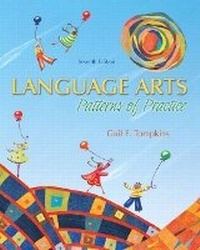
When I'm not teaching, I like to make quilts, and piecing together a quilt is a lot like planning effective language arts instruction. Instead of using pieces of cloth, teachers use the patterns of practice and other instructional procedures described in this text to design instruction for the diverse students in today's classrooms. That's why I like to use quilts on the cover of Language Arts. I want to thank quilter Cher Cartwright and illustrator Linda Bronson for their superb artistic contributions. You'll see their art on the cover and inside this book.
My first few years of teaching left me with more questions than answers, and I wanted to become a more effective teacher so I started taking graduate courses. In time I earned a master's degree and then a doctorate in Reading/Language Arts, both from Virginia Tech. Through my graduate studies, I learned a lot of answers, but more importantly, I learned to keep on asking questions.
Then I began teaching at the university level. First I taught at Miami University in Ohio, then at the University of Oklahoma, and finally at California State University, Fresno. I've taught preservice teachers and practicing teachers working on master's degrees, and I've directed doctoral dissertations. I've received awards for my teaching, including the Provost's Award for Excellence in Teaching at California State University, Fresno, and I was inducted into the California Reading Association's Reading Hall of Fame. Throughout the years, my students have taught me as much as I taught them. I'm grateful to all of them for what I've learned.
I've been writing college textbooks for more than 20 years, and I think of the books I write as teaching, too. I'll be teaching you as you read this text. As I write a book, I try to anticipate the questions you might ask and provide that information. I also include students' samples so you can see concepts that I'm explaining, and I include lists of trade books that you can refer to as you work with students.
When I'm not teaching, I like to make quilts, and piecing together a quilt is a lot like planning effective language arts instruction. Instead of using pieces of cloth, teachers use the patterns of practice and other instructional procedures described in this text to design instruction for the diverse students in today's classrooms. That's why I like to use quilts on the cover of Language Arts. I want to thank quilter Cher Cartwright and illustrator Linda Bronson for their superb artistic contributions. You'll see their art on the cover and inside this book.
Content
1. Learning and the Language Arts
2. Teaching and Assessing Language Arts
3. The Reading and Writing Processes
4. Emerging into Literacy
5. Looking Closely at Words
6. Personal Writing
7. Listening to Learn
8. Sustaining Talk in the Classroom
9. Reading and Writing Stories
10. Reading and Writing Information
11. Reading and Writing Poetry
12. Learning to Spell Conventionally
13. Language Tools: Grammar and Handwriting
14. Putting it All Together
2. Teaching and Assessing Language Arts
3. The Reading and Writing Processes
4. Emerging into Literacy
5. Looking Closely at Words
6. Personal Writing
7. Listening to Learn
8. Sustaining Talk in the Classroom
9. Reading and Writing Stories
10. Reading and Writing Information
11. Reading and Writing Poetry
12. Learning to Spell Conventionally
13. Language Tools: Grammar and Handwriting
14. Putting it All Together