

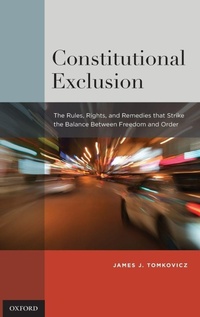
Constitutional Exclusion
The Rules, Rights, and Remedies that Strike the Balance Between Freedom and Order
1st Edition
Published on 12. May 2011
Book
Hardback
448 pages
978-0-19-536924-3 (ISBN)
Description
Supreme Court interpretations of the Bill of Rights have produced seven constitutional "exclusionary rules." These rules prevent prosecutors from introducing evidence of guilt in criminal trials, making it harder to convict offenders and enabling some criminals to avoid conviction and punishment. The importance of these evidentiary bars cannot be understated. They reflect inevitable tensions between liberty and security.
Constitutional Exclusion, by James J. Tomkovicz contains in-depth analyses of each constitutional doctrine that dictates the suppression of evidence. The text begins with an extensive treatment of the Fourth Amendment exclusionary rule which bars evidence acquired by means of unreasonable searches or seizures. It then addresses three distinct doctrines that suppress confessions---the due process and privilege against compelled self-incrimination bar to coerced confessions, Miranda v. Arizona's Fifth Amendment prophylactic presumption that certain confessions are inadmissible, and the Massiah doctrine's Sixth Amendment right to counsel bar to incriminating admissions. Next, the book explains two prohibitions on eyewitness identification evidence, one rooted in the Sixth Amendment right to counsel and another grounded in the due process guarantee. Finally, the text explores the exclusion of hearsay commanded by the Sixth Amendment Confrontation Clause.
Constitutional Exclusion analyzes the histories of, justifications for, and the legitimacy of these exclusion doctrines. By juxtaposing the rules and highlighting their distinctive characters, the book sheds new light on topics of vital importance to the administration of criminal justice.
Constitutional Exclusion, by James J. Tomkovicz contains in-depth analyses of each constitutional doctrine that dictates the suppression of evidence. The text begins with an extensive treatment of the Fourth Amendment exclusionary rule which bars evidence acquired by means of unreasonable searches or seizures. It then addresses three distinct doctrines that suppress confessions---the due process and privilege against compelled self-incrimination bar to coerced confessions, Miranda v. Arizona's Fifth Amendment prophylactic presumption that certain confessions are inadmissible, and the Massiah doctrine's Sixth Amendment right to counsel bar to incriminating admissions. Next, the book explains two prohibitions on eyewitness identification evidence, one rooted in the Sixth Amendment right to counsel and another grounded in the due process guarantee. Finally, the text explores the exclusion of hearsay commanded by the Sixth Amendment Confrontation Clause.
Constitutional Exclusion analyzes the histories of, justifications for, and the legitimacy of these exclusion doctrines. By juxtaposing the rules and highlighting their distinctive characters, the book sheds new light on topics of vital importance to the administration of criminal justice.
More details
Language
English
Place of publication
New York
United States
Target group
College/higher education
Law scholars, law students, judges, practitioners, political science scholars and students.
Dimensions
Height: 240 mm
Width: 161 mm
Thickness: 29 mm
Weight
837 gr
ISBN-13
978-0-19-536924-3 (9780195369243)
Copyright in bibliographic data and cover images is held by Nielsen Book Services Limited or by the publishers or by their respective licensors: all rights reserved.
Schweitzer Classification
Other editions
Additional editions
James J. Tomkovicz
Constitutional Exclusion
The Rules, Rights, and Remedies that Strike the Balance Between Freedom and Order
E-Book
10/2010
1st Edition
OUP eBook
€61.99
Available for download
Person
James J. Tomkovicz holds the Edward F. Howrey chair at the University of Iowa College of Law. Professor Tomkovicz attended the University of Southern California, where he received his Bachelor of Arts degree, and the University of California, Los Angeles School of Law, where he received his Juris Doctor degree. He served as a law clerk to the Honorable Edward J. Schwartz, Chief Judge of the United States District Court for the Southern District of California, and for the Honorable John M. Ferren, Associate Judge of the District of Columbia Court of Appeals. Professor Tomkovicz was an Associate Professor at the University of Iowa College of Law from 1982 until 1986, when he was tenured and promoted to full professor. He has served as a Visiting Professor of Law at the University of Michigan Law School, the UCLA School of Law, and the University of San Diego School of Law.
Content
PREFACE; INTRODUCTION; CONCLUSION; INDEX