

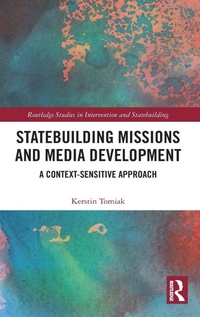
Statebuilding Missions and Media Development
A Context-Sensitive Approach
1st Edition
Published on 27. August 2021
Book
Hardback
172 pages
978-0-367-40506-9 (ISBN)
Description
This book examines the effects of media interventions in the global South, and argues for a more adaptive and context-sensitive media development.
The work investigates media development as part of statebuilding and the effects that Western-led media has in, and on, a newly built state. Drawing on extensive fieldwork, including interviews, observations and social surveys, it analyses the effect media interventions has on global South countries, from the population's point of view. The findings show that in practice media development can be alien to the societies in which a free press is implemented, which can lead to unintended and negative consequences for social relations in a country. While the book uses South Sudan as a case study, it also presents different perspectives and shows that local views on the media are different from those of Western experts and policymakers. Therefore, the book advocates taking local views seriously and an adaptive media development that is sensitive to the context in which it is set up.
This book will be of much interest to students of statebuilding, media studies, development studies and international relations in general.
The work investigates media development as part of statebuilding and the effects that Western-led media has in, and on, a newly built state. Drawing on extensive fieldwork, including interviews, observations and social surveys, it analyses the effect media interventions has on global South countries, from the population's point of view. The findings show that in practice media development can be alien to the societies in which a free press is implemented, which can lead to unintended and negative consequences for social relations in a country. While the book uses South Sudan as a case study, it also presents different perspectives and shows that local views on the media are different from those of Western experts and policymakers. Therefore, the book advocates taking local views seriously and an adaptive media development that is sensitive to the context in which it is set up.
This book will be of much interest to students of statebuilding, media studies, development studies and international relations in general.
Reviews / Votes
"Overall, the key arguments are effectively presented and contribute to the literature on statebuilding and media development. The book is worth adding to the library of anyone who is interested in (decolonizing) media assistance, international interventions, or peace- and statebuilding. Students, scholars, policymakers, journalists, practitioners, and interested readers will find valuable insights into the debate on decolonial approaches to media development and international cooperation." - Fabiola Ortiz dos Santos, Duisburg-Essen UniversityMore details
Series
Language
English
Place of publication
London
United Kingdom
Publishing group
Taylor & Francis Ltd
Target group
College/higher education
Professional and scholarly
Dimensions
Height: 240 mm
Width: 161 mm
Thickness: 15 mm
Weight
443 gr
ISBN-13
978-0-367-40506-9 (9780367405069)
Copyright in bibliographic data and cover images is held by Nielsen Book Services Limited or by the publishers or by their respective licensors: all rights reserved.
Schweitzer Classification
Other editions
Additional editions
Book
09/2023
1st Edition
Routledge
€65.20
Shipment within 10-20 days
E-Book
08/2021
1st Edition
Routledge
€59.49
Available for download
E-Book
08/2021
1st Edition
Routledge
€59.49
Available for download
Person
Kerstin Tomiak is Assistant Professor at the American University of Kurdistan, Iraq. She holds a PhD degree from Cardiff University and has worked as a media expert for NATO in Afghanistan.
Content
Introduction 1. Media development: The ideas behind the concept 2. Leadership and the media 3. Access to the media and trust in the media 4. The audience: Wishes and expectations 5. The journalists: Views, wishes and challenges 6. The conflict and the media 7. The host country and the international community Conclusion