

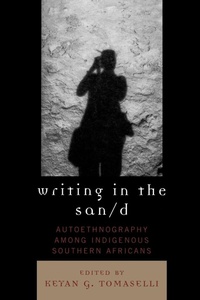
Writing in the San/d
Autoethnography among Indigenous Southern Africans
Published on 16. April 2007
Book
Paperback/Softback
190 pages
978-0-7591-0951-3 (ISBN)
Description
The San/Bushmen are one of the most studied people in anthropology, subjects of research going back one hundred years, of documentaries, and even of popular movies (The Gods Must Be Crazy). This intriguing new work on the San is a team-based ethnography, collaborative (one of the writers is married to a member of the community), reflexive (the authors become characters in the book themselves), and literary (with poetry, dialogue, interviews, photography, and first person accounts, as well as traditional ethnographic description). In this book, South Africans are studying other South Africans, in a new environment in which many San are no longer hunter gatherers, but are activist and engaged in cultural tourism. It will be an exciting counterpoint to traditional ethnographies and stories about the San people, for anthropologists and Africanists.
Reviews / Votes
Renowned international scholar Keyan Tomaselli has long been an advocate for forcing cultural studies outside of the confines of academia and into real life situations. Through the essays collected in Writing in the San/d, we witness the practice and evolution of a "reverse cultural studies" as Tomaselli and his colleagues immerse themselves in actual fieldwork situations in Southern Africa with revealing and often unexpected consequences. The dual awareness of self and subject explored through writing presents a model for students and academics to develop fieldwork practices for cultural studies in a variety of settings. As such the collection makes an excellent companion to contemporary cultural studies of indigenous populations in South Africa and the surrounding region. -- Matthew Durington, Towson University The Writing in the San/d anthology is an intriguing experiment in collaborative methods....The nine articles in the book make a number of important points. -- 2008 * Collaborative Anthropologies * These essays capture the spirit of a moment in anthropology. -- Paulla A. Ebron, Journal of Anthropological Research The emergence of Keyan Tomaselli's scholarship across various disciplines over the last twenty five years of the twentieth century is undoubtedly one of the most exciting events in South African intellectual history. Its depth, breadth and intensity surely brings to mind that of Clement Martyn Doke which dominated the first half of the past century. In recent years Tomaselli has engaged himself with the complex splay of modernity in South Africa. In this book, written with his colleagues, he broaches the dark side of this historical experience as is evident in its disastrous effect on the First People (KhoiSan) of South Africa. He poses a challenge to all of us South Africans by making it clear that until the First People are integrated into modernity largely on their own terms, the formation of modernity in our country is still very much incomplete. This incompleteness is a singular expression of the unfinished political and cultural project of the democratic experiment initiated in 1994. -- Ntongela Masilela, Pitzer CollegeMore details
Series
Language
English
Place of publication
California
United States
Target group
College/higher education
Dimensions
Height: 229 mm
Width: 152 mm
Thickness: 11 mm
Weight
287 gr
ISBN-13
978-0-7591-0951-3 (9780759109513)
Copyright in bibliographic data and cover images is held by Nielsen Book Services Limited or by the publishers or by their respective licensors: all rights reserved.
Schweitzer Classification
Other editions
Additional editions
E-Book
04/2007
1st Edition
AltaMira Press
€44.99
Available for download
E-Book
04/2007
1st Edition
AltaMira Press
€44.99
Available for download
Persons
Keyan G. Tomaselli is professor and chair of Culture, Communication and Media Studies (CCMS) at the University of KwaZulu-Natal, Durban. He has written extensively on his Kalahari research in Visual Anthropology, Cultural Studies, Critical Arts and Cultural Studies: Critical Methodologies. He is author of Appropriating Images: The Semiotics of Visual Representation.
Content
0 Introduction: Setting the Scene
Chapter 1 Representing Representation
Chapter 2 Romancing the Kalihari: Personal Journeys of Methodological Discovery
Chapter 3 'Op die Grond': Writing in the San/d, Surviving Crime
Chapter 4 A Letter to Myself-My Trip to Ngwatle
Chapter 5 Voices from the Kalahari: Methodology and the Absurd
Chapter 6 Meeting Points: Symbiotic Spaces
7 Wit Meisie /Morning Star: Encounters in the Desert
8 In the Sun with Silikat
9 Orality, Rhythmography and Visual Representation
Chapter 1 Representing Representation
Chapter 2 Romancing the Kalihari: Personal Journeys of Methodological Discovery
Chapter 3 'Op die Grond': Writing in the San/d, Surviving Crime
Chapter 4 A Letter to Myself-My Trip to Ngwatle
Chapter 5 Voices from the Kalahari: Methodology and the Absurd
Chapter 6 Meeting Points: Symbiotic Spaces
7 Wit Meisie /Morning Star: Encounters in the Desert
8 In the Sun with Silikat
9 Orality, Rhythmography and Visual Representation