

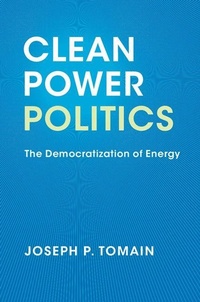
Clean Power Politics
The Democratization of Energy
Published on 6. March 2017
Book
Paperback/Softback
288 pages
978-1-316-64213-9 (ISBN)
Description
The United States has been experiencing an energy transition for over four decades, and now - thanks to the Clean Power Plan of the Obama Administration and the Paris climate agreement - a clean energy future is moving closer to reality. In Clean Power Politics, Joseph Tomain describes how clean energy policies have been developed and, more importantly, what's necessary for a successful transition to a clean energy future, including technological innovation, new business models, and regulatory reforms. The energy system of the future will minimize the environmental costs of traditional energy production and consumption, and emphasize expanded use of natural resources and energy efficiency. Because many new energy technologies can be produced and consumed at smaller scales, they will shift decision-making power away from traditional utilities and empower consumers to make energy choices about consumption and price. In this way, a clean energy future embodies a democratization of energy.
More details
Language
English
Place of publication
Cambridge
United Kingdom
Target group
Professional and scholarly
Product notice
Paperback (trade)
Illustrations
1 Line drawings, black and white
Dimensions
Height: 229 mm
Width: 152 mm
Thickness: 18 mm
Weight
474 gr
ISBN-13
978-1-316-64213-9 (9781316642139)
Copyright in bibliographic data and cover images is held by Nielsen Book Services Limited or by the publishers or by their respective licensors: all rights reserved.
Schweitzer Classification
Other editions
Additional editions
E-Book
03/2017
Cambridge University Press
€26.49
Available for download
Book
02/2017
Cambridge University Press
€98.30
Shipment within 15-20 days
Person
Joseph P. Tomain has been teaching and writing in the field of energy law since 1977. He has published numerous articles, essays, casebooks, treatises, and monographs on energy law and has delivered papers at conferences throughout the US and Europe. Tomain is actively involved with energy organizations, including the Center for Progressive Reform and the PUC Collaborative.
Content
Introduction; Part I. Preconditions for a Clean Power Transition: 1. The clean power plan and clean power politics; 2. Defining and measuring clean power; 3. The political economy of clean power; Part II. The Necessity of Innovation: 4. Innovation policy and institutions; 5. Clean power systems; 6. Regulatory innovation; Part III. The Democratization of Energy: 7. Energy and democracy.