

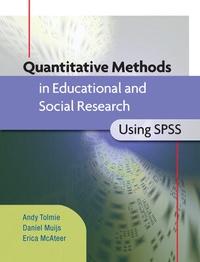
Quantitative Methods in Educational and Social Research using SPSS
Published on 16. November 2011
Book
Paperback/Softback
571 pages
978-0-335-23377-9 (ISBN)
Description
Quantitative Methods in Educational and Social Research Using SPSS bridges the gap between introductory and advanced volumes on quantitative methods. Central to the text is an emphasis on the concept of modelling at the core of data analysis.The implications of the modelling approach are taken all the way back to the stages of research design and sampling, and use of simple descriptive statistics. Using this as a lens the book then moves on to explain carefully a full range of statistical techniques from basic procedures such as correlation and analysis of variance, to advanced methods such as multiple regression, path analysis and multilevel modelling.Key features of the book include:
Crucial points illustrated by getting readers to work through key theoretical and analytical tasksA CD that offers step by step guidance on the use of SPSS and example analyses for each of the methods covered by the textClear explanation of the conceptual background to all the analytical techniques included in the bookA range of example datasets
The aim throughout is to help you gain a fully-grounded conceptual grasp of different techniques, allowing you to apply these thoughtfully, as well as helping you progress towards a more advanced understanding through a step-by-step approach.This book is for you if you are a student or researcher in education or a related field and want an introductory resource that helps you get up to speed quickly.
Crucial points illustrated by getting readers to work through key theoretical and analytical tasksA CD that offers step by step guidance on the use of SPSS and example analyses for each of the methods covered by the textClear explanation of the conceptual background to all the analytical techniques included in the bookA range of example datasets
The aim throughout is to help you gain a fully-grounded conceptual grasp of different techniques, allowing you to apply these thoughtfully, as well as helping you progress towards a more advanced understanding through a step-by-step approach.This book is for you if you are a student or researcher in education or a related field and want an introductory resource that helps you get up to speed quickly.
More details
Persons
Professor Andy Tolmie is Developmental Psychologist for the Department of Psychology and Human Development at the Institute of Education, University of London, UK.
Professor Daniel Muijs is Chair of Education at the Southampton Education School, University of Southampton, UK.
Dr Erica McAteer is Cognitive Psychologist for the Department of Psychology and Human Development at the Institute of Education, University of London, UK.
Professor Daniel Muijs is Chair of Education at the Southampton Education School, University of Southampton, UK.
Dr Erica McAteer is Cognitive Psychologist for the Department of Psychology and Human Development at the Institute of Education, University of London, UK.
Content
Section One: Modelling and research design
An introduction to the concept of data modelling
Sampling
Survey, experimental and secondary research
Section Two: Modelling associations between variables
Modelling categorical data
Measuring association in continuous data
Multiple regression
Multiple regression with categorical predictors
Section Three: Modelling and concepts of measurement
Concepts of measurement revisited
Measurement and factor analysis
Section Four: Modelling complex relationships
Complex models in multiple regression
Multilevel modelling
Log-linear modelling
Logistic regression
Complex ANOVA designs Conventions on reporting results of statistical analyses
Glossary
An introduction to the concept of data modelling
Sampling
Survey, experimental and secondary research
Section Two: Modelling associations between variables
Modelling categorical data
Measuring association in continuous data
Multiple regression
Multiple regression with categorical predictors
Section Three: Modelling and concepts of measurement
Concepts of measurement revisited
Measurement and factor analysis
Section Four: Modelling complex relationships
Complex models in multiple regression
Multilevel modelling
Log-linear modelling
Logistic regression
Complex ANOVA designs Conventions on reporting results of statistical analyses
Glossary