

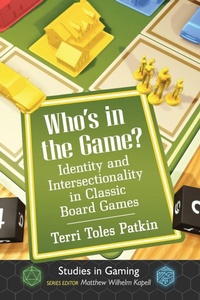
Who's in the Game?
Identity and Intersectionality in Classic Board Games
Published on 14. December 2020
Book
Paperback/Softback
281 pages
978-1-4766-7691-3 (ISBN)
Description
Some board games--like Candy Land, Chutes & Ladders, Clue, Guess Who, The Game of Life, Monopoly, Operation and Payday--have popularity spanning generations. But over time, updates to games have created significantly different messages about personal identity and evolving social values. Games offer representations of gender, sexuality, race, ethnicity, religion, age, ability and social class that reflect the status quo and respond to social change.
Using popular mass-market games, this rhetorical assessment explores board design, game implements (tokens, markers, 3-D elements) and playing instructions. This book argues the existence of board games as markers of an ever-changing sociocultural framework, exploring the nature of play and how games embody and extend societal themes and values.
Using popular mass-market games, this rhetorical assessment explores board design, game implements (tokens, markers, 3-D elements) and playing instructions. This book argues the existence of board games as markers of an ever-changing sociocultural framework, exploring the nature of play and how games embody and extend societal themes and values.
More details
Series
Language
English
Place of publication
Jefferson, NC
United States
Target group
Professional and scholarly
Interest Age: From 18 years
Product notice
Paperback (trade)
Illustrations
notes, bibliography, index
Dimensions
Height: 229 mm
Width: 152 mm
Thickness: 17 mm
Weight
462 gr
ISBN-13
978-1-4766-7691-3 (9781476676913)
Copyright in bibliographic data and cover images is held by Nielsen Book Services Limited or by the publishers or by their respective licensors: all rights reserved.
Schweitzer Classification
Persons
Terri Toles Patkin is a professor of communication at Eastern Connecticut State University. Her research program is eclectic, spanning time frames from prehistoric cave art to social media, and her interest in board games emerges from her long-standing examination of messages encoded in popular culture artifacts. Series editor Matthew Wilhelm Kapell teaches American studies, anthropology, and writing at Pace University in New York.
Content
Table of Contents
Preface
Introduction
1.?Welcome to Gameland: Games in American Culture
2.?Games and Toys for Girls and Boys: Performing Gender in Board Games
3.?Dirty Mind, Dirty Game: Sexuality and Romance
4.?Face Games Displace Race Games: Ethnic and Racial Images
5.?A Moral Fit to Improve the Mind: Religion, Morality and Social Justice
6.?For Kids from 8 to 80: Age and Youth
7.?Go to the Head of the Class: Ability, Physical and Intellectual
8.?Imagine an Ordinarily --Well-to-Do Household: Social Class
9.?You Can Learn About Life: Intersectionality and Identity
Chapter Notes
Bibliography
Index
Preface
Introduction
1.?Welcome to Gameland: Games in American Culture
2.?Games and Toys for Girls and Boys: Performing Gender in Board Games
3.?Dirty Mind, Dirty Game: Sexuality and Romance
4.?Face Games Displace Race Games: Ethnic and Racial Images
5.?A Moral Fit to Improve the Mind: Religion, Morality and Social Justice
6.?For Kids from 8 to 80: Age and Youth
7.?Go to the Head of the Class: Ability, Physical and Intellectual
8.?Imagine an Ordinarily --Well-to-Do Household: Social Class
9.?You Can Learn About Life: Intersectionality and Identity
Chapter Notes
Bibliography
Index