

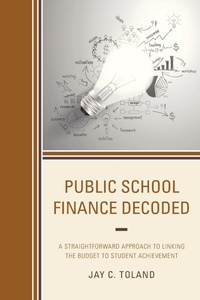
Public School Finance Decoded
A Straightforward Approach to Linking the Budget to Student Achievement
Published on 25. October 2016
Book
Paperback/Softback
116 pages
978-1-4758-2768-2 (ISBN)
Description
Public School Finance Decoded discusses why the finance department needs to have a seat at the table during discussions about how to educate the whole child. Written in plain language, this book will empower school administrators to improve student achievement through understanding the impact school finance has on each student. It lays out a process for using expenditure data for predictive purposes towards student achievement and for efficiency indicators, which ensure efficient resource use for the necessary services of a school district.
Reviews / Votes
Public School Finance Decoded details why a school district's CFO, finance director, or treasurer needs a seat at the table when all decisions are made to lead a school or district. -- Randy Bridges, superintendent, Florence School District One Public School Finance Decoded is written in school language and is a great tool for any school or district leader wanting to make a connection between the budget and student achievement. -- Freddie Williamson, superintendent, Hoke County SchoolsMore details
Language
English
Place of publication
United States
Publishing group
Bloomsbury Publishing Plc
Target group
Professional and scholarly
Illustrations
5 b/w illustrations;12 tables
Dimensions
Height: 229 mm
Width: 152 mm
Thickness: 7 mm
Weight
184 gr
ISBN-13
978-1-4758-2768-2 (9781475827682)
Copyright in bibliographic data and cover images is held by Nielsen Book Services Limited or by the publishers or by their respective licensors: all rights reserved.
Schweitzer Classification
Person
Jay C. Toland is the chief financial officer (CFO) for Scotland County Schools in Laurinburg, North Carolina. He is a certified management accountant (CMA) and certified administrator of school finance and operations (SFO). He received his bachelor's in business administration from the University of North Carolina at Wilmington and his MBA from the University of North Carolina at Pembroke.
Content
Preface
Introduction
Chapter 1: How Finance and Student Achievement Go Hand-In-Hand
Chapter 2: Looking At the Past to Predict the Future
Chapter 3: How to Use District Efficiency Indicators
Chapter 4: What Expenses to Include In the Indicators
Chapter 5: Child Nutrition Ratios
Chapter 6: Maintenance and Operation of Plant Ratios
Chapter 7: Transportation Ratios
Chapter 8: Technology Ratios
Chapter 9: Other Ratios to Consider
Chapter 10: What Expenditures Directly Correlate With Student Achievement
Chapter 11: Linking the Strategic Plan to Budget
Chapter 12: How It All Fits Together
Introduction
Chapter 1: How Finance and Student Achievement Go Hand-In-Hand
Chapter 2: Looking At the Past to Predict the Future
Chapter 3: How to Use District Efficiency Indicators
Chapter 4: What Expenses to Include In the Indicators
Chapter 5: Child Nutrition Ratios
Chapter 6: Maintenance and Operation of Plant Ratios
Chapter 7: Transportation Ratios
Chapter 8: Technology Ratios
Chapter 9: Other Ratios to Consider
Chapter 10: What Expenditures Directly Correlate With Student Achievement
Chapter 11: Linking the Strategic Plan to Budget
Chapter 12: How It All Fits Together