

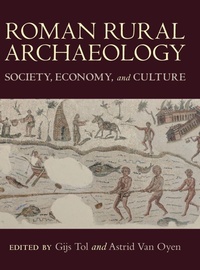
Roman Rural Archaeology
Society, Economy, and Culture
Will be published approx. on 25. June 2026
Book
Hardback
500 pages
978-1-316-51099-5 (ISBN)
Description
The Roman world was a rural world. Most of the Roman population lived in the countryside and had their immediate rural surroundings as their social and economic frame of reference. For much of the Roman period, rural property provided the basis for political power and urban development, and it was in rural areas that the agricultural crops that sustained an expanding empire were grown and many of the most important Roman industries were situated. Rural areas witnessed the presence of some of the most durable symbols of Roman imperial hegemony, such as aqueducts and paved roads. It was mainly here that native and Roman traditions collided and were negotiated. This volume, containing 30 chapters by leading scholars, leverages recent methodological advancements and new interpretative frameworks to provide a holistic view, with an empire-wide reach, of the importance of Roman rural areas in the success of ancient Rome.
Reviews / Votes
'After half a century of intensive surveys that have revealed the rich diversity of rural landscapes across the Roman world, Gijs Tol and Astrid Van Oyen have looked systematically beyond the many dots on the maps and have assembled the first comprehensive endeavor to account for rural communities and to foreground rural labor throughout the Roman world.' Peter van Dommelen, Joukowsky Family Professor of Archaeology and Professor of Anthropology, Brown University 'This innovative volume documents contemporary research on the countryside across the Roman Empire. Drawing on new evidence from surveys, remote sensing and excavations, it highlights distinctive transformations in our understandings, illustrating a rich diversity of activity across its varied but heavily exploited landscapes, whilst demonstrating the fine-grained realities of human life in them.' Martin Millett, President of the Society of Antiquaries of LondonMore details
Language
English
Place of publication
Cambridge
United Kingdom
Illustrations
Worked examples or Exercises
Dimensions
Height: 286 mm
Width: 222 mm
Thickness: 36 mm
Weight
500 gr
ISBN-13
978-1-316-51099-5 (9781316510995)
Copyright in bibliographic data and cover images is held by Nielsen Book Services Limited or by the publishers or by their respective licensors: all rights reserved.
Schweitzer Classification
Persons
Gijs Tol is Associate Professor of Archaeology at the University of Melbourne. He is a leading expert in landscape archaeology and material culture studies and has published widely on the social and economic dimensions of the Roman countryside, including the recent volume The Economic Integration of Roman Italy: Rural Communities in a Globalising World. Astrid Van Oyen is Professor of Archaeology at Radboud University's Institute for Culture and History. A Roman archaeologist with expertise in socioeconomic dynamics, the non-elite, and materiality, she is author of How Things Make History: The Roman Empire and its Terra Sigillata Pottery (2025) and The Socio-Economics of Roman Storage: Agriculture, Trade, and Family (2020).
Content
1. Roman rural archaeology: past, present, and future Gijs Tol and Astrid Van Oyen; Part I. A Rural Lens: 2. Exploring the Roman countryside: conceptual changes and recent advances in fieldwork methodology Stefano Campana; 3. A supra-regional view of the Roman countryside: integrating datasets from systematic field surveys Tymon de Haas, Gijs Tol, Peter Attema, Remco Bronkhorst, Maria-Cristina Capanna, Paolo Carafa, Wim Jongman, Martijn van Leusen, Christopher Smith, Robert Witcher and Niels Wouda; 4. An ideal life: perceptions of the Roman countryside in visual and literary culture Diana Spencer; 5. Reconstructing Roman rural landscapes John M. Marston; 6. Rural continuities, upheavels and resistance: post-colonial implications of Roman imperial landscapes David J. Mattingly; Part II. Rural Lives: 7. Peopling the countryside: the everyday experience of rural life Tamara Lewit; 8. Roman rural burials Liana Brent and Tracy Prowse; 9. Rural religion in the Western Mediterranean: materiality, spaces, dynamics Alejandro G. Sinner and Victor Revilla; 10. The diversity of Roman rural settlement Astrid Van Oyen and Gijs Tol; 11. Building and dwelling: non-elite rural architecture. raw-earth architecture in the countryside of Roman Etruria Maria Teresa Sgromo; 12. Building and dwelling: Roman villa culture Annalisa Marzano; 13. Cooking and dining in the Roman countryside: the Roman rural diet Maaike Groot and Laura I. Kooistra; 14. Rural connectivity: from local to global networks Cesar Carreras and Pau de Soto; Part III. Rural Stuff: 15. The diversity of Roman agriculture Dimitri Van Limbergen; 16. Roman livestock husbandry: the importance of the countryside Lidia Colominas Barbera; 17. Rural crafts and industries: consumer goods Benjamin P. Luley; 18. Quarrying and mining in rural landscapes of Rome's west Alfred M. Hirt; 19. Rural Crafts and industries: iron Nadine Dieudonne-Glad; 20. The exploitation of 'marginal' landscapes: the case of the Roman Gauls Frederic Trement; Part IV. Rural Trajectories: 21. Rural landscapes of Roman Italy Robert Witcher; 22. Roman Iberia: an overview of the archaeology of rural landscapes and societies Ignasi Grau Mira and Jesus Bermejo Tirado; 23. People and place in the Romano-British countryside Martyn G. Allen; 24. The abundant Egyptian countryside Irene Soto Marin; 25. The Galliae Michel Redde; 26. Roman rural archaeology in North Africa Mariette de Vos Raaijmakers, Redha Attoui and Alessandro Battisti ; 27. Rural structures and the empire: landscape and settlements in South-West Asia during the Roman period Rocco Palermo; Part V. Rural Afterlives: 28. The late Roman countryside: new data and approaches in the twenty-first century Alexandra Chavarria and Tamara Lewit; 29. Roman centuriation: form, function and impact on the landscape Tymon de Haas; 30. Rural landscapes, cultural heritage, and contemporary society: a challenge of public archaeology Giuliano Volpe.