

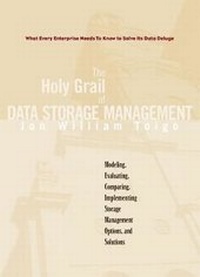
Holy Grail of Data Storage Management, The
Published on 2. September 1999
Book
Paperback/Softback
352 pages
978-0-13-013055-6 (ISBN)
Description
At least 75% of IT hardware expenditures in the next five years will be for data storage. This book shows IT executives how to create a comprehensive strategy for maximizing the availability, performance, and cost-effectiveness of enterprise storage.KEY TOPICS:A revolution in data storage is coming, as IT organizations realize that they must apply the same architectural, scalability, and investment protection criteria to storage purchases as they already apply to servers and other hardware. New categories of products are coming as well: network-attached storage, IBM's storage array architecture, JBOD ("just a bunch of disks") configurations, storage appliances, near-line storage, SANs (storage area networks); and more. Learn how to move towards the "holy grail" of data storage management. Toigo shows how define an enterprise storage framework that maps directly to a specific business and its technical needs, and helps make sense of any new storage alternative.MARKET:For all IT decision-makers responsible for enterprise storage, planning, architecture, and/or distributed systems.
More details
Person
JON WILLIAM TOIGO is author of six books, including the classic Disaster Recovery Planning, as well as more than 500 articles for the business trade press. He is a consultant who provides research, planning, and writing services to a broad range of commercial clients, including AT&T, Cabletron, Cisco, Citrix, Compaq, Hewlett-Packard, Storage Technologies Corporation, and EMC.
Content
I. THEORY OF STORAGE MANAGEMENT.
1. Data Storage Trends beyond the Millennium: The Road to Chaos.
A Paradigm Shift. Storage Management Defined. Endnotes.
2. Why Storage Management?
Increased Risk of Data Loss. Increased Personnel Cost. Increased Storage Acquisition Costs. Increased Downtime due to Storage-Related Issues. Increased Downtime due to Absence of an Availability-Optimized Architecture. Decreased Performance in Applications. Diminished End User Confidence and Satisfaction. Impediments to Storage Management. Endnotes.
3. Storage in the Modern Distributed Enterprise.
Data Distribution Models Evolve. Distributed-Anarchical Data Distribution. Regionalized-Managed Data Distribution. Centralized-Managed Data Distribution. A Continuum of Options. Endnotes.
II. STORAGE TECHNOLOGIES.
4. The Perpetuation of a Disk-Based Storage Strategy.
Evolution of Hard Disk Technology. Enabling Technology for Disk Drive Advancement. Read-Write Heads. Other Drive Improvements. New Initiatives in Drive Technology. PRML Channel Technology and Enhanced Management Features. Interfaces: Connecting Storage for Efficient Use. Advanced Technology Attachment/Intelligent Disk Electronics (ATA/IDE) Interface. Small Computer System Interface (SCSI). Ultra SCSI. Serial Storage Architecture (SSA). Fibre Channel. Thinking Outside the Box. Endnotes.
5. Raid.
Disk Storage Sub-systems: Cutting the Tether. RAID Levels. Beyond RAID 5. Implementing RAID. Stand-Alone Arrays. RAID Objectives Scorecard. Endnotes.
6. The Advent of SANs.
Fibre Channel: A SCSI Replacement? Networking Concepts for Storage Managers. SANS: Problems Solved, Issues Remain. Endnotes.
7. Network-Attached Storage (NAS) and Storage Appliances.
Distributed Storage Using NAS. Defining Terms. NAS and the Thin-Server Revolution. The NAS Operating System. Differences in Kernel Implementation. Anatomy of a NAS Operating System. Homogeneous NAS File Systems. Enhancing File Systems and MultiProtocol File Access. A Kludge at Best. Integrating NAS with the Enterprise Storage Infrastructure. Endnotes.
8. Secondary Storage: New Roles for Tape.
The Market for Tape. Tape in the Large Systems Market. Tape Products Crowd the Mid-Range. DLT: King of the Mountain. Knocking DLT of the Top of the Hill. QIC Tape and Its Descendents. Travan. Scalable Linear Recording (SLR). 4 mm and 8 mm Contenders. Digital Data Storage (DDS). Mammoth. Advanced Information Technology (AIT). New Players Enter the Mid-Range. Linear Tape Open (LTO). Ecrix and VXA. Into the Rack. Back to NFR. Endnotes.
9. Wither Optical Technologies?
Magneto-Optical Technology Evolves. LIMDOW. Phase-Change Optical Media. Media Selection Criteria. DVD Formats Proliferate. Seeing the Future of Optical Clearly.
III. STORAGE MANAGEMENT TECHNIQUES.
10. Implementing Enterprise Storage Management.
Needs Assessment Phase. Policy Development Phase. Architecture Definition Phase. Storage Management Tools Evaluation Phase. Implementation and Testing Phase. Monitoring and Management Phase. Change Management Phase. Model versus Reality. Continued Obstacles. Endnotes.
11. The Storage Infrastructure Perspective.
From a Repository to an Infrastructure View. A Dynamic Data Movement Example: HSM. SAN Architecture Forces Storage Infrastructure Viewpoint. Storage Infrastructure Requirements for Data Warehouse Applications. Storage-Related Data Layout Requirements for Databases. Storage Infrastructure Requirements for Multimedia Applications. The Storage Infrastructure Perspective. Endnotes.
12. Back to the Future.
Considerations for Selecting a Backup Strategy. Remote Mirroring. Hierarchical Storage Management. The Impact of HSM on Storage Planning. Endnotes.
IV. CONCLUSION.
13. The Holy Grail.
Sun Microsystems And StoreX. Compaq's ENSA. EMC'S Enterprise Storage Networks. Other Visions. The Quest Continues. Endnotes.
Glossary.
Index.
1. Data Storage Trends beyond the Millennium: The Road to Chaos.
A Paradigm Shift. Storage Management Defined. Endnotes.
2. Why Storage Management?
Increased Risk of Data Loss. Increased Personnel Cost. Increased Storage Acquisition Costs. Increased Downtime due to Storage-Related Issues. Increased Downtime due to Absence of an Availability-Optimized Architecture. Decreased Performance in Applications. Diminished End User Confidence and Satisfaction. Impediments to Storage Management. Endnotes.
3. Storage in the Modern Distributed Enterprise.
Data Distribution Models Evolve. Distributed-Anarchical Data Distribution. Regionalized-Managed Data Distribution. Centralized-Managed Data Distribution. A Continuum of Options. Endnotes.
II. STORAGE TECHNOLOGIES.
4. The Perpetuation of a Disk-Based Storage Strategy.
Evolution of Hard Disk Technology. Enabling Technology for Disk Drive Advancement. Read-Write Heads. Other Drive Improvements. New Initiatives in Drive Technology. PRML Channel Technology and Enhanced Management Features. Interfaces: Connecting Storage for Efficient Use. Advanced Technology Attachment/Intelligent Disk Electronics (ATA/IDE) Interface. Small Computer System Interface (SCSI). Ultra SCSI. Serial Storage Architecture (SSA). Fibre Channel. Thinking Outside the Box. Endnotes.
5. Raid.
Disk Storage Sub-systems: Cutting the Tether. RAID Levels. Beyond RAID 5. Implementing RAID. Stand-Alone Arrays. RAID Objectives Scorecard. Endnotes.
6. The Advent of SANs.
Fibre Channel: A SCSI Replacement? Networking Concepts for Storage Managers. SANS: Problems Solved, Issues Remain. Endnotes.
7. Network-Attached Storage (NAS) and Storage Appliances.
Distributed Storage Using NAS. Defining Terms. NAS and the Thin-Server Revolution. The NAS Operating System. Differences in Kernel Implementation. Anatomy of a NAS Operating System. Homogeneous NAS File Systems. Enhancing File Systems and MultiProtocol File Access. A Kludge at Best. Integrating NAS with the Enterprise Storage Infrastructure. Endnotes.
8. Secondary Storage: New Roles for Tape.
The Market for Tape. Tape in the Large Systems Market. Tape Products Crowd the Mid-Range. DLT: King of the Mountain. Knocking DLT of the Top of the Hill. QIC Tape and Its Descendents. Travan. Scalable Linear Recording (SLR). 4 mm and 8 mm Contenders. Digital Data Storage (DDS). Mammoth. Advanced Information Technology (AIT). New Players Enter the Mid-Range. Linear Tape Open (LTO). Ecrix and VXA. Into the Rack. Back to NFR. Endnotes.
9. Wither Optical Technologies?
Magneto-Optical Technology Evolves. LIMDOW. Phase-Change Optical Media. Media Selection Criteria. DVD Formats Proliferate. Seeing the Future of Optical Clearly.
III. STORAGE MANAGEMENT TECHNIQUES.
10. Implementing Enterprise Storage Management.
Needs Assessment Phase. Policy Development Phase. Architecture Definition Phase. Storage Management Tools Evaluation Phase. Implementation and Testing Phase. Monitoring and Management Phase. Change Management Phase. Model versus Reality. Continued Obstacles. Endnotes.
11. The Storage Infrastructure Perspective.
From a Repository to an Infrastructure View. A Dynamic Data Movement Example: HSM. SAN Architecture Forces Storage Infrastructure Viewpoint. Storage Infrastructure Requirements for Data Warehouse Applications. Storage-Related Data Layout Requirements for Databases. Storage Infrastructure Requirements for Multimedia Applications. The Storage Infrastructure Perspective. Endnotes.
12. Back to the Future.
Considerations for Selecting a Backup Strategy. Remote Mirroring. Hierarchical Storage Management. The Impact of HSM on Storage Planning. Endnotes.
IV. CONCLUSION.
13. The Holy Grail.
Sun Microsystems And StoreX. Compaq's ENSA. EMC'S Enterprise Storage Networks. Other Visions. The Quest Continues. Endnotes.
Glossary.
Index.