

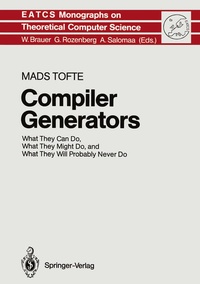
Compiler Generators
What They Can Do, What They Might Do, and What They Will Probably Never Do
Published on 5. October 2011
Book
Paperback/Softback
XI, 147 pages
978-3-642-64857-1 (ISBN)
Description
The OrIgIn of this monograph is a course entitled "Semantics directed Compiler Generation" which Professor Neil D. Jones gave in 1982 at Copenhagen University, where I was a student at the time. In this course, he described a compiler generator, called CERES, which he was developing. I immediately felt attracted to the unusual combination of mathematical reasoning about com pilers and the small intricate building blocks that made up the running system. As I came to understand the system I discovered that within the existing mathematical framework one could express compiler generation as a special case of compilation; this led to a specification of a compiler generator which was bootstrapped on itself resulting in a machine-generated compiler generator. The purpose of this monograph is to describe the CERES system we produced in 1983-84 and compare it with other systems, includ ing more recent ones. Also, it is as relevant today as it was then to discuss the role of compiler generators as an aid in the design and implementation of programming languages; this I do in Chap. 5. This monograph is a strongly revised version of the cando scient.
More details
Series
Edition
Softcover reprint of the original 1st ed. 1990
Language
English
Place of publication
Berlin
Germany
Publishing group
Springer Berlin
Target group
Professional and scholarly
Research
Illustrations
XI, 147 p.
Dimensions
Height: 242 mm
Width: 170 mm
Thickness: 10 mm
Weight
293 gr
ISBN-13
978-3-642-64857-1 (9783642648571)
DOI
10.1007/978-3-642-61504-7
Schweitzer Classification
Other editions
Additional editions
Mads Tofte
Compiler Generators
What They Can Do, What They Might Do, and What They Will Probably Never Do
Book
06/1990
Springer
€106.99
Shipment within 10-15 days
Content
1 Introduction.- 1.1 The Scope of This Monograph.- 2 Report on the Compiler Generator CERES.- 2.1 Overview of CERES.- 2.2 Description of Input to CERES.- 2.3 The Object Language T.- 2.4 The Compilers Generated by CERES.- 2.5 The Compiler Generator.- 2.6 Implementation and Experience.- 3 Compiler Generation, Composability, and Self-composability.- 3.1 Programming Languages and Compilers.- 3.2 The Compiler Generation Problem.- 3.3 Using a Semantic Language to Define Programming Languages.- 3.4 Composability and Self-composability.- 4 Discussion of Technical Aspects of Compiler Generation.- 4.1 The Algebraic Connection.- 4.2 On Choosing Good Semantic Languages.- 4.3 Interface Problems.- 5 On Semantics, Compiler Generation, and Hacking.- 5.1 On the Nature of Machine-Readable Language Definitions.- 5.2 On Writing Language Definitions.- 5.3 On the Role of Mathematical Proofs.- Appendix 1 The LOOP Interpretation.- Appendix 4 The SelfComposer.- References.- Table of Symbols and Their Meanings.