

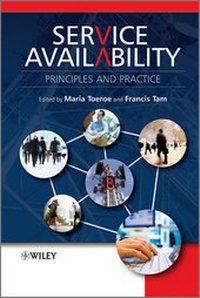
Service Availability
Principles and Practice
Will be published approx. on 19. April 2012
Book
Hardback
476 pages
978-1-119-95408-8 (ISBN)
Description
Our society increasingly depends on computer-based systems; the number of applications deployed has increased dramatically in recent years and this trend is accelerating. Many of these applications are expected to provide their services continuously. The Service Availability Forum has recognized this need and developed a set of specifications to help software designers and developers to focus on the value added function of applications, leaving the availability management functions for the middleware.
A practical and informative reference for the Service Availability Forum specifications, this book gives a cohesive explanation of the founding principles, motivation behind the design of the specifications, and the solutions, usage scenarios and limitations that a final system may have. Avoiding complex mathematical explanations, the book takes a pragmatic approach by discussing issues that are as close as possible to the daily software design/development by practitioners, and yet at a level that still takes in the overall picture. As a result, practitioners will be able to use the specifications as intended.
* Takes a practical approach, giving guidance on the use of the specifications to explain the architecture, redundancy models and dependencies of the Service Availability (SA) Forum services
* Explains how service availability provides fault tolerance at the service level
* Clarifies how the SA Forum solution is supported by open source implementations of the middleware
* Includes fragments of code, simple example and use cases to give readers a practical understanding of the topic
* Provides a stepping stone for applications and system designers, developers and advanced students to help them understand and use the specifications
More details
Product info
gebunden
Edition
1. Auflage
Language
English
Place of publication
New York
United States
Target group
College/higher education
Product notice
sewn/stitched
Cloth over boards
Dimensions
Height: 251 mm
Width: 175 mm
Thickness: 28 mm
Weight
885 gr
ISBN-13
978-1-119-95408-8 (9781119954088)
Schweitzer Classification
Other editions
Additional editions
E-Book
03/2012
Wiley
€99.99
Available for download
E-Book
02/2012
Wiley
€99.99
Available for download
Persons
Maria Toeroe, Ericsson, Canada
Maria Toeroe has been in the telecommunications industry for over 10 years conducting research and standardisation in the area of dependable software, service availability and fault tolerance utilizing the expertise she gained in her prior work in the academia related to formal description techniques and their use in protocol engineering. Having represented Ericsson in the Service Availability Forum since 2005, Maria has led several standardization efforts in different chair positions of the SA Forum Technical Work Group.? Within Ericsson she is also responsible for university collaborations related to her fields. She has been an Adjunct Associate Professor with the Department of Electrical and Computer Engineering of Concordia University since 2007. Maria holds a Diploma degree from the Institute of Engineering Economics Kharkov, a University Doctorate and a PhD from the Faculty of Electrical Engineering and Informatics of the Budapest University of Technology and Economics.
Francis Tam, Nokia, Finland
Francis Tam has conducted research, development and standardisation in the dependable software area of service availability and fault tolerance in the telecommunications industry for more than 16 years. He has served as industrial adviser to three European Commission funded projects on dependable computer systems and frequently gives lectures on highly available systems to the Master of Engineering students at INSA Lyon in France. Francis holds a BSc in Computer Science from Queen Mary College (University of London), an MSc in Computing Science from North Staffordshire Polytechnic and a Doctor of Science (Technology) in Software Systems from Tampere University of Technology in Finland.
Maria Toeroe has been in the telecommunications industry for over 10 years conducting research and standardisation in the area of dependable software, service availability and fault tolerance utilizing the expertise she gained in her prior work in the academia related to formal description techniques and their use in protocol engineering. Having represented Ericsson in the Service Availability Forum since 2005, Maria has led several standardization efforts in different chair positions of the SA Forum Technical Work Group.? Within Ericsson she is also responsible for university collaborations related to her fields. She has been an Adjunct Associate Professor with the Department of Electrical and Computer Engineering of Concordia University since 2007. Maria holds a Diploma degree from the Institute of Engineering Economics Kharkov, a University Doctorate and a PhD from the Faculty of Electrical Engineering and Informatics of the Budapest University of Technology and Economics.
Francis Tam, Nokia, Finland
Francis Tam has conducted research, development and standardisation in the dependable software area of service availability and fault tolerance in the telecommunications industry for more than 16 years. He has served as industrial adviser to three European Commission funded projects on dependable computer systems and frequently gives lectures on highly available systems to the Master of Engineering students at INSA Lyon in France. Francis holds a BSc in Computer Science from Queen Mary College (University of London), an MSc in Computing Science from North Staffordshire Polytechnic and a Doctor of Science (Technology) in Software Systems from Tampere University of Technology in Finland.
Content
List of Contributors xiii
Foreword xv
Preface xix
Acknowledgments xxv
List of Abbreviations xxvii
Part I INTRODUCTION TO SERVICE AVAILABILITY
1 Definitions, Concepts, and Principles 3
Francis Tam
1.1 Introduction 3
1.2 Why Service Availability? 4
1.3 Service Availability Fundamentals 6
1.4 Achieving Service Availability 13
1.5 Conclusion 20
2 The Birth of the Service Availability Forum 23
Francis Tam
2.1 Introduction 23
2.2 Technology Environment 23
2.3 Business Environment 24
2.4 The Service Availability Forum Era 27
2.5 Concluding Remarks 28
Part II THE SA FORUM SYSTEM: SERVICES AND FRAMEWORKS
3 Overview of the Service Availability Architecture 33
Dave Penkler
3.1 Introduction 33
3.2 HA Concepts Applied 39
3.3 Architecture 43
3.4 Open Issues 59
3.5 Conclusion 62
4 The SA Forum Information Model: The Heart of Control and Monitoring 63
Maria Toeroe
4.1 Introduction 63
4.2 Background 64
4.3 The SA Forum Information Model 67
4.4 Conclusion 83
5 Consistent and High Level Platform View 85
Maria Toeroe
5.1 Introduction 85
5.2 Hardware Platform Interface 86
5.3 Platform Management Service 96
5.4 Cluster Membership Service 121
5.5 Conclusion 131
6 Model Based Availability Management: The Availability Management Framework 133
Maria Toeroe
6.1 Introduction 133
6.2 Background 134
6.3 The Availability Management Framework 138
6.4 Conclusion 191
7 Communication and Synchronization Utilities 193
Maria Toeroe and Sayandeb Saha
7.1 Introduction 193
7.2 Event Service 194
7.3 Message Service 202
7.4 Checkpoint Service 212
7.5 Conclusion 223
8 Services Needed for System Management 227
Maria Toeroe
8.1 Introduction 227
8.2 Log Service 228
8.3 Notification Service 236
8.4 Information Model Management Service 247
8.5 Conclusion 262
9 Model-Based Software Management: The Software Management Framework 265
Maria Toeroe
9.1 Introduction 265
9.2 Background 266
9.3 Software Management a la Carte 268
9.4 Conclusion 294
10 Combining the Services 297
Maria Toeroe
10.1 Introduction 297
10.2 Application Design and Development 297
10.3 Application Platform Design 299
10.4 Operation and Maintenance 301
Part III SA FORUM MIDDLEWARE IN ACTION
11 SA Forum Programming Model and API Conventions 305
Francis Tam
11.1 Introduction 305
11.2 Programming Model 306
11.3 Making Sense of the API Specifications 312
11.4 Practical Topics 316
11.5 Concluding Remarks 322
12 SA Forum Java Mappings: Specifications, Usage, and Experience 325
Robert Hyerle and Jens Jensen
12.1 Introduction 325
12.2 Background 325
12.3 Understanding the Java Mappings 328
12.4 Using the Java Mappings 335
12.5 Going Further 343
13 SA Forum Middleware Implementations 347
Mario Angelic and Ulrich Kleber
13.1 Introduction 347
13.2 The OpenHPI Project 348
13.3 The OpenSAF Project 355
13.4 Conclusion 368
14 Integration of the VideoLAN Client with OpenSAF: An Example 371
Anik Mishra and Ali Kanso
14.1 Introduction 371
14.2 Going Under the Hood: The VLC Workflow 372
14.3 Integrating VLC with OpenSAF 373
14.4 Summary and Conclusion 387
15 Migration Paths for Legacy Applications 391
Mario Angelic
15.1 Introduction 391
15.2 Reasons for Migration 392
15.3 Integration Criteria 393
15.4 How to Migrate 399
15.5 Open Issues 413
15.6 Conclusion 413
16 Overcoming Complexity: Formal Modeling Techniques at the Rescue 415
Maria Toeroe and Ferhat Khendek
16.1 Introduction 415
16.2 Background 416
16.3 Model-Based Software Management 419
16.4 Conclusion 428
17 Conclusion 431
17.1 Summary 431
17.2 The Future 433
References 435
Index 443