

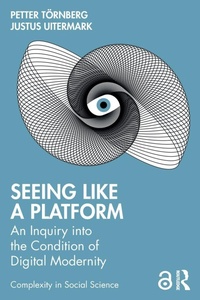
Seeing Like a Platform
An Inquiry into the Condition of Digital Modernity
1st Edition
Published on 29. January 2025
Book
Paperback/Softback
154 pages
978-1-032-35433-0 (ISBN)
Description
Power needs abstraction, to make the unwieldy complexity of the social world legible and manageable. The proposition at the heart of Seeing Like a Platform is that digital technology brings new metaphors through which power operates. While industrial modernity saw society as a machinery to be designed according to detailed blueprints, digital modernity views society as organic and alive, to be herded and nudged through digital infrastructures, AI, and algorithms.
Seeing Like a Platform explores the history, meaning, and far-reaching consequences of this epistemological shift. From social movements to Wikipedia, from digital platforms to city planning, from social science to media, society is being redefined by ideas from complexity science. While complexity offers a vision of a self-organized society freed from hierarchies and overbearing bureaucracies, it simultaneously enables new forms of domination and control.
Through theoretical reflections and case studies, Seeing Like a Platform offers an inquiry into digital modernity. Accessibly written and broad ranging, it is an essential reading for scholars, students, and practitioners in fields such as sociology, political science, urban studies, and technology studies. It will also interest anyone keen to understand the profound impact of digital technologies on governance, social organization, and everyday life.
The Open Access version of this book, available at http://www.taylorfrancis.com, has been made available under a Creative Commons Attribution (CC-BY) 4.0 license.
Seeing Like a Platform explores the history, meaning, and far-reaching consequences of this epistemological shift. From social movements to Wikipedia, from digital platforms to city planning, from social science to media, society is being redefined by ideas from complexity science. While complexity offers a vision of a self-organized society freed from hierarchies and overbearing bureaucracies, it simultaneously enables new forms of domination and control.
Through theoretical reflections and case studies, Seeing Like a Platform offers an inquiry into digital modernity. Accessibly written and broad ranging, it is an essential reading for scholars, students, and practitioners in fields such as sociology, political science, urban studies, and technology studies. It will also interest anyone keen to understand the profound impact of digital technologies on governance, social organization, and everyday life.
The Open Access version of this book, available at http://www.taylorfrancis.com, has been made available under a Creative Commons Attribution (CC-BY) 4.0 license.
More details
Series
Language
English
Place of publication
London
United Kingdom
Publishing group
Taylor & Francis Ltd
Target group
College/higher education
General and Postgraduate
Illustrations
9 s/w Abbildungen, 9 s/w Photographien bzw. Rasterbilder
9 Halftones, black and white; 9 Illustrations, black and white
Dimensions
Height: 234 mm
Width: 156 mm
Thickness: 9 mm
Weight
260 gr
ISBN-13
978-1-032-35433-0 (9781032354330)
Copyright in bibliographic data and cover images is held by Nielsen Book Services Limited or by the publishers or by their respective licensors: all rights reserved.
Schweitzer Classification
Other editions
Additional editions
Petter Toernberg | Justus Uitermark
Seeing Like a Platform
An Inquiry into the Condition of Digital Modernity
E-Book
01/2025
Routledge
€0.00
Available for download
Petter Toernberg | Justus Uitermark
Seeing Like a Platform
An Inquiry into the Condition of Digital Modernity
E-Book
01/2025
Routledge
€0.00
Available for download

Petter Toernberg | Justus Uitermark
Seeing Like a Platform
An Inquiry into the Condition of Digital Modernity
Book
01/2025
1st Edition
Routledge
€205.80
Shipment within 10-20 days
Persons
Petter Toernberg is Assistant Professor in Computational Social Science at the University of Amsterdam. He studies the intersection of AI, social media, and politics using computational methods and digital data for critical inquiry. His most recent book is Intimate Communities of Hate: Why Social Media Fuels Far-Right Extremism (with Anton Toernberg).
Justus Uitermark is a geographer and sociologist at the University of Amsterdam. He holds a chair in Urban Geography and directs the Amsterdam Institute for Social Science Research. Uitermark has written widely on cities, social movements, and digital platforms. His books include On Display: Instagram, the Self, and the City (with John Boy), Cities and Social Movements (with Walter Nicholls), and Dynamics of Power in Dutch Integration Politics.
Justus Uitermark is a geographer and sociologist at the University of Amsterdam. He holds a chair in Urban Geography and directs the Amsterdam Institute for Social Science Research. Uitermark has written widely on cities, social movements, and digital platforms. His books include On Display: Instagram, the Self, and the City (with John Boy), Cities and Social Movements (with Walter Nicholls), and Dynamics of Power in Dutch Integration Politics.
Content
1. Introduction
2. The social science of complexity
3. Complex cities: Longing for Wikitopia
4. Complex bureaucracies: Self-organization in Wikipedia
5. Complex media: The epistemology of digital capitalism
6. Complex contention: Anonymous' power dynamics
7. Digital Platforms: Complexity and power in the digital economy
8. Conclusion: The biopolitics of Artificial Intelligence
2. The social science of complexity
3. Complex cities: Longing for Wikitopia
4. Complex bureaucracies: Self-organization in Wikipedia
5. Complex media: The epistemology of digital capitalism
6. Complex contention: Anonymous' power dynamics
7. Digital Platforms: Complexity and power in the digital economy
8. Conclusion: The biopolitics of Artificial Intelligence