

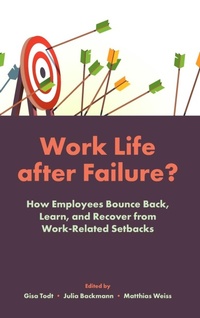
Work Life After Failure?
How Employees Bounce Back, Learn, and Recover from Work-Related Setbacks
Published on 28. April 2021
Book
Hardback
232 pages
978-1-83867-520-2 (ISBN)
Description
Work environments are paved with challenges and uncertainties that can result in the risk of setbacks and personal failure. Experiencing negative events such as these can be devastating for employees. This results in employees becoming distracted, detaching themselves from work and being unable to effectively engage in their work activities.
Work Life after Failure?: How Employees Bounce Back, Learn, and Recover from Work-Related Setbacks brings together the knowledge from three distinct concepts that currently lack integration: resilience, learning, and recovery. The authors regard resilience as the positive adaptation after adversity and examine aspects of learning from failure as a process of improvement through enhanced knowledge and understanding after negative professional experiences. The exploration of recovery is situated in the context of a process of reducing strain symptoms that were caused by work-related events. Together, these three concepts advance our understanding of how to effectively use personal resources to overcome the experience of failure and what organizations can do to support employees during these difficult times.
Encompassing both conceptual and empirical work from experts in the fields of resilience, learning from failure, and recovery, this book also sheds light on the classification of failures and setbacks and develops a measure of the setback severity.
Work Life after Failure?: How Employees Bounce Back, Learn, and Recover from Work-Related Setbacks brings together the knowledge from three distinct concepts that currently lack integration: resilience, learning, and recovery. The authors regard resilience as the positive adaptation after adversity and examine aspects of learning from failure as a process of improvement through enhanced knowledge and understanding after negative professional experiences. The exploration of recovery is situated in the context of a process of reducing strain symptoms that were caused by work-related events. Together, these three concepts advance our understanding of how to effectively use personal resources to overcome the experience of failure and what organizations can do to support employees during these difficult times.
Encompassing both conceptual and empirical work from experts in the fields of resilience, learning from failure, and recovery, this book also sheds light on the classification of failures and setbacks and develops a measure of the setback severity.
More details
Language
English
Place of publication
Bingley
United Kingdom
Target group
Professional and scholarly
Dimensions
Height: 235 mm
Width: 157 mm
Thickness: 17 mm
Weight
493 gr
ISBN-13
978-1-83867-520-2 (9781838675202)
Copyright in bibliographic data and cover images is held by Nielsen Book Services Limited or by the publishers or by their respective licensors: all rights reserved.
Schweitzer Classification
Other editions
Additional editions
Gisa Todt | Julia Backmann | Matthias Weiss
Work Life After Failure?
How Employees Bounce Back, Learn, and Recover from Work-Related Setbacks
E-Book
04/2021
1st Edition
Emerald Publishing Limited
€86.49
Available for download
Persons
Gisa Todt is a postdoctoral research fellow at the Institute for Leadership and Organization at Ludwig-Maximilians-University (LMU), and a lecturer at Campus M University in Munich.
Julia Backmann is an Assistant Professor in the University College Dublin School of Business. Her research focusses on collaboration and leadership in challenging environments.
Matthias Weiss holds the chair of innovation management and is head of the Center for Entrepreneurship, Innovation, and Transformation (CEIT) at Ruhr-University Bochum (RUB).
Julia Backmann is an Assistant Professor in the University College Dublin School of Business. Her research focusses on collaboration and leadership in challenging environments.
Matthias Weiss holds the chair of innovation management and is head of the Center for Entrepreneurship, Innovation, and Transformation (CEIT) at Ruhr-University Bochum (RUB).
Content
Chapter 1. Conceptualizing and Measuring the Severity of Setbacks at Work: An Event-Oriented Perspective; Julia Backmann, Matthias Weiss, and Gisa Todt
Part I. Recovery
Chapter 2: Building Psychological Resources and Resilience after Failure at Work: A Self-regulatory Perspective on Recovery and Personality Development in the Face of Setback Experiences; Stefan Diestel
Chapter 3: A Multilevel Perspective on the Emergence of Failures in Teams and Their (Dys)Functional Coping Through Vicious and Virtuous Circles of Cohesion; Stefan Razinskas
Chapter 4: The Rites of Passage of Business Failure: A Socialized Sensemaking Approach; Orla Byrne
Part II: Resilience
Chapter 5. Yes, We can Boost Resilience: Human Resource Management Practices to Build Resilience in the Workplace; Alma Rodriguez-Sanchez
Chapter 6. Resilience in the Goal Hierarchy: Strategy Change as a Form of Perseverance; Danielle D. King and Dominique Burrows
Chapter 7: The Moderating Role of Perceived Mistake Tolerance on the Relationship between Trait Resiliency and Turnover Intentions; Laurence G. Weinzimmer
Part III. Learning from Failure
Chapter 8: Identifying and Learning from Setbacks in Negotiations; Brooke A. Gazdag
Chapter 9: (Not) Learning from Failure? The Heavy Toll of Stigma on Entrepreneurs; Vivianna Fang He ad Gregor Kraehenmann
Chapter 10: How Collaborative Networks Fail, With the Implications for Participants Learning; Liisa Vaelikangas and Sirkka L. Jarvenpaa
Chapter 11. Integrating and Contrasting Research on Recovery, Resilience, and Learning in the Face of and after Work-Related Failure Experiences; Silja Hartmann
Part I. Recovery
Chapter 2: Building Psychological Resources and Resilience after Failure at Work: A Self-regulatory Perspective on Recovery and Personality Development in the Face of Setback Experiences; Stefan Diestel
Chapter 3: A Multilevel Perspective on the Emergence of Failures in Teams and Their (Dys)Functional Coping Through Vicious and Virtuous Circles of Cohesion; Stefan Razinskas
Chapter 4: The Rites of Passage of Business Failure: A Socialized Sensemaking Approach; Orla Byrne
Part II: Resilience
Chapter 5. Yes, We can Boost Resilience: Human Resource Management Practices to Build Resilience in the Workplace; Alma Rodriguez-Sanchez
Chapter 6. Resilience in the Goal Hierarchy: Strategy Change as a Form of Perseverance; Danielle D. King and Dominique Burrows
Chapter 7: The Moderating Role of Perceived Mistake Tolerance on the Relationship between Trait Resiliency and Turnover Intentions; Laurence G. Weinzimmer
Part III. Learning from Failure
Chapter 8: Identifying and Learning from Setbacks in Negotiations; Brooke A. Gazdag
Chapter 9: (Not) Learning from Failure? The Heavy Toll of Stigma on Entrepreneurs; Vivianna Fang He ad Gregor Kraehenmann
Chapter 10: How Collaborative Networks Fail, With the Implications for Participants Learning; Liisa Vaelikangas and Sirkka L. Jarvenpaa
Chapter 11. Integrating and Contrasting Research on Recovery, Resilience, and Learning in the Face of and after Work-Related Failure Experiences; Silja Hartmann