

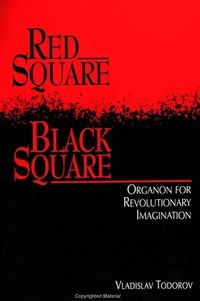
Red Square, Black Square
Organon for Revolutionary Imagination
Published on 22. November 1994
Book
Paperback/Softback
200 pages
978-0-7914-2192-5 (ISBN)
Description
This book builds a new vision of the development of Russian revolutionary culture, bringing together fiction, criticism, utopian projects, manifestos, performance and film theory, religious philosophy, and the imaginary space of communism centered around the Mummy of Lenin.
Revolution and modernization are two main issues of the book. The author argues that in Modernism the work of art was conceived as a miniature of the world to come; thus, art was meant to make projects, not master-pieces. He analyzes the genre of the manifesto as a special rhetorical device of modernist discourse and shows how projects of biological and social engineering elaborate a vision of a future human type apt to exist under unprecedented conditions.
Red Square, Black Square traces the process of totalitarian reduction of the modernist impulse into a rigid party doctrine. It follows the turbulent development of Russian Modernism through its categorical arrest under the official doctrine of "socialist realism." Moscow's Red Square is examined as a primal communist space that manifests the symbolism of power.
Viewing communism as an aesthetically, not economically, motivated society, the book enacts "political aesthetics" as a discipline that provides the fundamental tool for an adequate and thorough understanding of communism. Todorov concludes by discussing the rise of nationalism in Eastern Europe as a post-communist condition, and the new mission of the intellectuals.
Revolution and modernization are two main issues of the book. The author argues that in Modernism the work of art was conceived as a miniature of the world to come; thus, art was meant to make projects, not master-pieces. He analyzes the genre of the manifesto as a special rhetorical device of modernist discourse and shows how projects of biological and social engineering elaborate a vision of a future human type apt to exist under unprecedented conditions.
Red Square, Black Square traces the process of totalitarian reduction of the modernist impulse into a rigid party doctrine. It follows the turbulent development of Russian Modernism through its categorical arrest under the official doctrine of "socialist realism." Moscow's Red Square is examined as a primal communist space that manifests the symbolism of power.
Viewing communism as an aesthetically, not economically, motivated society, the book enacts "political aesthetics" as a discipline that provides the fundamental tool for an adequate and thorough understanding of communism. Todorov concludes by discussing the rise of nationalism in Eastern Europe as a post-communist condition, and the new mission of the intellectuals.
Reviews / Votes
"Because its postmodern approach echoes Baudrillard's own analyses of the economy of simulacra in Western societies, this book can serve as a solid basis for a comparative study of aesthetic and political productions both East and West. It can also be read as a "secret history" of modernism. Deliberately fragmentary and metaphorically charged, the book's form suits an exploration of the existential and political "ruins" of communism."- Marcel Cornis-Pope, Virginia Commonwealth UniversityMore details
Language
English
Place of publication
Albany, NY
United States
Target group
Professional and scholarly
US School Grade: College Graduate Student and over
Product notice
Paperback (trade)
Dimensions
Height: 224 mm
Width: 148 mm
Thickness: 13 mm
Weight
281 gr
ISBN-13
978-0-7914-2192-5 (9780791421925)
Copyright in bibliographic data and cover images is held by Nielsen Book Services Limited or by the publishers or by their respective licensors: all rights reserved.
Schweitzer Classification
Person
Vladislav Todorov is in the Department of Slavic Languages at the University of Pennsylvania, Philadelphia.
Content
Acknowledgments
Introduction: The Book of Quest and Conquest of the Past
Beginning
1. Revolutionary Merger of the Political and the Aesthetic
The Political Aesthetics of Modernization
Revolutionary Devices
2. Revolutionary Merger of Science and Art
The Plot of Modernism and Its Centers
On the Day After
Party Science vs. Political Art
The Hologram World
3. Induratio Spatii of the Revolution
Red/Black: Poetics of the Conspiratorial Space
The Appearance of the Whole is Figurative
Appendix: The Mummacrum of Power
4. Permutatio Publica
The Birth of the Mummy from the Spirit of Ideology
On the (Post)Conspiratorial Society
The Constitution of Social Integritas
The Dangerous Intellect
The End
References
Index
Introduction: The Book of Quest and Conquest of the Past
Beginning
1. Revolutionary Merger of the Political and the Aesthetic
The Political Aesthetics of Modernization
Revolutionary Devices
2. Revolutionary Merger of Science and Art
The Plot of Modernism and Its Centers
On the Day After
Party Science vs. Political Art
The Hologram World
3. Induratio Spatii of the Revolution
Red/Black: Poetics of the Conspiratorial Space
The Appearance of the Whole is Figurative
Appendix: The Mummacrum of Power
4. Permutatio Publica
The Birth of the Mummy from the Spirit of Ideology
On the (Post)Conspiratorial Society
The Constitution of Social Integritas
The Dangerous Intellect
The End
References
Index