

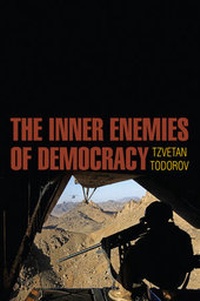
The Inner Enemies of Democracy
Will be published approx. on 5. September 2014
Book
Hardback
200 pages
978-0-7456-8574-8 (ISBN)
Description
The political history of the twentieth century can be viewed as the history of democracy's struggle against its external enemies: fascism and communism. This struggle ended with the fall of the Berlin Wall and the collapse of the Soviet regime. Some people think that democracy now faces new enemies: Islamic fundamentalism, religious extremism and international terrorism and that this is the struggle that will define our times. Todorov disagrees: the biggest threat to democracy today is democracy itself. Its enemies are within: what the ancient Greeks called 'hubris'.
Todorov argues that certain democratic values have been distorted and pushed to an extreme that serves the interests of dominant states and powerful individuals. In the name of 'democracy' and 'human rights', the United States and some European countries have embarked on a crusade to enlighten some foreign populations through the use of force. Yet this mission to 'help' others has led to Abu Ghraib and Guantanamo, to large-scale destruction and loss of life and to a moral crisis of growing proportions. The defence of freedom, if unlimited, can lead to the tyranny of individuals.
Drawing on recent history as well as his own experience of growing up in a totalitarian regime, Todorov returns to examples borrowed from the Western canon: from a dispute between Augustine and Pelagius to the fierce debates among Enlightenment thinkers to explore the origin of these perversions of democracy. He argues compellingly that the real democratic ideal is to be found in the delicate, ever-changing balance between competing principles, popular sovereignty, freedom and progress. When one of these elements breaks free and turns into an over-riding principle, it becomes dangerous: populism, ultra-liberalism and messianism, the inner enemies of democracy.
Reviews / Votes
One of the great intellectuals of our time. Stanley Hoffmann, Harvard University This is a voice to be listened to attentively, for our shared planetary home's and all its residents' sake. Zygmunt Bauman, University of Leeds Now, of all times, there is a need for cool heads, such as Todorov, who approaches the limits of free speech with admirable dexterity. The New York Review of Books A coherent, relevant work in which intelligence and sincere humanism do battle ? a world away from the slippery moralizing of intellectual fence-sitters. Le Nouvel Observateur Todorov's work is that of a sage, a man who has read the great texts, who has lived through two political regimes, and who dares to express an idea that may seem at odds with his fervent defence of freedom and democracy: freedom for its own sake, freedom that forgets its duties and responsibilities, is self-destructive. What he writes is never ordinary, but always tolerant and life affirming. L'EchoMore details
Other editions
Additional editions
Tzvetan Todorov
The Inner Enemies of Democracy
E-Book
06/2015
Polity Press
€14.99
Available for download
Tzvetan Todorov
The Inner Enemies of Democracy
E-Book
11/2014
Polity Press
€14.99
Available for download

Tzvetan Todorov
The Inner Enemies of Democracy
Book
09/2014
Polity Press
€36.08
Shipment within 15-20 days
Person
Content
CHAPTER 1. Democracy and its Discontents
The paradoxes of freedom
External and internal enemies
Democracy threatened by its own hubris
CHAPTER 2. An Ancient Controversy
The main characters
Pelagius: will and perfection
Augustine: the unconscious and original sin
The outcome of the debate
CHAPTER 3. Political Messianism
The revolutionary moment
The first wave: revolutionary and colonial wars
The second wave: the Communist project
The third wave: imposing democracy by bombs
The Iraq war
The internal damage: torture
The war in Afghanistan
The temptations of pride and power
The war in Libya: the decision
The war in Libya: the implementation
Idealists and realists
Politics in the face of morality and justice
CHAPTER 4. The Tyranny of Individuals
Protecting individuals
Explaining human behaviour
Communism and neoliberalism
The fundamentalist temptation
Neoliberalism's blind spots
Freedom and attachment
CHAPTER 5. The Effects of Individualism
Blame it on science?
The law retreats
Loss of meaning
Management techniques
The power of the media
Freedom of public speech
The limits of freedom
CHAPTER 6. Populism and Xenophobia
The rise of populism
Populist discourse
National identity
Down with multiculturalism: the German case
Britain and France
The debate about headscarves
One debate can hide another
Relations with foreigners
Living together better
CHAPTER 7. The Future of Democracy
Democracy, dream and reality
The enemy within us
Towards renewal?
NOTES