

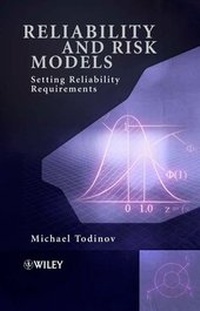
Reliability and Risk Models
Setting Reliability Requirements
1st Edition
Published on 19. April 2005
Book
Hardback
340 pages
978-0-470-09488-4 (ISBN)
Description
Presenting a radically new approach and technology for setting reliability requirements, this superb book also provides the first comprehensive overview of the M/F-FOP philosophy and its applications.
* Each chapter covers probabilistic models, statistical and numerical procedures, applications and/or case studies
* Comprehensively examines a new methodology for problem solving in the context of real reliability engineering problems
* All models have been implemented in C++
* The algorithms and programming code supplied can be used as a software toolbox for setting MFFOP
* Case studies are taken from the nuclear, automotive and offshore industry to provide 'real-world' applications.
* Each chapter covers probabilistic models, statistical and numerical procedures, applications and/or case studies
* Comprehensively examines a new methodology for problem solving in the context of real reliability engineering problems
* All models have been implemented in C++
* The algorithms and programming code supplied can be used as a software toolbox for setting MFFOP
* Case studies are taken from the nuclear, automotive and offshore industry to provide 'real-world' applications.
Reviews / Votes
"This well written book ranges widely over the field of reliability". (Insight, March 2006)More details
Edition
1., Auflage
Language
English
Place of publication
Chichester
United Kingdom
Publishing group
John Wiley and Sons Ltd
Target group
Professional and scholarly
Illustrations
Illustrations
Dimensions
Height: 22.9 cm
Width: 15.2 cm
Thickness: 2.5 cm
Weight
630 gr
ISBN-13
978-0-470-09488-4 (9780470094884)
Schweitzer Classification
Other editions
New editions
Book
11/2015
2nd Edition
Wiley
€155.50
Article not available at the moment
Content
Preface.
1. Some basic reliability concepts.
2. Common reliability and risk models and their applications.
3. Reliability and risk models based on mixture distributions.
4. Building reliability and risk models.
5. Load-Strength (Demand-Capacity) models.
6. Solving reliability and risk models using a Monte Carlo simulation.
7. Analysis of the properties of inhomogeneous media using Monte Carlo simulations.
8. Mechanisms of failure
9. Overstress reliability integral and damage factorisation law.
10. Determining the probability of failure for components containing flaws.
11. Uncertainty associated with the location of the ductile-to-brittle transition region of multi-run welds
12. Modelling the kinetics of deterioration of protective coatings due to corrosion.
13. Minimising the probability of failure of automotive suspension springs by delaying the fatigue failure mode.
14. Reliability governed by the relative locations of random variables in a finite domain.
15. Reliability dependent on the existence of minimum critical distances before the locations of random variables in a finite interval.
16. Reliability analysis and setting reliability requirements based on the cost of failure.
Appendices.
References.
1. Some basic reliability concepts.
2. Common reliability and risk models and their applications.
3. Reliability and risk models based on mixture distributions.
4. Building reliability and risk models.
5. Load-Strength (Demand-Capacity) models.
6. Solving reliability and risk models using a Monte Carlo simulation.
7. Analysis of the properties of inhomogeneous media using Monte Carlo simulations.
8. Mechanisms of failure
9. Overstress reliability integral and damage factorisation law.
10. Determining the probability of failure for components containing flaws.
11. Uncertainty associated with the location of the ductile-to-brittle transition region of multi-run welds
12. Modelling the kinetics of deterioration of protective coatings due to corrosion.
13. Minimising the probability of failure of automotive suspension springs by delaying the fatigue failure mode.
14. Reliability governed by the relative locations of random variables in a finite domain.
15. Reliability dependent on the existence of minimum critical distances before the locations of random variables in a finite interval.
16. Reliability analysis and setting reliability requirements based on the cost of failure.
Appendices.
References.