

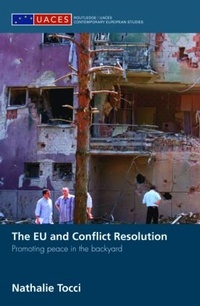
The EU and Conflict Resolution
Promoting Peace in the Backyard
1st Edition
Will be published approx. on 24. May 2007
Book
Hardback
208 pages
978-0-415-41394-7 (ISBN)
Description
Through the study of five ethno-political conflicts lying on or just beyond Europe's borders, this book analyzes the impact and effectiveness of EU foreign policy on conflict resolution.
Conflict resolution features strongly as an objective of the European Union's foreign policy. In promoting this aim, the EU's geographical focus has rested primarily in its beleaguered backyard to the south and to the east. Taking a strong comparative approach, Nathalie Tocci explores the principal determinants of conflict dynamics in Cyprus, Turkey, Serbia-Montenegro, Israel-Palestine and Georgia in order to assess the impact of EU contractual ties on them. The volume includes topical analyzis based on first-hand experience, in-depth interviews with all the relevant actors and photography in ongoing conflict areas in the Middle East, the Eastern Mediterranean, the Balkans and the Caucasus. This revealing study shows that the gap between EU potential and effectiveness often rests in the specific manner in which the EU collectively chooses to conduct its contractual relations.
The EU and Conflict Resolution will be of interest to all readers who wish to acquire an excellent understanding of the EU's impact on conflict contexts and will appeal to scholars of European politics, security studies and conflict resolution.
Conflict resolution features strongly as an objective of the European Union's foreign policy. In promoting this aim, the EU's geographical focus has rested primarily in its beleaguered backyard to the south and to the east. Taking a strong comparative approach, Nathalie Tocci explores the principal determinants of conflict dynamics in Cyprus, Turkey, Serbia-Montenegro, Israel-Palestine and Georgia in order to assess the impact of EU contractual ties on them. The volume includes topical analyzis based on first-hand experience, in-depth interviews with all the relevant actors and photography in ongoing conflict areas in the Middle East, the Eastern Mediterranean, the Balkans and the Caucasus. This revealing study shows that the gap between EU potential and effectiveness often rests in the specific manner in which the EU collectively chooses to conduct its contractual relations.
The EU and Conflict Resolution will be of interest to all readers who wish to acquire an excellent understanding of the EU's impact on conflict contexts and will appeal to scholars of European politics, security studies and conflict resolution.
More details
Series
Language
English
Place of publication
London
United Kingdom
Publishing group
Taylor & Francis Ltd
Target group
College/higher education
Illustrations
5 s/w Tabellen, 5 s/w Photographien bzw. Rasterbilder, 5 s/w Zeichnungen, 10 s/w Abbildungen
5 Tables, black and white; 5 Line drawings, black and white; 5 Halftones, black and white; 10 Illustrations, black and white
Dimensions
Height: 234 mm
Width: 156 mm
Weight
458 gr
ISBN-13
978-0-415-41394-7 (9780415413947)
Copyright in bibliographic data and cover images is held by Nielsen Book Services Limited or by the publishers or by their respective licensors: all rights reserved.
Schweitzer Classification
Other editions
Additional editions
Book
06/2008
1st Edition
Routledge
€76.94
Shipment within 15-20 days
E-Book
05/2007
Routledge
€64.49
Available for download
E-Book
05/2007
Routledge
€64.49
Available for download
Person
Nathalie Tocci is a Senior Fellow at the Istituto Affari Internazionali, Rome, Italy.
Content
1. Introduction 2. The EU's Role in Conflict Resolution: A Framework of Analysis 3. The Missed Opportunity to Promote Reunification in Cyprus 4. Ebbs and Flows in the Europeanization of Turkey's Kurdish Question 5. Mixed Signals to Serbia and Montenegro 6. The Glaring Gap between Rhetoric and Reality in the Israeli-Palestinian Conflict 7. Caught Between Neglect and Competing Mediation in Georgia's Secessionist Conflicts 8. Comparing the EU's Role in Neighbourhood Conflicts 9. Conclusions