

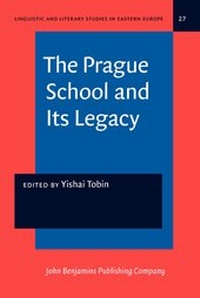
The Prague School and Its Legacy
Published on 1. January 1988
Book
Hardback
317 pages
978-90-272-1532-1 (ISBN)
Description
Many of the fundamental ideas of the classical Prague School have guided or inspired much of the interdisciplinary post World War II research in linguistics, literary theory, semiotics, folklore and the arts. The Prague School promoted a humanistic and functional Leitmotiv of language as an open, flexible, adaptable, and abstract system of systems used by human beings to communicate. This hommage to the Prague School presents papers in five areas of research:- Prague School phonology and its theoretical and methodological implications, - The Prague School and functional discourse analysis, - The Prague School and aspects of literary criticism, - The sociological and ethnographical concerns of the Prague School, - The Prague School's semiotic approach to the arts.
More details
Series
Language
English
Place of publication
Amsterdam
Netherlands
Target group
College/higher education
Professional and scholarly
Dimensions
Height: 245 mm
Width: 164 mm
Weight
570 gr
ISBN-13
978-90-272-1532-1 (9789027215321)
Copyright in bibliographic data and cover images is held by Nielsen Book Services Limited or by the publishers or by their respective licensors: all rights reserved.
Schweitzer Classification
Other editions
Additional editions
Yishai Tobin
The Prague School and Its Legacy
In Linguistics, Literature, Semiotics, Folklore and the Arts
E-Book
01/1988
1st Edition
John Benjamins Publishing Company
€149.99
Available for download
Content
1. Contributors; 2. Introduction (by Tobin, Yishai); 3. I. Prague school phonology and its theoretical and methodological implications; 4. Functional load and diachronic phonology (by Catford, John C.); 5. Distinctive features in synchronic and diachronic phonology (by Liberman, Anatoly); 6. From segments to autosegments: Nasalization in Sudanese (by Vago, Robert M.); 7. Phonetics versus phonology: The prague school and beyond (by Tobin, Yishai); 8. II. The Prague school and functional discourse analysis; 9. The discoursal iz of Yiddish (by Kahan-Newman, Zelda); 10. Frequency in communicative perspective: Some word order phenomena in Spanish (by Putte, Florimon C.M. van); 11. Paradigmatic structure and syntactic relations (by Schooneveld, Cornelis H. van); 12. Word order in children's literature: FSP and markedness (by Ziv, Yael); 13. Topic-chaining and dominance chaining (by Erteschik-Shir, Nomi); 14. The theme in text cohesion (by Kurzon, Dennis); 15. III. The Prague school and aspects of literary criticism; 16. Literary transduction: Prague school approach (by Dolezel, Lubomir); 17. Dominant = tonic + dominant (by Arie-Gaifman, Hana); 18. James Joyce and the Prague school: Aesthetic foregrouding in Finnegan's Wake (by Henke, S.A.); 19. Objective features of text-analysis according to Mukarovsky (by Moked, G.); 20. Phonology as a pattern of analysis: The deep message of the thrillers by Ambrose Bierce (by Langleben, Maria M.); 21. IV. The sociological and ethnological concerns of the Prague school; 22. The sociological concerns of the Prague school (by Matejka, Ladislav); 23. From folklore to folkstyle: The Prague circle's contribution to the ethnoinquiries (by Kaplan, Charles D.); 24. The relevance of structuralism to the study of nonverbal behavior (by Raffler-Engel, Walburga von); 25. V. The Prague school's semiotic approach to the arts; 26. The dialectic functioning of Mukarovsky's semiotic model (by Gandelman, Claude); 27. A chair is a chair is a CHAIR: The object as sign in the theatrical performance (by Rokem, F.); 28. Semiotics of the theatre: The Prague school heritage (by Pladott, Dinnah); 29. Name index; 30. Subject index