

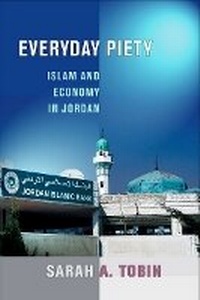
Everyday Piety
Islam and Economy in Jordan
Published on 4. February 2016
Book
Hardback
248 pages
978-1-5017-0045-3 (ISBN)
Description
Working and living as an authentic Muslim-comporting oneself in an Islamically appropriate way-in the global economy can be very challenging. How do middle-class Muslims living in the Middle East navigate contemporary economic demands in a distinctly Islamic way? What are the impacts of these efforts on their Islamic piety? To what authority does one turn when questions arise? What happens when the answers vary and there is little or no consensus? To answer these questions, Everyday Piety examines the intersection of globalization and Islamic religious life in the city of Amman, Jordan.
Drawing on in-depth ethnographic fieldwork in Amman, Sarah A. Tobin demonstrates that Muslims combine their interests in exerting a visible Islam with the opportunities and challenges of advanced capitalism in an urban setting, which ultimately results in the cultivation of a "neoliberal Islamic piety." Neoliberal piety, Tobin contends, is created by both Islamizing economic practices and economizing Islamic piety, and is done in ways that reflect a modern, cosmopolitan style and aesthetic, revealing a keen interest in displays of authenticity on the part of the actors. Tobin highlights sites at which economic life and Islamic virtue intersect: Ramadan, the hijab, Islamic economics, Islamic banking, and consumption. Each case reflects the shift from conditions and contexts of highly regulated and legalized moral behaviors to greater levels of uncertainty and indeterminacy. In its ethnographic richness, this book shows that actors make normative claims of an authentic, real Islam in economic practice and measure them against standards that derive from Islamic law, other sources of knowledge, and the pragmatics of everyday life.
Drawing on in-depth ethnographic fieldwork in Amman, Sarah A. Tobin demonstrates that Muslims combine their interests in exerting a visible Islam with the opportunities and challenges of advanced capitalism in an urban setting, which ultimately results in the cultivation of a "neoliberal Islamic piety." Neoliberal piety, Tobin contends, is created by both Islamizing economic practices and economizing Islamic piety, and is done in ways that reflect a modern, cosmopolitan style and aesthetic, revealing a keen interest in displays of authenticity on the part of the actors. Tobin highlights sites at which economic life and Islamic virtue intersect: Ramadan, the hijab, Islamic economics, Islamic banking, and consumption. Each case reflects the shift from conditions and contexts of highly regulated and legalized moral behaviors to greater levels of uncertainty and indeterminacy. In its ethnographic richness, this book shows that actors make normative claims of an authentic, real Islam in economic practice and measure them against standards that derive from Islamic law, other sources of knowledge, and the pragmatics of everyday life.
Reviews / Votes
Through her examination of Islamic banking, Tobin explores the role that piety plays in the commercial interactions of middle-class Muslims in Jordan's capital, Amman.... Her stylish, ambitious, and pragmatic interlocutors undermine any stale conceptions readers might have of contemporary Muslims, and her treatment of the workplace as a space where moral debates are negotiated points to the social significance of work relationships and their related social dynamics. The book's accessible and sensitive treatment of urban Jordanians and the role of morality in their economic choices make it a fine choice for students as well as scholars interested in the topics of work, identity, religion, and global finance.- Susan MacDougall, Oxford University (Anthropology of Work Review) Provides vivid insight into people's complex engagements with piety across a range of contexts.... Its subject matter, theoretical sophistication, and detailed fieldwork make this book a valuable resource for scholars and students of the Middle East, economic anthropology, and the anthropology of Islam.
(Contemporary Islam)
More details
Language
English
Place of publication
Ithaca
United States
Target group
College/higher education
Product notice
Paper over boards
Illustrations
10 halftones - 10 Halftones, black and white
Dimensions
Height: 229 mm
Width: 152 mm
Thickness: 24 mm
Weight
907 gr
ISBN-13
978-1-5017-0045-3 (9781501700453)
Copyright in bibliographic data and cover images is held by Nielsen Book Services Limited or by the publishers or by their respective licensors: all rights reserved.
Schweitzer Classification
Other editions
Additional editions
E-Book
02/2016
Cornell University Press
€23.49
Available for download
Person
Sarah A. Tobin is the Associate Director of Middle East Studies at Brown University.
Content
1 A Muslim Plays the Slot Machines
2 The History of Amman: "I Don't Recognize It Anymore"
3 Making It Meaningful: Ramadan
4 Love, Sex, and the Market: The Hijab
5 Making It Real: Adequation
6 Uncertainty Inside the Islamic Bank: "Is This the Real Islam?"
7 Consuming Islamic Banking: "They Say They're Islamic, So They Are."
8 Branding Islam: Jordan's Arab Spring, Middle Class, and Islam
2 The History of Amman: "I Don't Recognize It Anymore"
3 Making It Meaningful: Ramadan
4 Love, Sex, and the Market: The Hijab
5 Making It Real: Adequation
6 Uncertainty Inside the Islamic Bank: "Is This the Real Islam?"
7 Consuming Islamic Banking: "They Say They're Islamic, So They Are."
8 Branding Islam: Jordan's Arab Spring, Middle Class, and Islam