

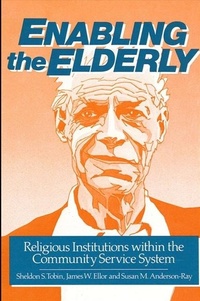
Enabling the Elderly
Religious Institutions within the Community Service System
Published on 30. November 1986
Book
Paperback/Softback
192 pages
978-0-88706-335-0 (ISBN)
Description
Here three gerontological professionals have combined their diverse backgrounds in a timely and urgently needed study of how religious institutions interact with their communities to provide care for the elderly. In an easily accessible and well-written text, actual and potential services are described, and ways of enhancing religious/agency collaboration are suggested. Data are presented from studies in four communities and in a variety of provider settings.
The book begins with an overview of aging in modern society, followed by a discussion of the vital importance of spiritual well-being for elderly women and men today. The authors show how church and synagogue can provide services for elderly persons, highlighting ways in which intentions can be translated into programs.
A second section identifies diverse categories of elderly persons in the community and their physical, social, emotional, and spiritual needs. It suggests opportunities for religious organizations to address these needs, particularly through collaboration with service agencies. Programs currently provided by synagogues and churches are detailed.
A final section examines the benefits of institutions working together with service agencies on potential problem areas. It provides ways to enhance the partnership-from simple communication, to cooperation, coordination, collaboration, and even confederation.
The book concludes with a useful model, developed from the authors' original research, that can enhance interaction between churches and synagogues, and service agencies.
The book begins with an overview of aging in modern society, followed by a discussion of the vital importance of spiritual well-being for elderly women and men today. The authors show how church and synagogue can provide services for elderly persons, highlighting ways in which intentions can be translated into programs.
A second section identifies diverse categories of elderly persons in the community and their physical, social, emotional, and spiritual needs. It suggests opportunities for religious organizations to address these needs, particularly through collaboration with service agencies. Programs currently provided by synagogues and churches are detailed.
A final section examines the benefits of institutions working together with service agencies on potential problem areas. It provides ways to enhance the partnership-from simple communication, to cooperation, coordination, collaboration, and even confederation.
The book concludes with a useful model, developed from the authors' original research, that can enhance interaction between churches and synagogues, and service agencies.
More details
Series
Language
English
Place of publication
Albany, NY
United States
Target group
Professional and scholarly
US School Grade: College Graduate Student and over
Product notice
Paperback (trade)
Dimensions
Height: 229 mm
Width: 152 mm
Thickness: 25 mm
Weight
286 gr
ISBN-13
978-0-88706-335-0 (9780887063350)
Copyright in bibliographic data and cover images is held by Nielsen Book Services Limited or by the publishers or by their respective licensors: all rights reserved.
Schweitzer Classification
Persons
Sheldon S. Tobin, Ph. D. , is Director of the Ringel Institute of Gerontology, Albany, New York. James W. Ellor, D. Min., A.C.S.W. , is Associate Professor, National School of Education, Evanston, Illinois. Susan M. Anderson-Ray, A. M. , is Assistant Director of Social Services at the Judson Retirement Community, Cleveland Heights, Ohio.