

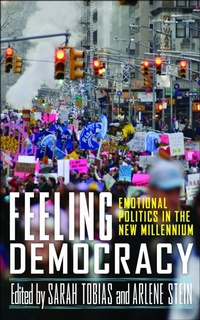
Feeling Democracy
Emotional Politics in the New Millennium
Published on 14. June 2024
Book
Paperback/Softback
250 pages
978-1-9788-3545-0 (ISBN)
Description
Cultural critic Lauren Berlant wrote that "politics is always emotional," and her words hold especially true for politics in the twenty-first century. From Obama to Trump, from Black Lives Matter to the anti-abortion movement, politicians and activists appeal to hope, fear, anger, and pity, all amplified by social media.
The essays in Feeling Democracy examine how both reactionary and progressive politics are driven largely by emotional appeals to the public. The contributors in this collection cover everything from immigrants' rights movements to white nationalist rallies to show how solidarities forged around gender, race, and sexuality become catalysts for a passionate democratic politics. Some essays draw parallels between today's activist strategies and the use of emotion in women-led radical movements from the 1960s and 1970s, while others expand the geographic scope of the collection by considering Asian decolonial politics and Egyptian pro-democracy protests.
Incorporating scholarship from fields as varied as law, political science, philosophy, psychoanalysis, and history, Feeling Democracy considers how emotional rhetoric in politics can be a double-edged sword-often wielded by authoritarian populists who seek to undermine democracy but sometimes helping to bring about a genuine renewal of participatory democracy.
The essays in Feeling Democracy examine how both reactionary and progressive politics are driven largely by emotional appeals to the public. The contributors in this collection cover everything from immigrants' rights movements to white nationalist rallies to show how solidarities forged around gender, race, and sexuality become catalysts for a passionate democratic politics. Some essays draw parallels between today's activist strategies and the use of emotion in women-led radical movements from the 1960s and 1970s, while others expand the geographic scope of the collection by considering Asian decolonial politics and Egyptian pro-democracy protests.
Incorporating scholarship from fields as varied as law, political science, philosophy, psychoanalysis, and history, Feeling Democracy considers how emotional rhetoric in politics can be a double-edged sword-often wielded by authoritarian populists who seek to undermine democracy but sometimes helping to bring about a genuine renewal of participatory democracy.
Reviews / Votes
"'Feeling democracy' sounds like a paradoxical practice as the normative foundation of liberal democracy is rationality. This book gives profound argumentations and examples to disentangle the emotional power dynamics in democracies from a global feminist and intersectional perspective. 'Feeling democracy' is especially important in times of right-wing challenges to liberal democracy and right-wing antagonistic affective mobilization across the globe." - Birgit Sauer (co-author of Governing Affects: Neoliberalism, Neo-Bureaucracies, and Service Work) "The need to think about feelings as being political is more urgent than ever, and this very smart collection of feminist essays deftly tracks past the persistent assumption that emotions undermine democracy. Feeling Democracy instead works with feelings, both good and bad, in order to offer timely insights for the current moment and new conceptions of what democracy looks-and feels-like." - Ann Cvetkovich (author of Depression: A Public Feeling)More details
Series
Language
English
Place of publication
New Brunswick NJ
United States
Target group
College/higher education
Professional and scholarly
Product notice
Paperback (trade)
Unsewn / adhesive bound
Illustrations
0 images
Dimensions
Height: 200 mm
Width: 125 mm
Thickness: 14 mm
Weight
260 gr
ISBN-13
978-1-9788-3545-0 (9781978835450)
Copyright in bibliographic data and cover images is held by Nielsen Book Services Limited or by the publishers or by their respective licensors: all rights reserved.
Schweitzer Classification
Other editions
Additional editions
E-Book
06/2024
1st Edition
Rutgers University Press
€76.99
Available for download
Persons
SARAH TOBIAS is executive director of the Institute for Research on Women at Rutgers University and affiliate faculty in the Women's, Gender, and Sexuality Studies department. She is the co-editor of Trans Studies: The Challenge to Hetero/Homo Normativites and Perils of Populism (Rutgers University Press).
ARLENE STEIN is distinguished professor of sociology at Rutgers University. She is the author or editor of nine books, including Unbound: Transgender Men and the Remaking of Identity and The Stranger Next Door: The Story of a Small Community's Battle Over Sex, Faith and Civil Rights.
ARLENE STEIN is distinguished professor of sociology at Rutgers University. She is the author or editor of nine books, including Unbound: Transgender Men and the Remaking of Identity and The Stranger Next Door: The Story of a Small Community's Battle Over Sex, Faith and Civil Rights.
Content
Introduction - Sarah Tobias and Arlene Stein
Chapter 1: Social Movements and Emotion Cultures: Learning from the Undocumented Immigrants' Movement - Kathy Abrams
Chapter 2: "The Women of Egypt are a Red Line": Anger and Women's Collective Action - Nermin Allam
Chapter 3: Our Paranoid Politics - NoElle McAfee
Chapter 4: The Political Branding of COVID-19 - Ciara Torres-Spelliscy
Chapter 5: Towards a Decolonial Democracy: Rageful Hope in the 1961 and 1972 Afro-Asian Women's Conferences - Kirin Gupta
Chapter 6: "The Kind of World We Wanted to Be In": "Protocol Feminism" and Participatory Democracy in Intersectional Consciousness-Raising Groups - Ileana Nachescu
Acknowledgments
Notes on Contributors
Index
Chapter 1: Social Movements and Emotion Cultures: Learning from the Undocumented Immigrants' Movement - Kathy Abrams
Chapter 2: "The Women of Egypt are a Red Line": Anger and Women's Collective Action - Nermin Allam
Chapter 3: Our Paranoid Politics - NoElle McAfee
Chapter 4: The Political Branding of COVID-19 - Ciara Torres-Spelliscy
Chapter 5: Towards a Decolonial Democracy: Rageful Hope in the 1961 and 1972 Afro-Asian Women's Conferences - Kirin Gupta
Chapter 6: "The Kind of World We Wanted to Be In": "Protocol Feminism" and Participatory Democracy in Intersectional Consciousness-Raising Groups - Ileana Nachescu
Acknowledgments
Notes on Contributors
Index