

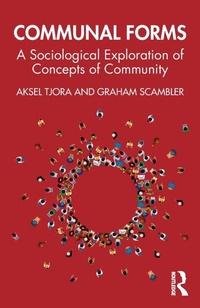
Communal Forms
A Sociological Exploration of Concepts of Community
1st Edition
Published on 15. April 2020
Book
Paperback/Softback
164 pages
978-0-367-43892-0 (ISBN)
Description
Drawing on a wide range of social theory, as well as empirical inputs from studies of work, neighbourhoods, events, meeting places and online self-help groups, this book suggests that communal forms are constructed on the basis of communicative, material, biographic-cultural, practice-based, and situational layers. The concept of community has long provided an important point of departure for the discipline of sociology, with the conflicting conceptions of community before and into modernity embodied in Ferdinand Toennies' Gemeinschaft and Gesellschaft and in Emile Duerkheim's Mechanical and Organic Solidarity, providing the focus for debate. Other contributors have maintained an interest in communities as communions, interactional competencies, symbolic identification, tribal connection, and more recently communication. Drawing on such theoretical contributions, as well as empirical inputs, the authors develop a more nuanced concept of community, based on the notion that it is constructed from several different layers. This concept is then presented as a sociological toolbox with which to fuel approaches to examining societal challenges and change. Providing a fresh approach to a core sociological question that also has a wider societal relevance, Communal Forms will be of interest to scholars and students concerned with social issues, and for those with a more general interest in community, society and its development over time.
Reviews / Votes
"In Communal Forms Aksel Tjora and Graham Scambler take us on a sociological journey into the meaning and significance of 'community' in the contemporary context. They masterfully traverse and weave together key social theories on this critical topic and draw from an extraordinarily diverse and intriguing series of case studies to illuminate the highly diversified communal forms of the 21st Century. This is a book for our time, where the need to understand the power of community, has never been more acute." - Alex Broom, The University of Sydney, Australia"The question of community becomes relevant anew with each social shift and transformation, and at the heart of this important book lies a concern with the quality of human life. Writing in a clear and engaging manner, Tjora and Scambler investigate the nuances of community as it is theorised and lived. A key strength of the book is the authors' knack for bringing to life insights from key sociological theories of community with the help of contemporary empirical examples from a rich variety of contexts and settings, including co-working spaces, rock festivals and online self-help groups." - Vanessa May, University of Manchester, UK
More details
Language
English
Place of publication
London
United Kingdom
Publishing group
Taylor & Francis Ltd
Target group
College/higher education
Illustrations
1 s/w Tabelle
1 Tables, black and white
Dimensions
Height: 198 mm
Width: 129 mm
Thickness: 10 mm
Weight
194 gr
ISBN-13
978-0-367-43892-0 (9780367438920)
Copyright in bibliographic data and cover images is held by Nielsen Book Services Limited or by the publishers or by their respective licensors: all rights reserved.
Schweitzer Classification
Other editions
Additional editions
Book
04/2020
1st Edition
Routledge
€191.50
Shipment within 15-20 days
E-Book
03/2020
1st Edition
Routledge
€55.49
Available for download
E-Book
03/2020
1st Edition
Routledge
€55.49
Available for download
Persons
Aksel Tjora is Professor of Sociology at the Norwegian University of Science and Technology (NTNU) and founder and director of the Sociology Clinic in Trondheim.
Graham Scambler is Emeritus Professor of Sociology at UCL, and a Visiting Professor of Sociology at Surrey University.
Graham Scambler is Emeritus Professor of Sociology at UCL, and a Visiting Professor of Sociology at Surrey University.
Content
1. The Phenomenon of Community 2. Community as Solidarity 3. Community as Integration 4. Community as Interaction 5. Community as Identification 6. Community as Communication 7. Community as Work 8. Community as Proximity 9. Community as Possibility