


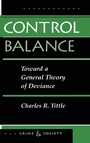
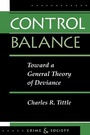
Control Balance
Toward A General Theory Of Deviance
1st Edition
Published on 2. November 1995
Book
Hardback
336 pages
978-0-8133-2631-3 (ISBN)
Description
Proposing an integrated theory of deviance, this book takes as its central premise that the total amount of control to which people are subjected, relative to the control they can exercise, will affect the probability and type of their deviant behaviour. The author reviews general theories such as anomie, Marxian conflict, social control, differential association/social learning, labelling, and routine activities, and suggests reasons why those theories are insufficient. Using real-world examples, he contends that deviance results from the convergence of four variables (disposition, motivation, opportunity and constraint), each of which represents an interactive nexus of several inputs - including, most prominently, a control imbalance. Control-balance theory also explains six basic types of deviance, ranging from predation, defiance and submissiveness at one end of a control-ratio continuum, to exploitation, plunder and decadence at the other.
More details
Language
English
Place of publication
United States
Publishing group
Taylor & Francis Inc
Target group
College/higher education
Professional and scholarly
Dimensions
Height: 229 mm
Width: 152 mm
ISBN-13
978-0-8133-2631-3 (9780813326313)
Copyright in bibliographic data is held by Nielsen Book Services Limited or its licensors: all rights reserved.
Schweitzer Classification
Other editions
Additional editions
Book
08/2019
1st Edition
Routledge
€207.00
Shipment within 15-20 days
E-Book
02/2018
Routledge
€72.49
Available for download
E-Book
02/2018
1st Edition
Routledge
€72.49
Available for download
Book
10/1995
1st Edition
Westview Press Inc
€79.10
Shipment within 10-20 days
Content
The problem with simple theories; features of adequate theory; conventional methods of theory building; theoretical integration; what is to be explained; the concepts of control-balance theory; the causal process of control-balance theory; contingencies for the central causal process; compatibility of the theory with the evidence; integration and critique.