

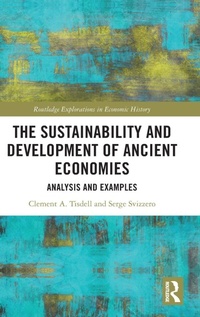
The Sustainability and Development of Ancient Economies
Analysis and Examples
1st Edition
Published on 7. July 2023
Book
Hardback
250 pages
978-1-032-27799-8 (ISBN)
Description
Drawing on modern economic theory, this book provides new insights into the economic development of ancient economies and the sustainability of their development. The book pays particular attention to the economics of hunting and gathering societies and their diversity. New ideas are presented about theories of the transition from hunting and gathering to agriculture, including Childe's theory of this development. The Agricultural Revolution was a major contributor to economic development because in most cases, it generated an economic surplus. However, as shown, income inequality was a necessary condition for the use of this surplus to promote economic development and to avoid the Malthusian population trap. This inequality was evident in the successful operation of the palatial economies of the Minoan and Mycenaean states. Nevertheless, some post-agricultural economies proved to be unsustainable, and they "mysteriously" disappeared. This happened in the case of the Silesian Unetice culture and population. Economic and ecological reasons for this are suggested. The nature of economic development altered with increased trade, the use of barter, and subsequently the supply of money to facilitate this trade. These developments are examined in the context of the palatial economies of Mesopotamia and Egypt. Elsewhere, multinational business made a substantial contribution to the economic growth of Phoenicia, where international trade was not determined by its natural resource endowments. Thus, Phoenician economic exchange and development provides a different set of insights. The book makes an important contribution to the understanding of the evolution of human societies and will therefore be of interdisciplinary interest including economists (especially economic historians), anthropologists and sociologists, some archaeologists, and historians.
More details
Series
Language
English
Place of publication
London
United Kingdom
Publishing group
Taylor & Francis Ltd
Target group
College/higher education
Academic and Postgraduate
Illustrations
13 s/w Abbildungen, 13 s/w Zeichnungen, 1 s/w Tabelle
1 Tables, black and white; 13 Line drawings, black and white; 13 Illustrations, black and white
Dimensions
Height: 240 mm
Width: 161 mm
Thickness: 19 mm
Weight
555 gr
ISBN-13
978-1-032-27799-8 (9781032277998)
Copyright in bibliographic data and cover images is held by Nielsen Book Services Limited or by the publishers or by their respective licensors: all rights reserved.
Schweitzer Classification
Other editions
Additional editions
Clement A. Tisdell | Serge Svizzero
The Sustainability and Development of Ancient Economies
Analysis and Examples
Book
12/2024
1st Edition
Routledge
€63.40
Shipment within 10-20 days
Clement A. Tisdell | Serge Svizzero
The Sustainability and Development of Ancient Economies
Analysis and Examples
E-Book
07/2023
1st Edition
Routledge
€55.49
Available for download
Clement A. Tisdell | Serge Svizzero
The Sustainability and Development of Ancient Economies
Analysis and Examples
E-Book
07/2023
1st Edition
Routledge
€55.49
Available for download
Persons
Clement A. Tisdell is Professor Emeritus of the School of Economics at the University of Queensland, Australia.
Serge Svizzero is Professor in the Faculte de Droit et d'Economie at the Universite de La Reunion, France.
Serge Svizzero is Professor in the Faculte de Droit et d'Economie at the Universite de La Reunion, France.
Content
1. An Overview of Our Perspectives on the Economic Development and Sustainability of Ancient Societies PART I: ECONOMICS OF HUNTING AND GATHERING SOCIETIES 2.Stages of Early Economic Development: Economic Evolution and the Diversity of Societies 3. Traditional Economies of Australian Aborigines - Their Sustainability, Desirability and Sahlins' Hypothesis 4. The Sustainability and Economic Development Options of Foragers: New Economic Analysis 5. The Lengthy Endurance of Hunting and Gathering Economies PART II: THE AGRICULTURAL REVOLUTION: THE TRANSITION TO AND THE ESTABLISHMENT OF AGRICULTURE 6. A Reconsideration of Theories about the Commencement of Agriculture and New Suggestions 7. Alternatives to and a Critique of Economic Optimization Theories as a Determinant of the Transition to Agriculture 8. Contemporary Thought and Childe's Theory of Economic Development and the Agricultural Revolution PART III: EVOLUTION OF EARLY ECONOMIES AFTER THE COMMENCEMENT OF AGRICULTURE 9. Analysis of Why Some Agrarian Societies Avoided the Malthusian Trap and Developed 10. Economic and Ecological Reasons Why the Silesian Unetice Population Disappeared 11. The Palatial Economic Development of Minoan and Mycenaean States 12. Barter and the Origins of Money: Insights from the Ancient Palatial Economies of Mesopotamia and Egypt 13. Phoenicia: Its Economic Development Before its use of Coinage