

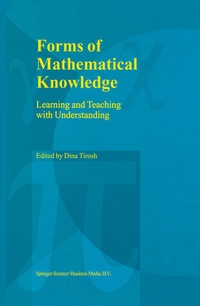
Forms of Mathematical Knowledge
Learning and Teaching with Understanding
Published on 1. December 2010
Book
Paperback/Softback
IV, 252 pages
978-90-481-5330-5 (ISBN)
Description
What mathematics is entailed in knowing to act in a moment? Is tacit, rhetorical knowledge significant in mathematics education? What is the role of intuitive models in understanding, learning and teaching mathematics? Are there differences between elementary and advanced mathematical thinking? Why can't students prove? What are the characteristics of teachers' ways of knowing?
This book focuses on various types of knowledge that are significant for learning and teaching mathematics. The first part defines, discusses and contrasts psychological, philosophical and didactical issues related to various types of knowledge involved in the learning of mathematics. The second part describes ideas about forms of mathematical knowledge that are important for teachers to know and ways of implementing such ideas in preservice and in-service education.
The chapters provide a wide overview of current thinking about mathematics learning and teaching which is of interest for researchers in mathematics education and mathematics educators.
Topics covered include the role of intuition in mathematics learning and teaching, the growth from elementary to advanced mathematical thinking, the significance of genres and rhetoric for the learning of mathematics and the characterization of teachers' ways of knowing.
This book focuses on various types of knowledge that are significant for learning and teaching mathematics. The first part defines, discusses and contrasts psychological, philosophical and didactical issues related to various types of knowledge involved in the learning of mathematics. The second part describes ideas about forms of mathematical knowledge that are important for teachers to know and ways of implementing such ideas in preservice and in-service education.
The chapters provide a wide overview of current thinking about mathematics learning and teaching which is of interest for researchers in mathematics education and mathematics educators.
Topics covered include the role of intuition in mathematics learning and teaching, the growth from elementary to advanced mathematical thinking, the significance of genres and rhetoric for the learning of mathematics and the characterization of teachers' ways of knowing.
More details
Edition
Softcover reprint of hardcover 1st ed. 1999
Language
English
Place of publication
Dordrecht
Netherlands
Target group
Professional and scholarly
Research
Illustrations
IV, 252 p.
Dimensions
Height: 235 mm
Width: 155 mm
Thickness: 15 mm
Weight
400 gr
ISBN-13
978-90-481-5330-5 (9789048153305)
DOI
10.1007/978-94-017-1584-3
Schweitzer Classification
Other editions
Additional editions
Book
11/1999
Kluwer Academic Publishers
€106.99
Shipment within 15-20 days
Content
Intuitions and Schemata in Mathematical Reasoning.- Intuitive Rules: A Way to Explain and Predict Students' Reasoning.- Forms of Knowledge in Mathematics and Mathematics Education: Philosophical and Rhetorical Perspectives.- Why Johnny Can't Prove.- Knowledge Construction and Diverging Thinking in Elementary & Advanced Mathematics.- Beyond Mere Knowledge of Mathematics: The Importance of Knowing-To Act in the Moment.- Conceptualizing Teachers' Ways of Knowing.- Forms of Knowing Mathematics: What Preservice Teachers Should Learn.- The Transition from Comparison of Finite to the Comparison of Infinite Sets: Teaching Prospective Teachers.- Integrating Academic and Practical Knowledge in a Teacher Leaders' Development Program.