

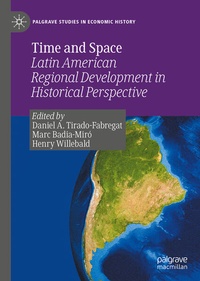
Time and Space
Latin American Regional Development in Historical Perspective
1st Edition
Published on 8. November 2020
Book
Hardback
432 pages
978-3-030-47552-9 (ISBN)
Description
This edited collection examines the evolution of regional inequality in Latin America in the long run. The authors support the hypothesis that the current regional disparities are principally the result of a long and complex process in which historical, geographical, economic, institutional, and political factors have all worked together. Lessons from the past can aid current debates on regional inequalities, territorial cohesion, and public policies in developing and also developed countries.
In contrast with European countries, Latin American economies largely specialized in commodity exports, showed high levels of urbanization and high transports costs (both domestic and international). This new research provides a new perspective on the economic history of Latin American regions and offers new insights on how such forces interact in peripheral countries. In that sense, natural resources, differences in climatic conditions, industrial backwardness and low population density areas leads us to a new set of questions and tentative answers.
This book brings together a group of leading American and European economic historians in order to build a new set of data on historical regional GDPs for nine Latin American countries: Argentina, Bolivia, Brazil, Chile, Colombia, Mexico, Peru, Uruguay and Venezuela. This transnational perspective on Latin American economic development process is of interest to researchers, students and policy makers.
In contrast with European countries, Latin American economies largely specialized in commodity exports, showed high levels of urbanization and high transports costs (both domestic and international). This new research provides a new perspective on the economic history of Latin American regions and offers new insights on how such forces interact in peripheral countries. In that sense, natural resources, differences in climatic conditions, industrial backwardness and low population density areas leads us to a new set of questions and tentative answers.
This book brings together a group of leading American and European economic historians in order to build a new set of data on historical regional GDPs for nine Latin American countries: Argentina, Bolivia, Brazil, Chile, Colombia, Mexico, Peru, Uruguay and Venezuela. This transnational perspective on Latin American economic development process is of interest to researchers, students and policy makers.
More details
Product info
HC runder Rücken kaschiert
Series
Edition
1st ed. 2020
Language
English
Place of publication
Cham
Switzerland
Publishing group
Springer International Publishing
Target group
Professional and scholarly
Illustrations
80 s/w Abbildungen
80 Illustrations, black and white; XXIV, 407 p. 80 illus.
Dimensions
Height: 216 mm
Width: 153 mm
Thickness: 28 mm
Weight
668 gr
ISBN-13
978-3-030-47552-9 (9783030475529)
DOI
10.1007/978-3-030-47553-6
Schweitzer Classification
Other editions
Additional editions
Daniel A. Tirado-Fabregat | Marc Badia-Miró | Henry Willebald
Time and Space
Latin American Regional Development in Historical Perspective
Book
11/2021
Palgrave Macmillan
€149.79
Shipment within 7-9 days
Daniel A. Tirado-Fabregat | Marc Badia-Miró | Henry Willebald
Time and Space
Latin American Regional Development in Historical Perspective
E-Book
11/2020
1st Edition
Palgrave Macmillan
€139.09
Available for download
Persons
Daniel A. Tirado-Fabregat is Professor of Economic History at the University of València, Spain. His broad research interests include the historical roots of regional economic development and inequality. Marc Badia-Miró is Associate Professor of Economic History at the University of Barcelona, Spain. His research interests refer to economic geography, trade and natural resources in historical perspective, mainly focused on Latin America.
Henry Willebald is Professor in Economic History at the Universidad de la República, Uruguay. His research interests refer to modern economic growth in settler economies and Latin American countries, focused on inequality, productive specialization, natural resources and sustainability.
Content
Chapter 1: Introduction-Time, space and economics in the history of Latin America.- Chapter 2: Comparing different estimation methodologies of regional GDPs in Latin American countries.- Chapter 3:Productive and regional development policies in Latin America since 1890.- Chapter 4: Regional inequality in Latin American countries.- Chapter 4.1: Growth and convergence among Argentine provinces since 1895.- Chapter 4.2: From West to East: Bolivian Regional GDPs since the 1950s. A story of natural resources and infrastructure.- Chapter 4.3: The evolution of regional income inequality in Brazil, 1872-2015.- Chapter 4.4: Spatial inequality in Chile in the long run: a paradox of extreme concentration in absence of agglomeration forces (1890-2017).- Chapter 4.5: Regional Economic Inequality in Colombia, 1926-2018.- Chapter 4.6: Regional GDP in Mexico, 1895-2010.- Chapter 4.7: Peruvian regional inequality: 1847-2017.- Chapter 4.8:Patterns of regional income distribution in Uruguay (1872-2012): a story of agglomeration, natural resources and public policies.- Chapter 4.9: Was the oil sown evenly? Long-term patterns of regional inequality in Venezuela (1881-2011).- Chapter 5: Spatial Inequality in Latin America (1895-2010): convergence and clusters in a long-run approach.- Chapter 6: Regional inequality in Latin America: does it mirror the European pattern?.