

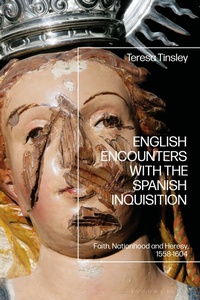
English Encounters with the Spanish Inquisition
Faith, Nationhood and Heresy, 1558-1604
Will be published approx. on 20. August 2026
Book
Hardback
280 pages
978-1-350-46863-4 (ISBN)
Description
Between 1558 and 1604, more than 400 subjects of Queen Elizabeth I found themselves in contact with the Spanish Inquisition. This book draws on the records of their experiences and testimonies to provide a fresh perspective on a crucial period of religious divergence.
Teresa Tinsley examines the varied experiences of merchants, sailors, diplomats and prisoners of war, highlighting cases of persecution, conversion, ambivalence, and cultural adaptation. Paying close attention to an impressive assemblage of original sources, Tinsley challenges exaggerated claims about the cruelty and scale of the Inquisition's actions against the English, which fed contemporary anti-Spanish propaganda and continue to colour perceptions of early modern globalisation and European colonisation today. She shows that there were witnesses, litigants and collaborators as well as defendants, not all were Protestant, very few were treated harshly and most attempted, with variable success, to bridge the Reformation gap between Elizabeth's Protestant England and Philip II's post-Tridentine Spain.
Their stories provide not only a comprehensive rebuttal of notions derived from the Black Legend, but also privileged access to the historical reality of the lives of individuals at the interface of opposed religious cultures. Cross cultural contact - whether through trade or maritime conflict - brought individuals face to face with differences in religious faith and practice and those interrogated by the Inquisition were required to articulate these. This has resulted in a unique corpus of historical evidence which exposes the multi-dimensional and fluid nature of religious affiliation, nationhood, and personal identity which drove conflict between the two nations.
Teresa Tinsley examines the varied experiences of merchants, sailors, diplomats and prisoners of war, highlighting cases of persecution, conversion, ambivalence, and cultural adaptation. Paying close attention to an impressive assemblage of original sources, Tinsley challenges exaggerated claims about the cruelty and scale of the Inquisition's actions against the English, which fed contemporary anti-Spanish propaganda and continue to colour perceptions of early modern globalisation and European colonisation today. She shows that there were witnesses, litigants and collaborators as well as defendants, not all were Protestant, very few were treated harshly and most attempted, with variable success, to bridge the Reformation gap between Elizabeth's Protestant England and Philip II's post-Tridentine Spain.
Their stories provide not only a comprehensive rebuttal of notions derived from the Black Legend, but also privileged access to the historical reality of the lives of individuals at the interface of opposed religious cultures. Cross cultural contact - whether through trade or maritime conflict - brought individuals face to face with differences in religious faith and practice and those interrogated by the Inquisition were required to articulate these. This has resulted in a unique corpus of historical evidence which exposes the multi-dimensional and fluid nature of religious affiliation, nationhood, and personal identity which drove conflict between the two nations.
Reviews / Votes
This book presents a novel development of well-known arguments concerning the 'Black Legend', Anglo-Protestant nation-building versus Spanish Counter-Reformation providentialism, and propaganda. What makes this study original is its archive-led uncovering of 'live-and-let-live' attitudes on both sides and of the exception rather than rule of ultimate penalties by the Inquisition. The historian has thus gone deeper into the weeds than such authoritative historians as William Maltby was able to go. * Mark Lawrence, University of Kent, UK * This is a work of formidable scholarship, drawing on a very wide range of archive sources, both in English and Spanish, as well as the Inquisition archives.... It is clearly written, and is a fascinating account of a conflict of values. Recommended for opening a window on the lives of seamen and merchants in the Elizabethan era. * Jonathan Seagrave, South West Maritime History Society, UK *More details
Language
English
Place of publication
London
United Kingdom
Publishing group
Bloomsbury Publishing PLC
Target group
Professional and scholarly
Product notice
Laminated cover
Illustrations
5 bw illus
Dimensions
Height: 234 mm
Width: 156 mm
Thickness: 15 mm
Weight
454 gr
ISBN-13
978-1-350-46863-4 (9781350468634)
Copyright in bibliographic data and cover images is held by Nielsen Book Services Limited or by the publishers or by their respective licensors: all rights reserved.
Schweitzer Classification
Other editions
Additional editions
Teresa Tinsley
English Encounters with the Spanish Inquisition
Faith, Nationhood and Heresy, 1558-1604
E-Book
approx. 07/2026
Bloomsbury Academic
€94.49
Available for download
Teresa Tinsley
English Encounters with the Spanish Inquisition
Faith, Nationhood and Heresy, 1558-1604
E-Book
approx. 07/2026
Bloomsbury Academic
€94.49
Available for download
Person
Teresa Tinsley obtained her PhD in History from the University of Exeter, UK in 2019. She is the author of Reconciliation and Resistance in Early Modern Spain (Bloomsbury Academic, 2022) and numerous articles exploring 15th and 16th Spanish history, published in English and Spanish respectively.
Content
List of Illustrations
List of Tables
Preface
Acknowledgements
Note on rendering of English names
Abbreviations
Glossary of Specialist Terms
Maps
1. The Spanish Inquisition in Diplomacy and Spanish Society
2. Elizabethans and the Spanish Inquisition: An Introduction
to the Data
3. Black Legend/Grey Reality
4. Signs of Heresy
5. Persistent Protestants
6. Turning Catholic
7. Manifestations of ambivalence: Nicodemites, double bookkeepers
and religious travellers
8. Faith and nationhood: Microhistories
a. John Cuerton, the Inquisition Familiar
b. Charles Chester - The 'Odde Foule-Mouthed Knave'
c. Agustin 'Hopkin' David - A Welshman Adrift
d. Edward Stride, The Repeat Offender
e. William Rock - The Integrationist
f. Bartholomew Cowel - The Smuggler-Turned-Informer
List of Tables
Preface
Acknowledgements
Note on rendering of English names
Abbreviations
Glossary of Specialist Terms
Maps
1. The Spanish Inquisition in Diplomacy and Spanish Society
2. Elizabethans and the Spanish Inquisition: An Introduction
to the Data
3. Black Legend/Grey Reality
4. Signs of Heresy
5. Persistent Protestants
6. Turning Catholic
7. Manifestations of ambivalence: Nicodemites, double bookkeepers
and religious travellers
8. Faith and nationhood: Microhistories
a. John Cuerton, the Inquisition Familiar
b. Charles Chester - The 'Odde Foule-Mouthed Knave'
c. Agustin 'Hopkin' David - A Welshman Adrift
d. Edward Stride, The Repeat Offender
e. William Rock - The Integrationist
f. Bartholomew Cowel - The Smuggler-Turned-Informer