

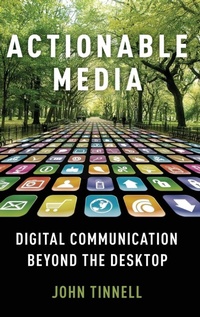
Actionable Media
Digital Communication Beyond the Desktop
Published on 16. November 2017
Book
Hardback
280 pages
978-0-19-067807-4 (ISBN)
Description
In 1991, Mark Weiser and his team at Xerox PARC declared they were reinventing computers for the twenty-first century. The computer would become integrated into the fabric of everyday life; it would shift to the background rather than being itself an object of focus. The resulting rise of ubiquitous computing (smartphones, smartglasses, smart cities) have since thoroughly colonized our digital landscape. In Actionable Media, John Tinnell contends that there is an unsung rhetorical dimension to Weiser's legacy, which stretches far beyond recent iProducts. Taking up Weiser's motto, "Start from the arts and humanities," Tinnell develops a theoretical framework for understanding nascent initiatives--the Internet of things, wearable interfaces, augmented reality--in terms of their intellectual history, their relationship to earlier communication technologies, and their potential to become vibrant platforms for public culture and critical media production.
It is clear that an ever-widening array of everyday spaces now double as venues for multimedia authorship. Writers, activists, and students, in cities and towns everywhere, are digitally augmenting physical environments. Audio walks embed narratives around local parks for pedestrians to encounter during a stroll; online forums are woven into urban infrastructure and suburban plazas to invigorate community politics. This new wave of digital communication, which Tinnell terms "actionable media," is presented through case studies of exemplar projects by leading artists, designers, and research-creation teams. Chapters alter notions of ubiquitous computing through concepts drawn from Bernard Stiegler, Gregory Ulmer, and Hannah Arendt; from comparative media analyses with writing systems such as cuneiform, urban signage, and GUI software; and from relevant stylistic insights gleaned from the open air arts practices of Augusto Boal, Claude Monet, and Janet Cardiff. Actionable Media challenges familiar claims about the combination of physical and digital spaces, beckoning contemporary media studies toward an alternative substrate of historical precursors, emerging forms, design philosophies, and rhetorical principles.
It is clear that an ever-widening array of everyday spaces now double as venues for multimedia authorship. Writers, activists, and students, in cities and towns everywhere, are digitally augmenting physical environments. Audio walks embed narratives around local parks for pedestrians to encounter during a stroll; online forums are woven into urban infrastructure and suburban plazas to invigorate community politics. This new wave of digital communication, which Tinnell terms "actionable media," is presented through case studies of exemplar projects by leading artists, designers, and research-creation teams. Chapters alter notions of ubiquitous computing through concepts drawn from Bernard Stiegler, Gregory Ulmer, and Hannah Arendt; from comparative media analyses with writing systems such as cuneiform, urban signage, and GUI software; and from relevant stylistic insights gleaned from the open air arts practices of Augusto Boal, Claude Monet, and Janet Cardiff. Actionable Media challenges familiar claims about the combination of physical and digital spaces, beckoning contemporary media studies toward an alternative substrate of historical precursors, emerging forms, design philosophies, and rhetorical principles.
Reviews / Votes
As Tinnell's cases illustrate, the actionable media model offers political potential. His provo-cation suggests a path where scholars, artists, and the public could collaborate to critique dominant societal structures at a time where tech leaders hold as much power as world governments. Yet, the implementation of actionable media faces legitimate practical challenges related to funding, tenure and promotion requirements, and technological infrastructure. These limitations do not minimize the theoretical contributions of Actionable Media. Instead, they highlight the need for more projects in this vein, where scholars consider how their work interfaces with technology and the public in a more meaningful fashion. * Cory Barker, Convergence *More details
Language
English
Place of publication
New York
United States
Target group
Professional and scholarly
Dimensions
Height: 240 mm
Width: 161 mm
Thickness: 20 mm
Weight
584 gr
ISBN-13
978-0-19-067807-4 (9780190678074)
Copyright in bibliographic data and cover images is held by Nielsen Book Services Limited or by the publishers or by their respective licensors: all rights reserved.
Schweitzer Classification
Other editions
Additional editions
Book
11/2017
Oxford University Press Inc
€43.00
Shipment within 15-20 days
E-Book
10/2017
1st Edition
OUP eBook
€16.49
Available for download
E-Book
10/2017
1st Edition
OUP eBook
€15.49
Available for download
Person
John Tinnell is Assistant Professor of English at the University of Colorado Denver. His essays and articles have appeared in Boston Review, Computational Culture, Convergence, Deleuze Studies, Enculturation, Environmental Communication, and The Fibreculture Journal. With Sean Morey, he co-edited the collection Augmented Reality: Innovative Perspectives across Art, Industry, and Academia (Parlor Press, 2017).
Content
Acknowledgments
Preface. Three Walks in Central Park
Introduction. Making Media Actionable
Chapter 1. The Invention of Ubiquitous Computing
Chapter 2. Interpreting Post-Desktop Practices
Chapter 3. Futures of Computing via Histories of Writing
Chapter 4. A Theory of Two Archives, from Cuneiform to Augmented Reality
Chapter 5. Forms of Actionable Media
Chapter 6. Creating Actionable Media
Epilogue. Kairotic Intellectuals
Bibliography
Preface. Three Walks in Central Park
Introduction. Making Media Actionable
Chapter 1. The Invention of Ubiquitous Computing
Chapter 2. Interpreting Post-Desktop Practices
Chapter 3. Futures of Computing via Histories of Writing
Chapter 4. A Theory of Two Archives, from Cuneiform to Augmented Reality
Chapter 5. Forms of Actionable Media
Chapter 6. Creating Actionable Media
Epilogue. Kairotic Intellectuals
Bibliography