

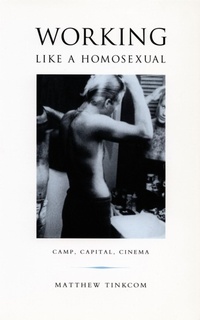
Working Like a Homosexual
Camp, Capital, Cinema
Will be published approx. on 18. March 2002
Book
Hardback
240 pages
978-0-8223-2862-9 (ISBN)
Description
What does camp have to do with capitalism? How have queer men created a philosophy of commodity culture? Why is cinema central to camp? With chapters on the films of Vincente Minnelli, Andy Warhol, Kenneth Anger, and John Waters, Working Like a Homosexual responds to these questions by arguing that post-World War II gay male subcultures have fostered their own ways not only of consuming mass culture but of producing it as well.
With a special emphasis on the tensions between high and low forms of culture and between good and bad taste, Matthew Tinkcom offers a new vision of queer politics and aesthetics that is critically engaged with Marxist theories of capitalist production. He argues that camp-while embracing the cheap, the scorned, the gaudy, the tasteless, and what Warhol called "the leftovers" of artistic production-is a mode of intellectual production and a critical philosophy of modernity as much as it is an expression of a dissident sex/gender difference. From Minnelli's musicals and the "everyday glamour" of Warhol's films to Anger's experimental films and Waters's "trash aesthetic," Tinkcom demonstrates how camp allowed these gay men to design their own relationship to labor and to history in a way that protected them from censure even as they struggled to forge a role for themselves within a system of "value" that failed to recognize them.
With a special emphasis on the tensions between high and low forms of culture and between good and bad taste, Matthew Tinkcom offers a new vision of queer politics and aesthetics that is critically engaged with Marxist theories of capitalist production. He argues that camp-while embracing the cheap, the scorned, the gaudy, the tasteless, and what Warhol called "the leftovers" of artistic production-is a mode of intellectual production and a critical philosophy of modernity as much as it is an expression of a dissident sex/gender difference. From Minnelli's musicals and the "everyday glamour" of Warhol's films to Anger's experimental films and Waters's "trash aesthetic," Tinkcom demonstrates how camp allowed these gay men to design their own relationship to labor and to history in a way that protected them from censure even as they struggled to forge a role for themselves within a system of "value" that failed to recognize them.
Reviews / Votes
"A brilliant, innovative study of camp that exceeds the terms in which this topic traditionally has been conceived. The result is a reformulation of camp as queer industrial labor, from the perspective of the production as well as the reception of that work. Anyone working on camp will hereafter have to reckon with this book."-Steven Cohan, author of Masked Men: Masculinity and the Movies in the FiftiesMore details
Series
Language
English
Place of publication
North Carolina
United States
Target group
Professional and scholarly
Product notice
Cloth over boards
Dimensions
Height: 243 mm
Width: 152 mm
Thickness: 24 mm
Weight
494 gr
ISBN-13
978-0-8223-2862-9 (9780822328629)
Copyright in bibliographic data and cover images is held by Nielsen Book Services Limited or by the publishers or by their respective licensors: all rights reserved.
Schweitzer Classification
Other editions
Additional editions
Matthew Tinkcom | Michèle Aina Barale | Jonathan Goldberg
Working Like a Homosexual
Camp, Capital, Cinema
E-Book
03/2002
1st Edition
De Gruyter
€198.99
Available for download
Person
Matthew Tinkcom is Assistant Professor of English and of Communication, Culture, and Technology at Georgetown University.
Content
Acknowledgments
Introduction
1. Working like a Homosexual: Vincente Minnelli in the Metro-Goldwyn-Mayer Freed Unit
2. Andy Warhol and the Crises of Value's Appearances
3. "A Physical Relation between Physical Things": The World of the Commodity according to Kenneth Anger
4. "Beyond the Critics' Reach": John Waters and the Trash Aesthetic
Afterword
Notes
Bibliography
Index
Introduction
1. Working like a Homosexual: Vincente Minnelli in the Metro-Goldwyn-Mayer Freed Unit
2. Andy Warhol and the Crises of Value's Appearances
3. "A Physical Relation between Physical Things": The World of the Commodity according to Kenneth Anger
4. "Beyond the Critics' Reach": John Waters and the Trash Aesthetic
Afterword
Notes
Bibliography
Index