

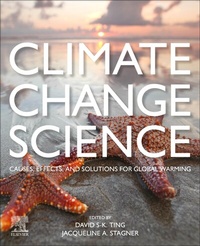
Climate Change Science
Causes, Effects and Solutions for Global Warming
Published on 26. May 2021
Book
Paperback/Softback
302 pages
978-0-12-823767-0 (ISBN)
Description
Climate Change Science: Causes, Effects and Solutions for Global Warming presents unbiased, state-of-the-art, scientific knowledge on climate change and engineering solutions for mitigation. The book expands on all major prospective solutions for tackling climate change in a complete manner. It comprehensively explains the variety of climate solutions currently available, including the remaining challenges associated with each. Effective, complementary solutions for engineering to combat climate change are discussed and elaborated on. Some of the more high-risk proposals are qualitatively and quantitatively compared and contrasted with low-risk mitigation actions to facilitate the formulation of feasible, environmentally-friendly solutions.
The book provides academics, postgraduate students and other readers in the fields of environmental science, climate change, atmospheric sciences and engineering with the information they need for their roles. Through exploring the fundamental information currently available, exergy utilization, large-scale solutions, and current solutions in place, the book is an invaluable look into how climate change can be addressed from an engineering-perspective using scientific models and calculations.
The book provides academics, postgraduate students and other readers in the fields of environmental science, climate change, atmospheric sciences and engineering with the information they need for their roles. Through exploring the fundamental information currently available, exergy utilization, large-scale solutions, and current solutions in place, the book is an invaluable look into how climate change can be addressed from an engineering-perspective using scientific models and calculations.
More details
Language
English
Place of publication
United States
Target group
Professional and scholarly
Dimensions
Height: 235 mm
Width: 191 mm
Weight
570 gr
ISBN-13
978-0-12-823767-0 (9780128237670)
Copyright in bibliographic data and cover images is held by Nielsen Book Services Limited or by the publishers or by their respective licensors: all rights reserved.
Schweitzer Classification
Other editions
Additional editions
David S-K. Ting | Jacqueline A. Stagner
Climate Change Science
Causes, Effects and Solutions for Global Warming
E-Book
05/2021
Elsevier
€131.00
Available for download
Persons
David S.-K. Ting is the founder of the Turbulence and Energy Laboratory at the University of Windsor, through which he supervises students primarily on energy and thermofluids. He is a prolific author/editor and a member of the Association of Professional Engineers, Geologists, and Geophysicists of Alberta (APPEGA); Professional Engineers Ontario (PEO); the American Society of Heating, Refrigerating, and Air-conditioning Engineers (ASHRAE); the American Society of Mechanical Engineers (ASME); the Engineering Society for Advancing Mobility Land Sea Air and Space (SAE). He has edited several books for Elsevier, the most recent ones especially focused on sustainable engineering and development practices. Jacqueline A. Stagner is the Undergraduate Programs Coordinator in the Faculty of Engineering at the University of Windsor. She is an adjunct graduate faculty member in the Department of Mechanical, Automotive and Materials Engineering and co-advises students in the areas of sustainability and renewable energy, in the Turbulence & Energy Laboratory. She is a professional engineer with a PhD in Materials Science and Engineering and prior to joining the University of Windsor, she worked as a release engineer in the automotive industry. She has disseminated numerous journal articles focused on sustainability and the built environment, in addition to coediting sixteen volumes.
Editor
Professor, Department of Mechanical, Automotive and Materials Engineering (MAME), Faculty of Engineering, University of Windsor, Windsor, Ontario, Canada
Assistant Professor and Undergraduate Programs Coordinator, Dept. of Mechanical, Automotive and Materials Engineering (MAME), Faculty of Engineering, University of Windsor, Windsor, Ontario, Canada
Content
1. Engineering for climate change
2. Pros and cons of climate change
3. Man-made versus natural causes
4. Population, urbanization and climate change
5. Alternate view, dynamics of self-adjusting earth
6. The climate change equation, y = f(x1, x2, x3, ...)
7. When will exergy be exhausted?
8. The second law of thermodynamics and climate change
9. What is the threshold for doomsday?
10. Is carbon dioxide an accurate measure?
11. Large-scale solutions
12. Low-risk mitigations
13. Deep sea and climate change
2. Pros and cons of climate change
3. Man-made versus natural causes
4. Population, urbanization and climate change
5. Alternate view, dynamics of self-adjusting earth
6. The climate change equation, y = f(x1, x2, x3, ...)
7. When will exergy be exhausted?
8. The second law of thermodynamics and climate change
9. What is the threshold for doomsday?
10. Is carbon dioxide an accurate measure?
11. Large-scale solutions
12. Low-risk mitigations
13. Deep sea and climate change