

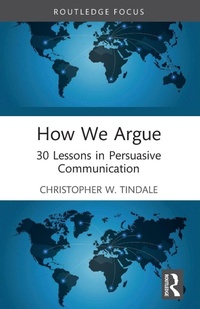
How We Argue
30 Lessons in Persuasive Communication
1st Edition
Published on 27. May 2024
Book
Paperback/Softback
158 pages
978-1-032-35313-5 (ISBN)
Description
This accessible book provides a practical discussion of the main elements of argumentation as illustrated by 30 public arguments from a recent year on a wide variety of social, cultural, and scientific topics.
Arguing is an important form of communication in any society and a principal way in which ideas are exposed, discussed, and modified. The real-life examples examined in this book reflect the different considerations that go into composing arguments and the range of strategies that can be chosen as vehicles for our positions. They demonstrate the roles that emotion can play along with other modes of conveying evidence, from the use of images to the use of gestures. They show the power of threats, comparisons, and consequences. What emerges is an instructive discussion that illustrates the way we argue and that shows argument, invention, and evaluation in action.
This book is a stimulating read for anyone interested in argument and public discourse and can be used as a supplemental text for courses in argumentation, persuasive communication, critical thinking, composition, and informal logic.
Arguing is an important form of communication in any society and a principal way in which ideas are exposed, discussed, and modified. The real-life examples examined in this book reflect the different considerations that go into composing arguments and the range of strategies that can be chosen as vehicles for our positions. They demonstrate the roles that emotion can play along with other modes of conveying evidence, from the use of images to the use of gestures. They show the power of threats, comparisons, and consequences. What emerges is an instructive discussion that illustrates the way we argue and that shows argument, invention, and evaluation in action.
This book is a stimulating read for anyone interested in argument and public discourse and can be used as a supplemental text for courses in argumentation, persuasive communication, critical thinking, composition, and informal logic.
More details
Language
English
Place of publication
London
United Kingdom
Publishing group
Taylor & Francis Ltd
Target group
College/higher education
General, Undergraduate Advanced, and Undergraduate Core
Illustrations
2 farbige Abbildungen, 2 Farbfotos bzw. farbige Rasterbilder
2 Halftones, color; 2 Illustrations, color
Dimensions
Height: 216 mm
Width: 140 mm
Thickness: 10 mm
Weight
225 gr
ISBN-13
978-1-032-35313-5 (9781032353135)
Copyright in bibliographic data and cover images is held by Nielsen Book Services Limited or by the publishers or by their respective licensors: all rights reserved.
Schweitzer Classification
Other editions
Additional editions
E-Book
10/2022
1st Edition
Routledge
€31.49
Available for download
E-Book
10/2022
1st Edition
Routledge
€31.49
Available for download
Book
10/2022
1st Edition
Routledge
€71.90
Shipment within 10-20 days
Person
Christopher W. Tindale is Director of the Centre for Research in Reasoning, Argumentation, and Rhetoric (CRRAR) and Distinguished University Professor at the University of Windsor, Canada.
Content
Part 1: The nature of argument 1. "Traditional" argument (the power of deduction) 2. Counterargument: the power of rebuttal (what can be trusted?) 3. Numers matter (arguing with the use of polls) 4. Know your audience (rhetorical address) 5. Arguments and definitions (cults and presidents) 6. Saying less but meaning more (the use of hidden reasons) 7. Argument and explanation (what it all means) 8. Seeing is believing (the power of an image) 9. Moral reasoning (what is fair) Part II: Rhetorical argumentation 10. Arguing in silence (the power of a pause) 11. What's in a gesture? (racism in an act of dismissal) 12. Say it again (the power of repetition) 13. Argument and satire (what do we do with the children?) 14. Turning the tables (who would be worse?) 15. Emotional appeal (a call to aid) Part III: Character-based argumentation 16. Praising character (the best amongst us) 17. Reflecting values (an excellent choice) 18. Bad Behavior (a failure of character) 19. Damning character (the worse amongst us) 20. Associations (the company we keep) 21. The power of the expert (who you are and what you know matters) Part IV: Strategies of reason 22. Using threats (let this be a warning) 23. Establishing precedents (what we do now matters later) 24. A causal chain (if this, then that) 25. Negative consequences (if this, then also that) 26. An unexpected outcome (the benefit of a pandemic) 27. For example (lessons from a case in point) 28. Argument and analogy (comparing cases) 29. A sign of the times (what do masks mean?) Part V: Epilogue: how we argue 30. A robot's point of view