

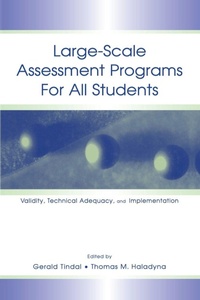
Large-scale Assessment Programs for All Students
Validity, Technical Adequacy, and Implementation
1st Edition
Published on 7. May 2015
Book
Paperback/Softback
536 pages
978-1-138-86664-5 (ISBN)
Description
The need for a comprehensive volume that reviews both the processes and issues involved in developing, administering, and validating large-scale assessment programs has never been greater. These programs are used for many purposes, including instructional program evaluation, promotion, certification, graduation, and accountability. One of the greatest problems we face is how to deal with special needs and bilingual populations. Examining these processes and issues is the mission of this book. It is organized into the following five sections: Introduction, Validity Issues, Technical Issues, Implementation Issues, and Epilogue. Each chapter follows a common structure: Overview of critical issues, review of relevant research, descriptions of current assessment methodologies, and recommendations for the future research and practice.
Written by nationally recognized scholars,Large-Scale Assessment Programs for All Students: Validity, Technical Adequacy, and Implementation will appeal to anyone seriously involved in large scale testing, including educators, policymakers, testing company personnel, and researchers in education, psychology, and public policy.
Written by nationally recognized scholars,Large-Scale Assessment Programs for All Students: Validity, Technical Adequacy, and Implementation will appeal to anyone seriously involved in large scale testing, including educators, policymakers, testing company personnel, and researchers in education, psychology, and public policy.
Reviews / Votes
"This book's coverage of assessment issues is fairly broad and will have material that is of interest to researchers working in the areas of test use and development, as well as psychometric research methodology."-Journal of the Royal Statistical Society
"... this is an important book. The editors have done an excellent job of making sure the chapter authors use technical language consistently. They also clearly have made each author aware of what the others have written, and the authors in turn have incorporated helpful cross-references throughout. This book is a must for state and district assessment and accountability program directors."
-Contemporary Psychology
More details
Language
English
Place of publication
London
United Kingdom
Publishing group
Taylor & Francis Ltd
Target group
Professional and scholarly
Dimensions
Height: 229 mm
Width: 152 mm
Thickness: 29 mm
Weight
767 gr
ISBN-13
978-1-138-86664-5 (9781138866645)
Copyright in bibliographic data and cover images is held by Nielsen Book Services Limited or by the publishers or by their respective licensors: all rights reserved.
Schweitzer Classification
Other editions
Additional editions
Gerald Tindal | Thomas M. Haladyna
Large-scale Assessment Programs for All Students
Validity, Technical Adequacy, and Implementation
E-Book
12/2012
1st Edition
Routledge
€76.49
Available for download
Gerald Tindal | Thomas M. Haladyna
Large-scale Assessment Programs for All Students
Validity, Technical Adequacy, and Implementation
E-Book
12/2012
1st Edition
Routledge
€76.49
Available for download
Gerald Tindal | Thomas M. Haladyna
Large-scale Assessment Programs for All Students
Validity, Technical Adequacy, and Implementation
E-Book
12/2012
1st Edition
Routledge
€126.49
Available for download
Gerald Tindal | Thomas M. Haladyna
Large-scale Assessment Programs for All Students
Validity, Technical Adequacy, and Implementation
Book
04/2002
Routledge
€209.70
Shipment within 10-20 days
Persons
Gerald Tindal, Thomas M. Haladyna
Content
Contents: Preface. G. Tindal, Large-Scale Assessments for All Students: Issues and Options. Part I: Validity Issues.R.L. Linn, Validation of the Uses and Interpretations of Results of State Assessment and Accountability Systems. R. Gersten, S. Baker, The Relevance of Messick's Four Faces for Understanding the Validity of High-Stakes Assessments. J.M. Ryan, S. DeMark, Variation in Achievement Scores Related to Gender, Item Format, and Content Area Tested. T.M. Haladyna, Supporting Documentation: Assuring More Valid Test Score Interpretations and Uses. S.E. Phillips, Legal Issues Affecting Special Populations in Large-Scale Testing Programs. W.A. Mehrens, Consequences of Assessment: What Is the Evidence. Part II: Technical Issues.R. Tate, Test Dimensionality. M.C. Rodriguez, Choosing an Item Format. C.S. Taylor, Incorporating Classroom-Based Assessments Into Large-Scale Assessment Programs. G. Engelhard, Jr., Monitoring Raters in Performance Assessments. J.M. Ryan, Issues, Strategies, and Procedures for Applying Standards When Multiple Measures Are Employed. S.W. Choi, M. McCall, Linking Bilingual Mathematics Assessments: A Monolingual IRT Approach. Part III: Implementation Issues.P.J. Almond, C. Lehr, M.L. Thurlow, R. Quenemoen, Participation in Large-Scale State Assessment and Accountability Systems. R.P. Duran, C. Brown, M. McCall, Assessment of English-Language Learners in the Oregon Statewide Assessment System: National and State Perspectives. K. Hollenbeck, Determining When Test Alterations Are Valid Accommodations or Modifications for Large-Scale Assessment. R. Helwig, A Methodology for Creating an Alternative Assessment System Using Modified Measures. M.L. Thurlow, J. Bielinski, J. Minnema, J. Scott, Out-of-Level Testing Revisited: New Concerns in the Era of Standards-Based Reform. J. Ysseldyke, J.R. Nelson, Reporting Results of Student Performance on Large-Scale Assessments. Part IV: Epilogue.T.M. Haladyna, Research to Improve Large-Scale Testing.