

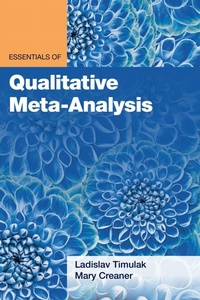
Essentials of Qualitative Meta-Analysis
Published on 13. September 2022
Book
Paperback/Softback
100 pages
978-1-4338-3848-4 (ISBN)
Description
This book is a step-by-step guide to conducting qualitative meta-analysis (QMA).
This flexible and generic method synthesizes the findings of several research studies investigating similar phenomena. Given the ever-increasing number of qualitative studies in the social sciences, QMA answers the need for rigorous secondary analysis that offers a more conclusive picture of a field of inquiry.
The brief, practical texts in the Essentials of Qualitative Methods series introduce social science and psychology researchers to key approaches to qualitative methods, offering exciting opportunities to gather in-depth qualitative data and to develop rich and useful findings.
About the Essentials of Qualitative Methods series
Even for experienced researchers, selecting and correctly applying the right method can be challenging. In this groundbreaking series, leading experts in qualitative methods provide clear, crisp, and comprehensive descriptions of their approach, including its methodological integrity, and its benefits and limitations. Each book includes numerous examples to enable readers to quickly and thoroughly grasp how to leverage these valuable methods.
This flexible and generic method synthesizes the findings of several research studies investigating similar phenomena. Given the ever-increasing number of qualitative studies in the social sciences, QMA answers the need for rigorous secondary analysis that offers a more conclusive picture of a field of inquiry.
The brief, practical texts in the Essentials of Qualitative Methods series introduce social science and psychology researchers to key approaches to qualitative methods, offering exciting opportunities to gather in-depth qualitative data and to develop rich and useful findings.
About the Essentials of Qualitative Methods series
Even for experienced researchers, selecting and correctly applying the right method can be challenging. In this groundbreaking series, leading experts in qualitative methods provide clear, crisp, and comprehensive descriptions of their approach, including its methodological integrity, and its benefits and limitations. Each book includes numerous examples to enable readers to quickly and thoroughly grasp how to leverage these valuable methods.
Reviews / Votes
This practical field guide is exceptionally instructive, as well as sophisticated about the origins, essence, and rationale of qualitative meta-analysis. Vividly illustrated by real examples throughout. Indispensable for any qualitative researcher-at all stages in their career. - Hanne Weie Oddli, PhD, Clinical Psychologist and Professor of Psychology, University of Oslo Here, finally, is an accessible and practical-yet nonetheless comprehensive-guidebook to navigate the discipline of qualitative meta-synthesis. The authors thoroughly illustrate each step of the analysis with helpful examples that allow the reader to clearly envision a new plane of development in qualitative research.- Shigeru Iwakabe, PhD, Professor, Department of Psychology, Ritsumeikan University, Co-Editor-in-Chief, Counselling Psychology Quarterly
More details
Series
Language
English
Place of publication
Washington DC
United States
Target group
Professional and scholarly
Product notice
Paperback (trade)
Dimensions
Height: 153 mm
Width: 228 mm
Thickness: 9 mm
Weight
164 gr
ISBN-13
978-1-4338-3848-4 (9781433838484)
Copyright in bibliographic data and cover images is held by Nielsen Book Services Limited or by the publishers or by their respective licensors: all rights reserved.
Schweitzer Classification
Persons
Ladislav Timulak, PhD is professor in counselling psychology at Trinity College Dublin, Ireland. Ladislav ( amp ldquo Laco amp rdquo -read amp ldquo Latso amp rdquo ) is Course Director of the Doctorate in Counselling Psychology. His main interest is psychotherapy research, particularly the development of emotion-focused therapy. He has written or co-written eight books, over 9 peer reviewed papers and chapters. His most recent books include Essentials of Descriptive-Interpretive Qualitative Research: A Generic Approach (with co-author Robert Elliott) and Transdiagnostic Emotion-Focused Therapy (with co-author Daragh Keogh) published by the American Psychological Association (2 2 ). He serves on various editorial boards and, in the past, coedited Counselling Psychology Quarterly.
Mary Creaner, DPsych, is assistant professor with the doctorate in counselling psychology and director of the MSc in Clinical Supervision, Trinity College, Dublin, Ireland. Mary is a member of the American Psychological Association and the Society of Counseling Psychology (APA, Division 7). She is an accredited therapist and supervisor with the Irish Association for Counselling and Psychotherapy. Her publications include the text, Getting the best out of supervision in counselling and psychotherapy (Sage, 2 4). Mary amp rsquo s research interests include qualitative methods, clinical supervision, and psychotherapy research. Mary is actively involved in training, research, and practice and presents her research nationally and internationally.
Mary Creaner, DPsych, is assistant professor with the doctorate in counselling psychology and director of the MSc in Clinical Supervision, Trinity College, Dublin, Ireland. Mary is a member of the American Psychological Association and the Society of Counseling Psychology (APA, Division 7). She is an accredited therapist and supervisor with the Irish Association for Counselling and Psychotherapy. Her publications include the text, Getting the best out of supervision in counselling and psychotherapy (Sage, 2 4). Mary amp rsquo s research interests include qualitative methods, clinical supervision, and psychotherapy research. Mary is actively involved in training, research, and practice and presents her research nationally and internationally.
Content
Chapter . Qualitative Meta-Analysis: Its Origins and Rationale-Situating Our Perspective
Chapter 2. Defining the Research Problem and Planning the Study
Chapter 3. Selecting the Primary Studies and Extracting the Data
Chapter 4. Analyzing Meta-Analytic Data
Chapter 5. Limitations and Challenges of Qualitative Meta-Analysis
Chapter . Publishing Qualitative Meta-Analysis
Chapter 7. Summary and Future Directions
Appendix
References
Chapter 2. Defining the Research Problem and Planning the Study
Chapter 3. Selecting the Primary Studies and Extracting the Data
Chapter 4. Analyzing Meta-Analytic Data
Chapter 5. Limitations and Challenges of Qualitative Meta-Analysis
Chapter . Publishing Qualitative Meta-Analysis
Chapter 7. Summary and Future Directions
Appendix
References