

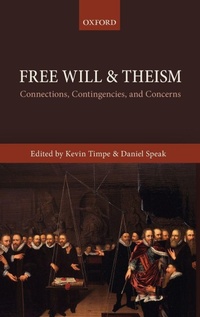
Free Will and Theism
Connections, Contingencies, and Concerns
Published on 19. May 2016
Book
Hardback
336 pages
978-0-19-874395-8 (ISBN)
Description
Concerns both about the nature of free will and about the credibility of theistic belief and commitment have long preoccupied philosophers. In addition, there can be no denying that the history of philosophical inquiry into these two issues has been dynamic and, at least to some degree, integrated. In a great many cases, classical treatments of one have influenced classical treatments of the other-and in a variety of ways. Without pretending to be able to trace all
the historical integrations of these treatments, there is no real question that these philosophical interrelations exist and are worthy of further exploration. In addition, contemporary discussions contain more than a few hints of suspicion that theistic belief is adversely affecting the purity of
inquiry into contours of human free will.
Nevertheless, until now there has been no volume systematically exploring the relationship between religious beliefs and various accounts of free will in the contemporary domain. With a particular eye on how the former might be-either legitimately or illegitimately-affecting the latter, this collection fills an important gap in the current debate. Here, sixteen leading philosophers focus their attention on a crucial point of intellectual intersection, with surprising and illuminating
results.
the historical integrations of these treatments, there is no real question that these philosophical interrelations exist and are worthy of further exploration. In addition, contemporary discussions contain more than a few hints of suspicion that theistic belief is adversely affecting the purity of
inquiry into contours of human free will.
Nevertheless, until now there has been no volume systematically exploring the relationship between religious beliefs and various accounts of free will in the contemporary domain. With a particular eye on how the former might be-either legitimately or illegitimately-affecting the latter, this collection fills an important gap in the current debate. Here, sixteen leading philosophers focus their attention on a crucial point of intellectual intersection, with surprising and illuminating
results.
Reviews / Votes
"Free Will and Theism is a helpful tool that will allow the reader to develop a good grasp of the contemporary theistic philosophical debate on free will."--Reading Religion"It's hard to convey in such summary fashion the richness of this collection. It should be essential reading for theistic philosophers interested in the intersection of theism and free will...[and] of considerable interest to non-theists who want to see what the big crossword puzzle--at least that part of the crossword puzzle that concerns free agency--looks like when philosophers with different commitments from theirs endeavor to fill in some of the squares. That interest in how things look under an alternative set of assumptions is the essence of the philosophical spirit." -- Notre Dame Philosophical ReviewsMore details
Other editions
Additional editions
E-Book
05/2016
1st Edition
OUP eBook
€50.49
Available for download
E-Book
04/2016
1st Edition
OUP eBook
€50.49
Available for download
Persons
Kevin Timpe is William Harry Jellema Chair in Christian Philosophy at Calvin College, and a former Templeton Research Fellow at St. Peter's College, Oxford University. His research is focused on the metaphysics of free will and moral responsibility, virtue ethics, philosophy of disability, and issues in the philosophy of religion. He is the author of Free Will: Sourcehood and its Alternatives, 2nd edn (Bloomsbury, 2012) and Free Will in Philosophical
Theology (Bloomsbury, 2013). He has edited a number of volumes, including Virtues and Their Vices (OUP, 2014) and Arguing about Religion (Routledge, 2009). He is currently working (with Meghan Griffith and Neil Levy) on The Routledge Companion to Free Will.
Daniel Speak is Associate Professor of Philosophy at Loyola Marymount University. He has recently served as a Visiting Research Fellow at Biola University's Center for Christian Thought and as a Senior Fellow at the Center for Philosophy of Religion at Rutgers University. He thinks and writes principally about the metaphysics, ethics, and epistemology of free will and about related issues in the philosophy of religion. His articles have appeared in The Philosophical Quarterly,
Faith and Philosophy, and The Oxford Handbook of Free Will, among others.
Theology (Bloomsbury, 2013). He has edited a number of volumes, including Virtues and Their Vices (OUP, 2014) and Arguing about Religion (Routledge, 2009). He is currently working (with Meghan Griffith and Neil Levy) on The Routledge Companion to Free Will.
Daniel Speak is Associate Professor of Philosophy at Loyola Marymount University. He has recently served as a Visiting Research Fellow at Biola University's Center for Christian Thought and as a Senior Fellow at the Center for Philosophy of Religion at Rutgers University. He thinks and writes principally about the metaphysics, ethics, and epistemology of free will and about related issues in the philosophy of religion. His articles have appeared in The Philosophical Quarterly,
Faith and Philosophy, and The Oxford Handbook of Free Will, among others.
Content
Daniel Speak and Kevin Timpe: Introduction; 1 Manuel R. Vargas: The runeburg problem: theism, libertarianism, and motivated reasoning; 2 John Martin Fischer: Libertarianism and the problem of flip-flopping; 3 Laura W. Ekstrom: The cost of freedom; 4 Jerry L. Walls: One hell of a problem for christian compatibilists; 5 Tamler Sommers: Relative responsibility and theism; 6 Derk Pereboom: Libertarianism and theological determinism; 7 Timothy O'Connor: Against theological determinism; 8 T. J. Mawson: Theism has no implications for the debate between libertarianism and compatibilism; 9 Helen Steward: Libertarianism as a naturalistic position; 10 Meghan Griffith: Agent causation and theism; 11 Michael J. Almeida: Bringing about perfect worlds; 12 W. Matthews Grant: Divine universal causality and libertarian freedom; 13 Neal Judisch: Divine conservation and creaturely freedom; 14 Rebekah L. H. Rice: Divine agency and acting for reasons; 15 Kevin Timpe: God's freedom, God's character; 16 Jesse Couenhoven: Immutable freedom