

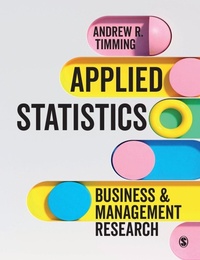
Applied Statistics
Business and Management Research
1st Edition
Published on 18. May 2022
Book
Paperback/Softback
456 pages
978-1-4739-4745-0 (ISBN)
Description
Written for the non-mathematician and free of unexplained technical jargon, Applied Statistics: Business and Management Research provides a user-friendly introduction to the field of applied statistics and data analysis.
Featuring step-by-step explanations of how to carry out successful quantitative research, and supported by examples from IBM (R) SPSS (R) Statistics, this textbook is an essential resource for students and researchers of business and management.
A range of online resources for both students and lecturers, including a teaching guide, PowerPoint slides and datasets, are available via the companion website.
Andrew R. Timming is Professor of Human Resource Management and Deputy Dean Research & Innovation in the School of Management at RMIT University, Australia.
Featuring step-by-step explanations of how to carry out successful quantitative research, and supported by examples from IBM (R) SPSS (R) Statistics, this textbook is an essential resource for students and researchers of business and management.
A range of online resources for both students and lecturers, including a teaching guide, PowerPoint slides and datasets, are available via the companion website.
Andrew R. Timming is Professor of Human Resource Management and Deputy Dean Research & Innovation in the School of Management at RMIT University, Australia.
More details
Language
English
Place of publication
London
United Kingdom
Target group
College/higher education
Dimensions
Height: 246 mm
Width: 189 mm
Thickness: 25 mm
Weight
875 gr
ISBN-13
978-1-4739-4745-0 (9781473947450)
Copyright in bibliographic data and cover images is held by Nielsen Book Services Limited or by the publishers or by their respective licensors: all rights reserved.
Schweitzer Classification
Other editions
Additional editions
Book
05/2022
1st Edition
SAGE Publications Ltd
€204.60
Shipment within 15-20 days
E-Book
05/2022
1st Edition
SAGE Publications Ltd
€103.99
Available for download
E-Book
05/2022
1st Edition
SAGE Publications Ltd
€103.99
Available for download
Person
Andrew R. Timming is Professor of Human Resource Management and Organizational Psychology at RMIT University, also known as the Royal Melbourne Institute of Technology, in Australia. He holds a Ph.D. degree from the University of Cambridge, England. He is the inaugural Registered Reports Editor at Human Resource Management Journal. His previous book, Human Resource Management and Evolutionary Psychology: Exploring the Biological Foundations of Managing People at Work was published in 2019. Professor Timming is mainly known for his research on tattoos and is currently researching mental illness in the workplace. When he's not working in the office, he can usually be found working at home.
Content
Part I: Foundations
Chapter 1: Introduction to Statistics
Chapter 2: Exploring IBM SPSS
Chapter 3: Descriptive Statistics and Graphical Representations
Chapter 4: The Principle of Statistical Inference
Part II: Comparing Means
Chapter 5: The T-Test
Chapter 6: Analysis of Variance
Part III: Non-Parametric and Correlational Relationships
Chapter 7: Chi-Square
Chapter 8: Simple Regression and Pearson's r
Part IV: Multivariate Modeling
Chapter 9: Multiple Regression
Chapter 10: Logistic Regression
Chapter 11: Exploratory and Confirmatory Factor Analyses
Chapter 12: Structural Equation Modeling
Chapter 1: Introduction to Statistics
Chapter 2: Exploring IBM SPSS
Chapter 3: Descriptive Statistics and Graphical Representations
Chapter 4: The Principle of Statistical Inference
Part II: Comparing Means
Chapter 5: The T-Test
Chapter 6: Analysis of Variance
Part III: Non-Parametric and Correlational Relationships
Chapter 7: Chi-Square
Chapter 8: Simple Regression and Pearson's r
Part IV: Multivariate Modeling
Chapter 9: Multiple Regression
Chapter 10: Logistic Regression
Chapter 11: Exploratory and Confirmatory Factor Analyses
Chapter 12: Structural Equation Modeling